


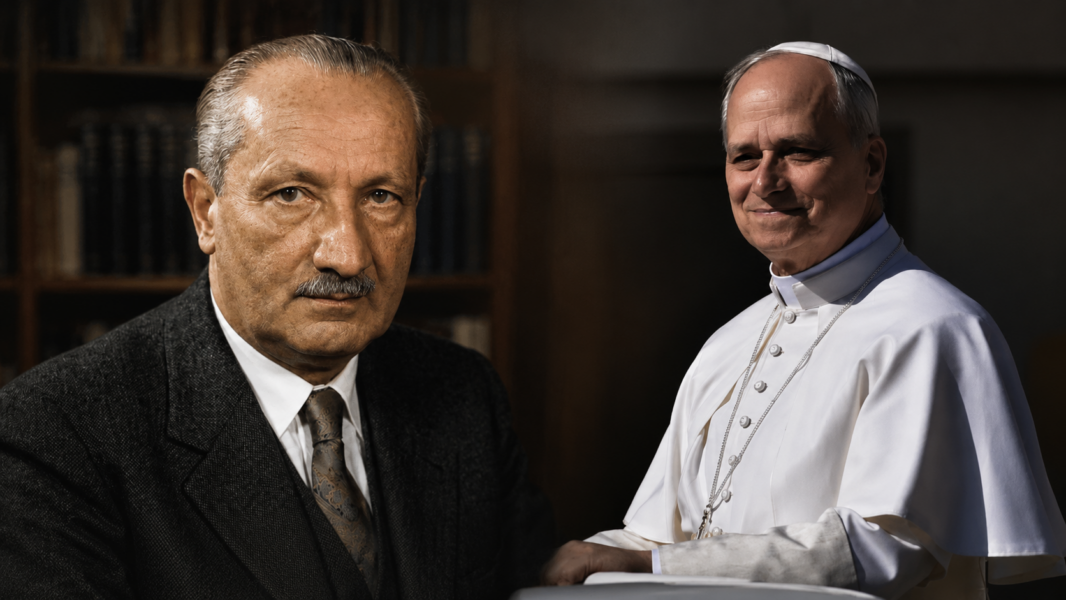
What Pope Leo XIV advocates was already demanded by Martin Heidegger 70 years ago
Papal encyclicals at the beginning of a pontificate usually have a programmatic character. John Paul II presented himself to public opinion in 1979 with the encyclical titled “Redemptor hominis” and reflected on the Redeemer of the human race. Leo XIV titles his first encyclical “Magnifica humanitas” and dedicates it to “magnificent humanity.” It deals with artificial intelligence, that is, computers and robots.
From a political point of view, the choice of topic may be appropriate. The Bishop of Rome is intervening in a global debate marked by uncertainty. Undoubtedly, he intends to restore the Church’s capacity to participate in geopolitical discourse, which his predecessor had damaged. At the same time, he can place himself in the tradition of his namesake Leo XIII (who died in 1903). However, his influential sociopolitical encyclical “Rerum novarum” was, in reality, his thirty-eighth encyclical.
Whether Leo XIV is doing his own Church a service with his first work is another question. As a servant of God, he is venturing into a technical-instrumental field that is still relatively unexplored and whose future development no one can predict. Moreover, as Pope, in the realm of the Church’s social doctrine, he cannot assert an authority even within his own Church that goes beyond the philosophical soundness of his arguments. Social doctrine is not a matter of faith but a theological reflection on earthly realities. In this sense, the statement of Pope Benedict XVI remains valid: the Church’s decisions regarding contingent matters necessarily had to be contingent themselves, precisely because they referred to a reality that is in itself changeable.
Faced with a technology that no longer threatens to compete with human beings in the realm of physical strength but in that of intellectual power, and which, as far as “calculation” is concerned, already surpasses them today, Leo XIV attempts to find a middle ground. He has learned from Voltaire, who pointed out that the Holy Scriptures are not there to turn us into physicists. In this sense, the Pope does not draw scientific conclusions from divine revelation. The case of Galileo undoubtedly has its repercussions here. That is why AI is considered in a differentiated way and is not condemned precipitously. It is valued as a useful instrument, as long as it remains so.
Nevertheless, a globalist and interventionist perspective emerges. Leo does not resort to the brutal rhetoric of his predecessor, who spoke of an economy that kills. His assertion that AI must be “disarmed,” however, expresses a friend-enemy way of thinking. Undoubtedly, AI plays a role in wars. But it also helps detect and treat diseases. And it enables communication beyond linguistic barriers that until recently was considered almost impossible. Therefore, equating AI with military weaponry is a polemic that harms the cause.
It is precisely at this point that the pastoral letter becomes vulnerable. It seeks to remove AI from the “logic of armed competition.” The race for the most powerful algorithm and the greatest amount of data is pernicious. The market and competition among AI providers are thus presented as problematic. This is followed by the demand for “regulatory instruments.” The Pope even mentions the UN. Because private actors, often transnational, must be controlled. Whether the paternalistic position of the state or the liberal market position is better in this case is difficult to decide even with the help of worldly criteria. It must also be taken into account that competition among AI systems can help prevent monopolies and curb abuses.
Even less evident is how this question can be resolved on the basis of the sacred texts of a revealed religion. Here, once again, the problematic nature of teachings based on religion becomes apparent in matters which, by their nature and complexity, should be answered with the faculties of reason. It is true that Leo XIV mentions the Second Vatican Council, which sixty years ago spoke of the “autonomy of reality.” By this it meant that the realities of this world should not be ordered according to the rules of a sacred book. Rather, one must follow the laws inherent to them. But the conclusions derived from this idea are not presented with sufficient clarity in the papal letter. Nevertheless, it must be acknowledged that the text is written out of concern for the human being. Special reference is made to those who, like children and young people, deceived by the false empathy of a machine, become atrophied in their humanity or are used as merchandise. Likewise, dehumanizing futurism, as it attempts to manifest itself in posthumanism and transhumanism, is rejected.
Ultimately, however, the Pope is also concerned with interpretive authority. He worries that a few, who have enormous technical and economic resources at their disposal, may provoke cultural changes and influence a significant number of people. These few would decide what is true “about the human being, about the world, about the meaning of existence, about the family, and even about God.” In fact, this activity has already been successfully carried out for 2000 years…
One of the main criticisms raised before the publication of the encyclical was that by raising the issue of AI, a populist public relations campaign was being conducted in an area that was not at all part of the Pope’s fundamental mission. His predecessor had left him, with regard to the doctrine of the faith proper, a chaotic legacy. This disorder should have been addressed primarily, not with the help of artificial intelligence, but through natural intelligence.
However, the desire to address a supposed deficit of modernity in the Church seems to have prevailed in the choice of the encyclical’s themes. It is noticeable that efforts have been made in the Vatican to be perceived as up-to-date. Thus, Hannah Arendt, Tolkien, and Viktor Frankl all have a voice.
Nevertheless, it seems that the true prophet regarding AI has been overlooked. That is Martin Heidegger. Already in 1955 he delivered a lecture titled “Serenity” (“Gelassenheit”) in his hometown of Messkirch. In it he predicted that “an assault on the life and essence of the human being is being prepared by means of technology.” What is disturbing about this is “that the human being is not prepared for this universal transformation.” Technology is capable of “fascinating man, enchanting him, dazzling and blinding him” in such a way that “one day calculative thinking might become the only valid and practiced form.” Nevertheless, in the technical world “a hidden meaning” reaches us. What thus shows itself and at the same time withdraws, he called “mystery.” And he advocated for an always reflective attitude of “openness to mystery.” He considered the correct way of dealing with technology to lie in a “serenity toward things.” This consisted of a simultaneous “yes” and “no.” The human being should not, therefore, “condemn” technical objects, but prevent them from “demanding us so exclusively that they bend, confuse, and finally devastate our essence.”
Heidegger arrived at his assertion that “meditative reflection” must take priority over “calculative thinking” solely with the resources of natural reason. The validity of this postulate has not changed at all. The theological reflections of Pope Leo XIV on calculating machines and algorithms confirmed it seventy years later.
Note: Articles published as Tribuna express the opinion of their authors and do not necessarily represent the editorial line of Infovaticana, which offers this space as a forum for reflection and dialogue.