


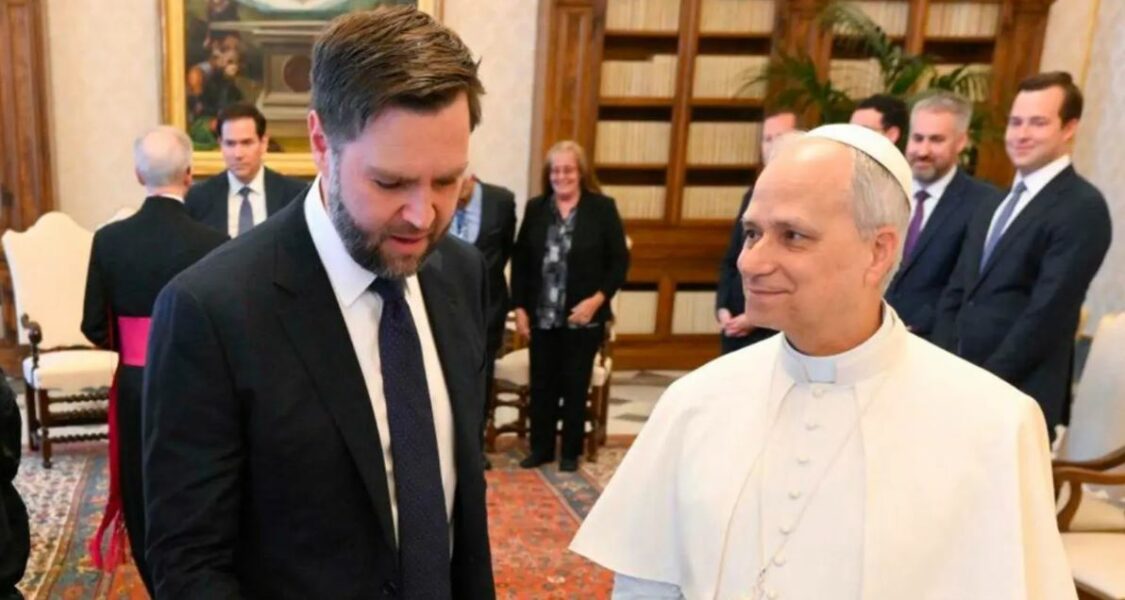
The Vice President of the United States, JD Vance, this week praised the new encyclical by Leo XIV dedicated to the ethical challenges of artificial intelligence and stated that the Church can play a decisive role in moral leadership amid the advance of new technologies.
In an interview with NBC News, Vance confirmed he had read excerpts and summaries of the document recently published by the Pontiff and described the text as “profound” and fitting “what one expects from a Church leader”.
“The Church must rethink social doctrine in the face of the new world”
During the conversation, Vance maintained that moral principles remain stable, although their application must respond to historical and technological changes.
The Vice President noted that phenomena such as artificial intelligence or new forms of warfare require rethinking specific aspects of social doctrine and the Christian moral tradition.
In that context, he interpreted Leo XIV’s encyclical as an attempt to provide ethical criteria for addressing the challenges of a new technological era marked by the accelerated development of AI.
Anthropic’s participation and dialogue with Silicon Valley
The publication of the encyclical was accompanied by the participation of Christopher Olah, co-founder of Anthropic, one of the leading companies dedicated to the development of artificial intelligence.
The company’s presence at the launch drew attention in the United States due to existing tensions between Anthropic and the Donald Trump administration. According to NBC News, the U.S. government recently ordered various agencies to stop using the company’s technologies following disagreements related to military access to its systems.
At the same time, the Vatican appears willing to open a broader dialogue with the technology sector. Father Brendan McGuire, a parish priest in Silicon Valley and one of the voices involved in the presentation of the encyclical Magnifica humanitas, explained that the goal now is to create “circles of wisdom,” spaces for encounter where experts, companies, and citizens can listen to one another.
McGuire stated that new meetings are already planned and that there is an intention to send a delegation to Silicon Valley soon to expand conversations with the technological world.
Leo XIV and the “age of artificial intelligence”
In the Vice President’s view, the new Pope now faces a challenge equivalent to the beginning of the age of artificial intelligence. For this reason, he considered that the Church can offer the moral guidance needed to address issues related to work, human relationships, and armed conflicts in the new technological context.
Although Vance has traditionally been favorable to the development of artificial intelligence and critical of excessive state regulation, in recent months he has adopted a more cautious stance in light of growing public concerns about the social and economic impact of these technologies.
In the interview, he insisted that AI raises profound questions about the future of work, human interaction, and international security—issues for which he considers a solid moral reference necessary.