


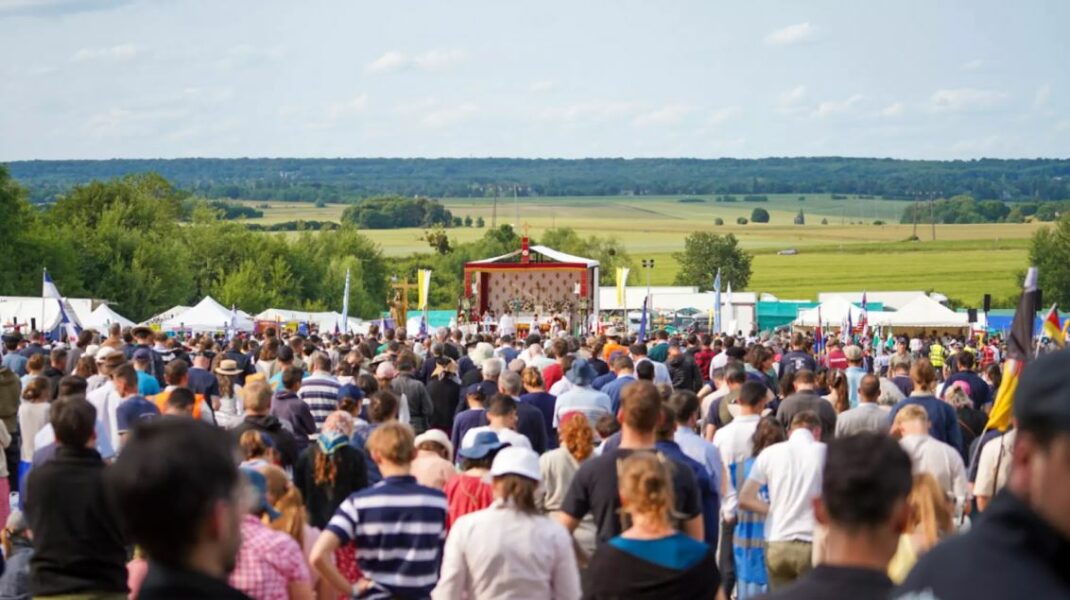
More than 20,000 pilgrims walked this year the nearly one hundred kilometers that separate Paris from Chartres in a new edition of the traditional Pèlerinage de Chrétienté, an event that once again confirms the spiritual and human vigor of the communities linked to the traditional liturgy in Europe.
Tanzanian priest Antonius Maria Mamsery, superior general of the Missionaries of the Holy Cross, was in charge of celebrating the solemn Pentecost Mass during the pilgrimage and left a message of hope about the future of European Catholicism. In statements given to AdVaticanum, the religious defined Chartres as “the hope of Europe” and especially highlighted the massive presence of young people, large families, and priestly vocations.
Read also. Burke in Chartres: «We do not give in to discouragement or despair»
A Catholic youth that surprises in Europe
One of the aspects that most impressed the African priest was precisely the number of children and young people present during the pilgrimage. Faced with the secularization that much of the continent is experiencing, Mamsery said he had found in Chartres a reality different from what is usual in many European parishes.
The superior of the Missionaries of the Holy Cross stressed that communities linked to the traditional liturgy are attracting numerous young families and can play a decisive role in the religious and cultural future of Europe.
The pilgrimage, marked by long walks, confessions, prayers, and hymns, was presented by the priest as a concrete manifestation of spiritual renewal in a society increasingly dominated by individualism and technological distraction.
The growth of the Traditional Mass in Africa
Mamsery, originally from Tanzania, also spoke about the growing interest in the Traditional Mass in various African countries. According to him, many faithful felt that “something had been lost” after the liturgical changes following the Council and today show a renewed interest in the traditional liturgy when they have the opportunity to experience it.
The priest said he is receiving more and more requests from young people from countries such as Mozambique, Angola, or South Africa interested in discovering the Traditional Mass and deepening in classical Catholic spirituality.
In several African countries, he explained, priestly vocations continue to grow strongly. In Tanzania alone, where decades ago there were three major seminaries, there are now at least seven, all of them full of seminarians.
Africa could help re-evangelize Europe
The religious considers it likely that, in the future, African priests will play an important role in the re-evangelization of the European continent, especially in light of the serious shortage of vocations affecting numerous Western dioceses.
According to him, many European dioceses have only one or two seminarians, while in Africa and Asia the number of young people wishing to train for the priesthood continues to increase.
Mamsery also pointed out that this reality is already beginning to be seen in some European countries, where a growing number of priests come from the African continent.
Peaceful coexistence with Muslims in Tanzania
During the interview, the superior of the Missionaries of the Holy Cross also highlighted the peaceful coexistence between Christians and Muslims in Tanzania. Unlike other African regions marked by religious tensions, he assured that in his country there is a cordial relationship between both communities.
He even explained that numerous Muslim families enroll their children in Catholic schools and that during the past Easter several Muslims received baptism after completing their catechesis.
Vocations and expansion of his community
The community founded under the charism of preserving and spreading the traditional liturgy is also experiencing significant vocational growth. Mamsery recounted that he recently opened a minor seminary initially intended for fifty young men, but which quickly exceeded all expectations by receiving around 300 candidates.
The priest explained that they now need to expand infrastructure and resources to support the formation of the seminarians and respond to the growing interest of young people who wish to join the congregation in different countries.
This year’s edition of Chartres thus consolidates itself once again as one of the main references of contemporary traditional Catholicism and as a religious phenomenon that, far from disappearing, continues to attract new generations both inside and outside Europe.