


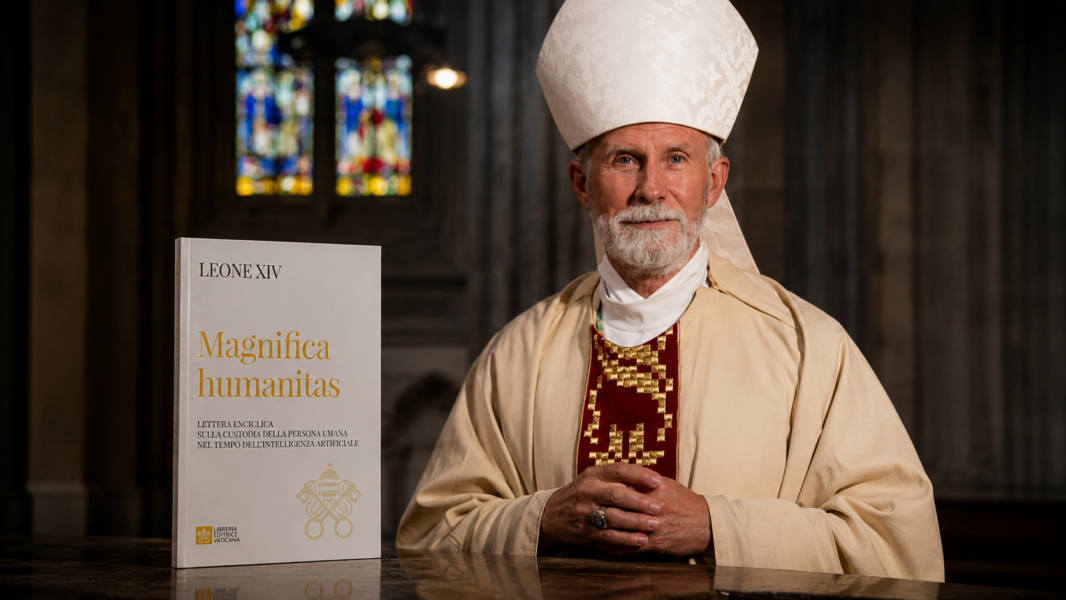
Bishop Emeritus Joseph Strickland published an extensive critical reflection on Pope Leo XIV’s encyclical Magnifica Humanitas, focused on artificial intelligence, transhumanism, and human dignity, in which he warns of what he sees as a shift in the center of Catholic theology “from God to man.”
“True charity requires clarity”
At the beginning of his writing, the American bishop states that his intention is not to create division within the Church, but to offer doctrinal discernment regarding certain approaches present in the pontifical document.
“True charity requires clarity,” Strickland writes, adding that “the faithful deserve pastors willing to speak honestly when certain emphases or theological frameworks seem capable of leading souls into confusion.”
The bishop acknowledges that the encyclical contains numerous elements that are “clearly Catholic and even admirable,” including the rejection of transhumanism, the critique of technocracy, the defense of human dignity, and the warnings about technological manipulation and artificial intelligence.
However, he maintains that the main problem does not lie in doctrinally erroneous statements, but in the “overall orientation” and the “theological center of gravity” of the document.
The critique of the “shift” toward man
Strickland asserts that the encyclical places excessive emphasis on concepts such as “human dignity,” “fraternity,” “solidarity,” or “human relationships,” to the point of risking “obscuring the primacy of God, of sin, of redemption, and of salvation.”
“Catholics theology begins with God,” the bishop writes, insisting that the dignity of man “flows from God and remains subordinate to God.”
According to Strickland, the text of Leo XIV frequently presents Christ primarily as “the revelation of authentic humanity” or “the model of communion,” relegating to the background his role as Redeemer and Savior from sin.
“There are moments when Christ seems more important as the fulfillment of humanity than as the Savior from sin,” warns the American bishop.
Concern over a “Christianized humanism”
Another central point of the reflection is Strickland’s concern over what he describes as a possible drift toward a “Christianized humanism.”
The bishop maintains that the document speaks at length about systems of power, technocracy, war, or economic injustice, but devotes “comparatively little space” to original sin, penance, judgment, or the eternal destiny of the soul.
“The deepest crisis is not technology; the crisis is man separated from God,” he states.
Finally, Strickland warns that “the world does not need a new religion centered on humanity. The world needs the Gospel.”