


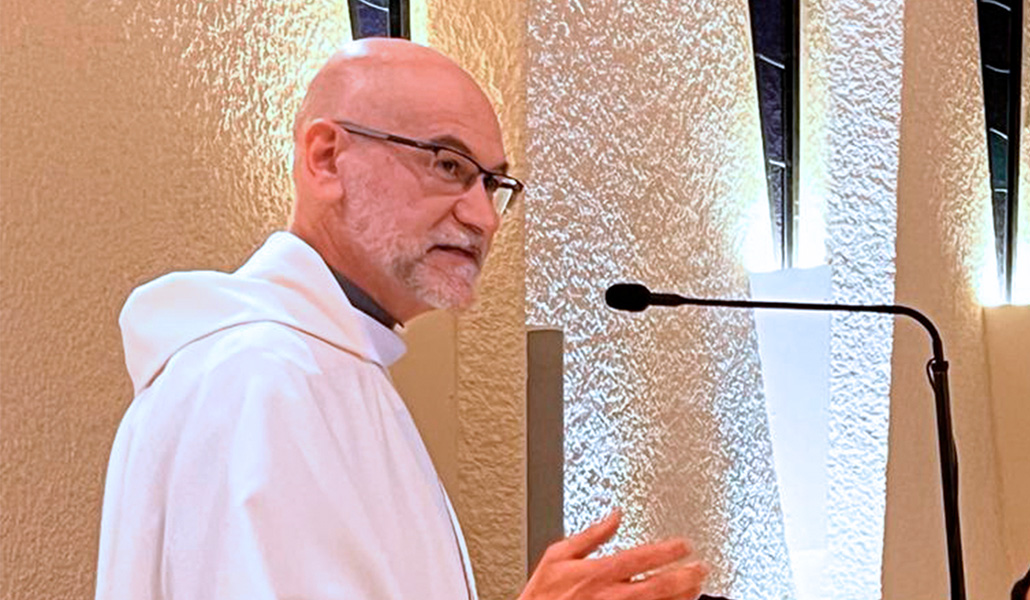
The pastoral overload, the growing secularization, and the accumulated wear after years of ministry are leading many priests to a state of deep physical and spiritual exhaustion. This is the warning from the rector of the Pontifical Spanish College of St. Joseph in Rome, Fr. Carlos Comendador, who considers it urgent to change a pastoral model that, in many cases, has turned the clergy into mere “maintainers of obsolete structures.”
In an interview given to ACI Prensa, the Spanish priest alerts that numerous presbyters live trapped in exhausting dynamics, absorbed by administrative and pastoral tasks that barely leave room for the interior life, priestly fraternity, or personal discernment.
The wear of an increasingly overloaded clergy
The rector’s statements come after the celebration of the Priestly Update Course organized at the Pontifical Spanish College in Rome, in which 28 priests from 12 Spanish dioceses took part.
According to Fr. Comendador, this type of gathering allows priests to “pause” and temporarily step out of a ministerial pace that, in many cases, ends up slowly consuming the clergy.
“Slowing down our pace to give ourselves the time and attention we steal from ourselves in the daily hustle,” he summarizes.
The situation has worsened especially in dioceses where the decline in vocations has meant fewer priests must attend to more parishes, more responsibilities, and increasingly aging communities in a society that is progressively de-Christianized.
The danger of the “bureaucratization of the sacred”
One of the harshest diagnoses made by the rector of the Spanish College points to the risk of turning the priesthood into a mere mechanical management of religious services.
“There is a danger of offering mechanical pastoral services that today’s society often does not value,” he warns.
The priest even speaks of a possible inner fracture in some presbyters, when the external exercise of ministry ends up separating from their own spiritual and vocational life.
Alongside this, he identifies growing threats such as individualism, the loss of priestly fraternity, and the human wear accumulated after decades of ministry.
“Waiting is no longer enough”
For Fr. Comendador, the core problem is that many ecclesial structures continue to operate with schemes designed for a society that no longer exists.
“We need to move from a model of mere ‘maintainers’ of obsolete structures to a profile of authentic missionaries,” he states.
In his view, the Church cannot limit itself to preserving pastoral inertia while secularization advances and the number of faithful decreases in many places.
“Waiting is no longer enough; we must go out of the churches and proclaim the Gospel to those who do not know Christ,” he emphasizes.
The proposal of a “culture of sabbatical rest”
In response to this situation, the rector of the Pontifical Spanish College proposes establishing in the dioceses a true “culture of sabbatical rest” for priests.
The idea would consist of offering extended periods of spiritual and human renewal—three months, six months, or even a year—upon reaching certain stages of priestly ministry, such as 10, 15, or 25 years of ordination.
According to him, these times would allow the priest to calmly reread his life, review his ministry, and recover the deep meaning of his vocation away from daily wear.
The goal, he maintains, is not simply to rest, but to prevent exhaustion from extinguishing the spiritual and missionary drive of priests who for years have almost single-handedly sustained parishes, communities, and ecclesial structures that are increasingly weakened.