


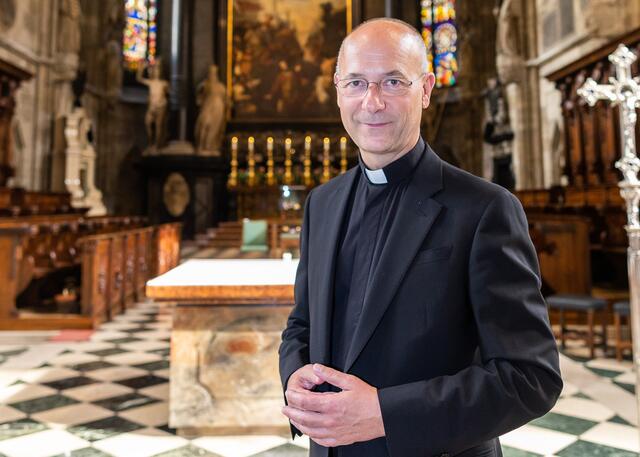
The Archdiocese of Vienna has officially confirmed that Toni Faber will step down in 2027 from his role as rector of St. Stephen’s Cathedral after nearly thirty years in the position. However, Archbishop Josef Grünwidl has made it clear that he does not intend to remove the controversial Austrian priest from pastoral life or from the public ecclesiastical scene.
Far from announcing a clear retirement, Grünwidl repeatedly stressed that Faber will remain linked to the cathedral and will continue to carry out pastoral duties in Vienna.
Grünwidl avoids a break with Faber
In statements to the Austrian public broadcaster ORF, the archbishop justified the change mainly by citing Faber’s long tenure and his approaching retirement age.
“No one had held this position for 30 years,” Grünwidl said, even highlighting the “record” set by the priest.
At the same time, he wanted to emphasize that this is not a real departure from the front line of Church life. The archbishop said he greatly values Faber’s work and explicitly ruled out any distancing from pastoral ministry or from the environment of St. Stephen’s Cathedral.
The message from Vienna seems clear: an institutional change is taking place, but not a correction of course regarding the figure and pastoral style of Toni Faber.
A priest marked by controversy
Toni Faber has for years been one of the most media-exposed and controversial figures in the Austrian Church.
In addition to his frequent public appearances, the Viennese priest has sparked debate over his critical stance on priestly celibacy and a pastoral style usually associated with progressive sectors of the Central European Church.
In recent months, Austrian media also reported on controversies linked to his lifestyle and public appearances accompanied by women, increasing pressure on the Vienna archdiocese.
Despite this, Grünwidl has chosen to keep him visible within the diocese’s pastoral life.
Faber wants to remain a “bridge”
For his part, Toni Faber himself made it clear that he does not envision a discreet withdrawal.
“Being a priest and pastor is written in my DNA,” he said, adding that he wishes to continue serving as a “bridge” between the Church and areas such as politics, the economy, culture, and society.
Among his possible new responsibilities, he even mentioned urban pastoral work in central Vienna.
The continuity of an ecclesial line in Austria
The decision also reflects the particular situation of the Austrian Church, where many reformist and media-oriented sectors continue to wield strong influence despite the decline in religious practice and vocations.
Although Faber will formally leave the rectorship of St. Stephen’s Cathedral, the archdiocese has made it clear that he will remain a visible and active figure in Viennese pastoral ministry.
The change does not represent so much a shift in orientation as a carefully managed internal reorganization aimed at avoiding a public break with one of the best-known—and most debated—faces of Austrian Catholicism.