


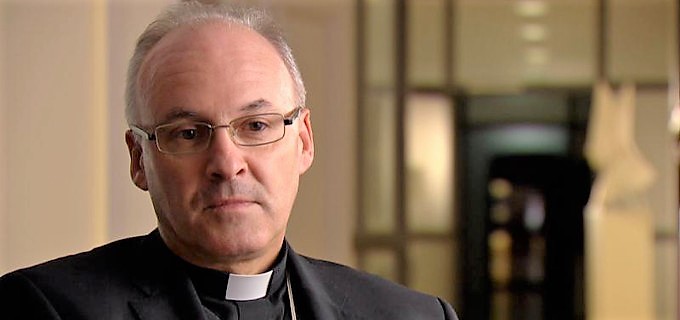
The Bishop of Regensburg, Rudolf Voderholzer, has issued a serious warning about the profound crisis of faith affecting Germany and has criticized the drift of a Church that, according to him, has become the universal Church “in which everything is problematized and everything is questioned.” In an extensive interview given to the Catholic channel K-TV, the German prelate defended the need to place Christ once again at the center of preaching and warned of the spiritual emptiness caused by decades of secularization.
The interview begins with a particularly worrying statistic: according to a survey by the Allensbach Institute cited during the conversation, only 28% of Germans currently believe that Jesus Christ is the Son of God. For Voderholzer, this situation reflects something deeper than a simple loss of religious practice.
Read also: German bishop admits errors of the Synodal Way in its relationship with Rome
“It should concern us enormously”
The bishop directly linked this decline in faith to the process of secularization that has affected Western Europe for decades.
“It is a consequence of secularization and it should concern us enormously in all ecclesial circles,” he stated.
In his view, the Church should focus primarily on restoring the centrality of the Christian proclamation, rather than dispersing itself in secondary debates.
“The first and most important thing should be to ask ourselves how to place once again at the center of our preaching what constitutes Christianity,” he noted.
Voderholzer summarized the essence of the Christian faith by drawing on a famous formula from Bishop Johann Michael Sailer: “God in Christ, salvation for the sinful world.” According to him, when this truth ceases to occupy the center, all other expressions of Christianity are weakened, including the Church’s social action.
Criticism of the drift of the German Church
During the interview, the Bishop of Regensburg hinted at a clear criticism of certain ecclesial currents present in Germany. Citing Jesuit theologian Henri de Lubac, he recalled how the latter had warned decades ago of the danger of a “self-destruction of the Church” when sociology replaces theology and philosophy.
Voderholzer lamented that in many ecclesial circles the proclamation of Christ has been overshadowed by an excessively horizontal and sociological approach.
“Social and charitable action must be a consequence of the proclamation of Christ, not replace it,” he stated.
The bishop also denounced that the German Church is perceived from other parts of the world as a Church obsessed with questioning everything.
“In Germany we are seen as those who problematize everything and question everything,” he acknowledged.
Madagascar, France and the awakening of young people
In contrast to the German situation, Voderholzer highlighted the spiritual vigor he recently encountered in Madagascar, where he visited Catholic communities full of enthusiasm and joy despite material poverty.
“I have been able to experience a poor Church, but full of joy in the faith,” he explained.
According to him, the large-scale liturgical celebrations and the fervor of thousands of young people contrast with the spiritual fatigue he perceives in Europe.
However, the bishop also pointed to hopeful signs in the West. He specifically mentioned the cases of France, England, and the United States, where he observes a growing search for an “authentic” and “integral” faith among the new generations.
“Many young people are no longer satisfied with a merely sociological or horizontal preaching,” he stated.
He also highlighted the renewed interest in the beauty of the liturgy and recalled that in France some dioceses are being overwhelmed by the growing number of young adults requesting baptism.
The crisis of vocations as a symptom of a crisis of faith
Another central theme of the interview was the collapse of priestly and religious vocations in Germany. Voderholzer said he was personally concerned about the situation and emphasized that the shortage of priests is not the main problem, but the visible symptom of a deeper crisis.
“The lack of vocations is a symptom of the diminishing strength of the faith,” he explained.
Instead of purely organizational or structural solutions, he insisted that the Church needs to regain credibility, doctrinal substance, and self-confidence.
“When the Church regains substance of faith and self-esteem, vocations will come on their own,” he assured.
Praise for Pope Leo XIV
Voderholzer also dedicated some words to Pope Leo XIV, of whom he said he felt “very, very happy.” The bishop especially praised the Pontiff’s constant references to Saint Augustine and saw in them a continuity with Benedict XVI.
He also positively highlighted the liturgical style and aesthetics of the new Pope, which —according to him— partially distance themselves from the style of Francis.
“We Catholics can be proud to have a Pope who speaks clearly to the powerful without losing his composure,” he stated, also referring to the recent international interventions of Leo XIV.
Rudolf Voderholzer’s statements once again highlight the internal division within German Catholicism between those who believe that the Church’s priority should focus on structural reforms and those who maintain that the true crisis of the West is, above all, a crisis of faith, of identity, and of the loss of the supernatural sense of Christianity.