


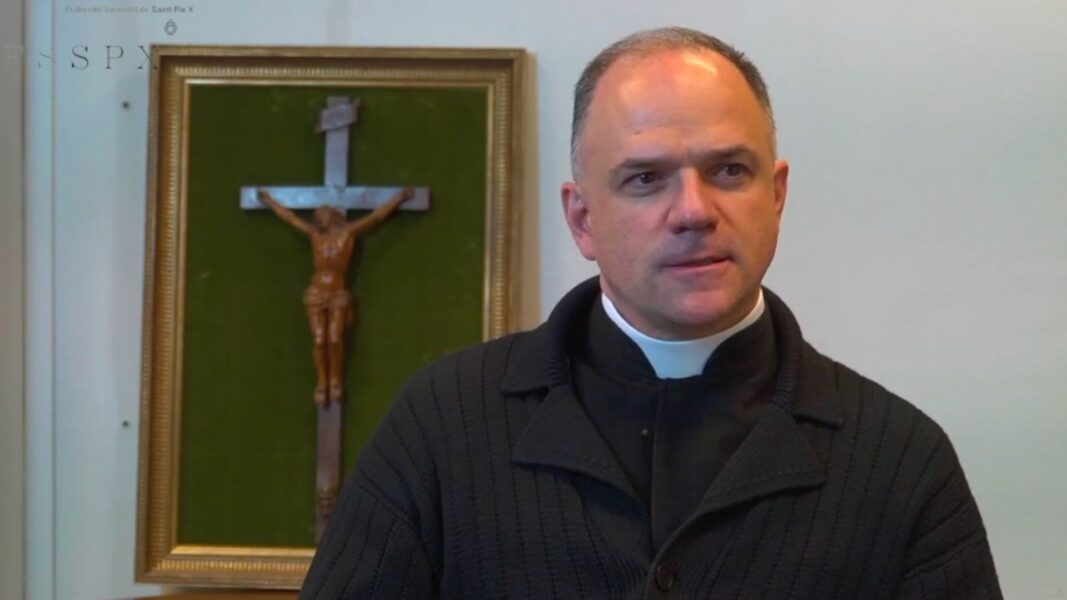
The Priestly Fraternity of Saint Pius X has made public an extensive letter from its Superior General, Abbot Davide Pagliarani, addressed to the priests and members of the Fraternity on the occasion of the upcoming episcopal consecrations scheduled for July 1. The text, dated in Menzingen on March 7, aims to offer a spiritual and moral preparation for a decision that the leadership of the FSSPX considers necessary for the preservation of the faith and of Catholic Tradition.
In the letter, Pagliarani repeatedly insists that the consecrations must not be approached in a spirit of human combat or triumph, but rather with supernatural prudence, humility, and charity. The Superior General also warns against bitterness, resentment, and any attitude of contempt toward the ecclesiastical hierarchy, even in the event of a possible canonical condemnation, and presents the Virgin Mary as a model of strength and charity in the midst of suffering.
Et nos credidimus caritati.
“Also we have believed in charity.”
1 Jn 4,16
Dear confreres and members of the Fraternity:
With great joy, after the public announcement of the consecrations and following a whole series of explanations, I can finally address you in a more personal way. I wish to share some advice to help us in our moral and spiritual preparation as members of the Fraternity. This preparation is what will enable us, in turn, to accompany the faithful appropriately.
The necessity and the context of the consecrations
There is no shortage of apologetic arguments: it is a matter of preserving the faith and all the means necessary to transmit it and to give life to the souls. If one could already speak of a state of necessity in 1988, this need is unfortunately even more evident in 2026. This explains that the decision of the Fraternity elicits an understanding that extends far beyond its own borders.
A positive fact accompanies this situation: the announcement of last February 2 has not left anyone indifferent in the Church. Almost all feel concerned and perceive the duty to express their approval or disapproval. This is providential, because there comes a time when words, positions, and declarations are no longer sufficient. They must be accompanied by significant acts that Providence can use to shake consciences and the Church herself. I firmly believe that Providence is acting in the current debate.
Supernatural prudence
As for us, we must be able to take a certain distance from this debate, while being fully involved in it. The decision to proceed with episcopal consecrations must be guided above all by supernatural prudence. This prudence does not only affect those who take the decision, but also those who receive and follow it. In other words, the matter is so important that each member of the Fraternity must be able to, at their level, understand and assume this decision personally before God.
The charity
But the gravity of this decision is such that it cannot be guided solely by supernatural prudence. For this decision to be understood and explained properly, as well as from the highest causes, sub specie æternitatis —in the light of eternity—, it is essential to ask the Holy Spirit to grant us his wisdom. Now, we must not forget that the true wisdom, the one that must guide us in this exceptional choice, is the daughter of charity. Only the virtue of charity can give us a certain connaturality with Our Lord and, consequently, make us capable to perceive the reality a little in the way of God. Only in this condition can we have a just appreciation of it.
We have already said and repeated that the reason that underlies the decision to proceed with episcopal consecrations is the salvation of the souls. It must not be viewed as a simple rhetorical formula or a mere justification of canonical order. This reason of charity toward the souls and toward the Church is what, ultimately, must truly prepare our souls and the souls of the faithful for the ceremony on July 1.
Sometimes, when one speaks of charity, some have the impression that one yields to a form of weakness or, at least, that certain softness is mixed with the authentic profession of the Catholic faith. Such sensitivity is incompatible with the spirit of Archbishop Lefebvre, with that of the Fraternity, and even more so with the spirit of the Redemption: the force of Our Lord in his Passion and on the cross is not something else than the measure of his charity.
It is with that same charity with which, now more than ever, we must love the souls and the Church, even if its official representatives were to declare us once again excommunicated and schismatic: “These things have been said to you so that you do not scandalize yourselves. You will be expelled from the synagogues, and the time will come when whoever kills you will believe he is offering worship to God. And they will do this because they have not known either the Father nor me. These things have been said to you so that, when the time comes, you remember that I had already told you.” (Jn 16,1-4)
The ultimate proof that we are in the truth will be our ability to maintain this spirit of charity, whatever happens, and toward all without distinction.
What does this charity concretely consist of?
It consists first of all in never falling into bitterness: although we certainly have the duty to do everything possible to justify and explain the deep reasons of the consecrations, this must be done with firmness, but never with bitterness or revealing a trace of bitter zeal. Obviously, one can fallen into bitterness both by excess of zeal or because one would have preferred such a date, such a candidate, or that the things happened in another way. Little matter the material cause of the bitterness; the remedy is always the same: caritas patiens est —charity is patient.
With respect to our interlocutors, whether they are whoever they are, whether they understand us or not, we must always give witness to kindness. When there is no understanding gegenüber uns, when there is even not a disposition to listen our speech and capture its reasons, it is very easy, humanly speaking, to fall into resentment. Caritas benigna est —charity is benign.
We must remember always that, if Providence has made the mercy of giving us a little light, of allowing us to conserve the Tradition of the Church and to take the means to defend it, this corresponds to an exceptional grace that we have not deserved. This consciousness must condition entirely our attitude. If the consecrations represent a grace for the entire Fraternity —a grace of which we must thank from now an the Providence—, this deeply supernatural joy must not be confused with a misplaced triumphalism, as if it were a human victory that we attributed to ourselves, which inevitably diminishes its intrinsic value. Caritas non agit perperam, non inflatur —charity does not act rashly, not inflate with pride.
Following Archbishop Lefebvre, in everything we do we do not seek our own interest nor the survival of a personal work, but the good of the souls and of the Church. The Fraternity is not another thing of a means to remain faithful to the Church. If today we take exceptional means to conserve the faith, the holy sacrifice of the Mass and the priesthood, we want that a day the entire Church and every soul without distinction can freely benefit from it. All this belongs to the Church, and we are not more than its guardians. We do not request anything for ourselves: our only reward will be to see someday the entire Church reclaim its Tradition. Caritas non quærit quæ sua sunt —charity does not seek its own interest.
If we must deploy all our efforts to defend adequately the consecrations —and the Fraternity has already for this purpose an entire “arsenal”—, if a holy anger is today more necessary than ever against the terrible deviations that shake the Church, we must nevertheless not manifest neither contempt nor irritation in our explanations with respect to our interlocutors, and especially not with respect to the hierarchy of the Church. We must know to remain firm and sweet at the same time. But that only is possible with the aid of Our Lord. Caritas non irritatur —charity does not irritates.
If we were to be declared excommunicated and schismatic, that does not mean that we seek such a sanction nor that we rejoice in it, because it would be objectively unjust. One thing is to rejoice of having a new humiliation to offer to God; another would be to rejoice, in spirit of defiance, of a mal and an injustice objective that causes scandal for the entire Church. Caritas non gaudet super iniquitatem —charity does not rejoice of the injustice.
If, by contrast, there exists in the Church a whole part that positively welcomes and supports the decision of the Fraternity, if the consecrations become a providential occasion of a renewed value and enthusiasm within and outside of the Fraternity, we cannot but rejoice of it, as God himself can rejoice. Caritas congaudet veritati —charity rejoices with the truth.
No one better than St. Paul knew to summarize in four words the program of the vier months that separates us from the consecrations and the force that must characterize our charity: omnia suffert, omnia credit, omnia sperat, omnia sustinet —everything bears, everything believes, everything hopes, everything suffers.
That gilt for the present moment and for always: caritas numquam excidit —charity never disappears.
The example of the Blessed Virgin Mary
Now more than ever, the Immaculate Heart of Mary must be the refuge of the Fraternity and the model of each one of us. No one better than her had the sense of the souls and the sense of the Church. It was by love to the souls and by love to the Church that she accepted to offer her own Son on the Calvary. Her will did not make only one with the of the Eternal and High Priest, in the same moment in which He offered himself to the Father as a victim of expiation. That charity and those immense pains are those that made Our Lady the co-redemptrix of the human race and gave her a unique glory in the time and in the eternity.
And yet, despite all what that Immaculate Heart, pierced by a sword of pain, could suffer, never the slightest bitterness nor the slightest resentment darkened, even for a single instant, the splendor of her charity, even with respect to those who had given death to her divine Son. The same way as she did not hesitate an instant to consumm the sacrifice until the end, so neither her charity toward the sinners never failed. Mystery fathomless of strength, sweetness, and love.
With these feelings and with this charity we must prepare the ceremony of July 1 and strive to prepare also for it the all faithful who have been entrusted an to uns.
¡God bless you!
Menzingen, March 7, feast of Saint Thomas Aquinas
Abbot Davide Pagliarani, Superior General