


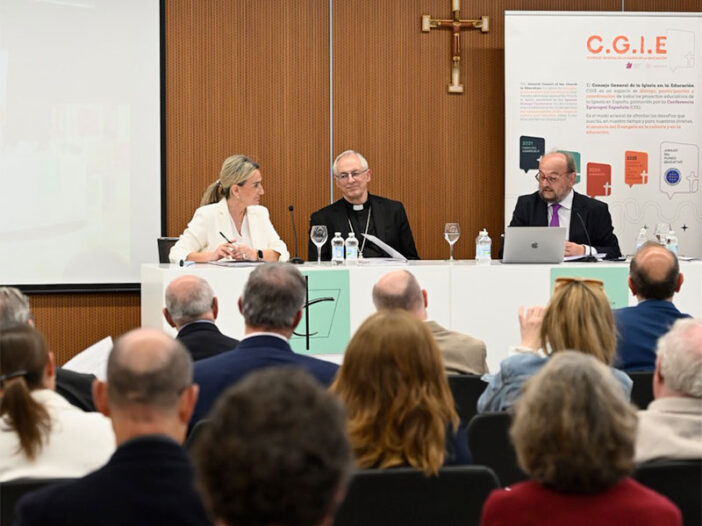
The Spanish Episcopal Conference (CEE) continues to strengthen its institutional alignment with the government of Pedro Sánchez ahead of Pope Leo XIV’s visit to Spain. The latest sign of this strategy came this Wednesday with the participation of the Minister of Education, Vocational Training and Sport, Milagros Tolón, in the plenary session of the General Council of the Church in Education, held at the CEE headquarters.
The meeting, officially presented as a day of dialogue on education, produced numerous statements reflecting the desire to maintain a “fluid and stable” relationship between the socialist government and the Spanish ecclesiastical hierarchy, in a context marked by preparations for the papal visit and the need to project an image of institutional normality.
The minister claims a “fluid and stable” relationship
In her speech, Milagros Tolón highlighted the “long and deep-rooted presence” of the Catholic Church in the Spanish education system and defended the importance of collaboration between the Ministry and the Church.
“That is why it makes sense for the ministry I represent and the General Council of the Church in Education to always maintain a fluid and stable relationship,” the minister stated, adding that the Church “has much to say” in educational matters.
The CEE insists on “dialogue” with public institutions
Mons. Alfonso Carrasco Rouco, president of the Episcopal Commission for Education and Culture, thanked Tolón for her presence and highlighted the Church’s willingness to collaborate with public institutions “in everything that serves the good of our education system.”
In his welcome address, Carrasco Rouco stressed the need for the Church to take an active part in the “great dialogue” and the “public debate” on education in Spain.
The repeated use of concepts such as “dialogue,” “encounter,” and “institutional collaboration” comes at a time when the CEE seeks to consolidate a climate of stability with the government ahead of Leo XIV’s arrival.
Leo XIV, used as a reference to strengthen the institutional discourse
One of the most striking aspects of the meeting was the repeated use of references to Pope Leo XIV to reinforce the discourse of institutional openness promoted by the Episcopal Conference.
Carrasco Rouco specifically cited a recent text by the Pontiff, Designing Maps of Hope, to speak of “educational constellations” and a Church open to dialogue and plurality.
The note issued by the CEE itself underlined that Catholic educational institutions wish to work “together with the entire educational community and public institutions” to build an education that is “truly human and integral”.
An approach that raises concerns among ecclesial sectors
Although the institutional tone of the meeting was cordial and collaborative, this progressive rapprochement between the Episcopal Conference and the socialist government continues to be viewed with suspicion by sectors of Spanish Catholicism.
There is no shortage of reasons for this caution. The promotion of ideological laws, the advance of the abortion agenda, reforms on gender identity, or attempts to reduce the weight of state-subsidized education continue to be a source of concern for many Catholics.
In this context, the normalization of relations between the CEE and a government that has repeatedly clashed with principles upheld by Catholic doctrine raises an uncomfortable question: to what extent can legitimate institutional dialogue end up diluting the necessary prophetic clarity of the Church.
The papal visit as a backdrop
The presence of Milagros Tolón in the plenary session of the General Council of the Church in Education comes just weeks before the arrival of Leo XIV in Spain, scheduled for early June.
Both the Episcopal Conference and the government are working to ensure that the visit takes place in a climate of maximum institutional normality and with a public image of collaboration between Church and State.
In this context, gestures of mutual rapprochement have multiplied in the last few months, while the CEE continues to project an image of unity, dialogue and cooperation with civil authorities.