


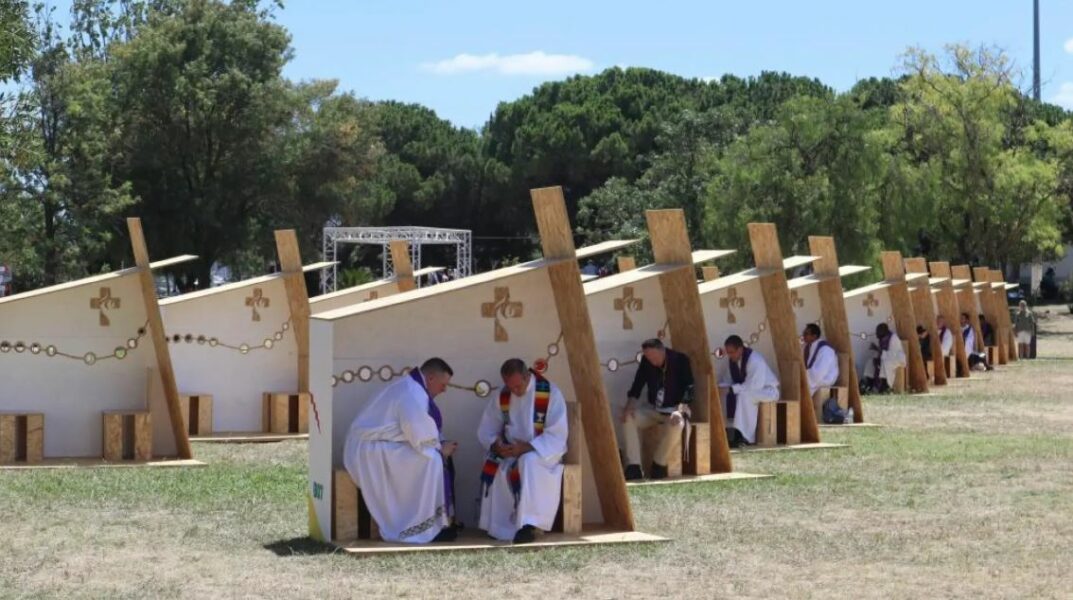
The Archdiocese of Madrid will not install confessionals during the youth vigil or at the main large-scale events of Pope Leo XIV’s visit to Spain next June. Instead, “listening spaces” will be set up, attended by lay pastoral agents to accompany and converse with attendees, especially young people.
In the large ecclesial gatherings of recent decades—particularly the World Youth Days—the visible presence of priests hearing confessions had become one of the most recognizable signs of the centrality of the sacrament of reconciliation. Replacing that image with “listening points” conveys the idea that both realities are equivalent, even though the archdiocese itself insists they are not.
“Listening spaces do not replace confessionals”
During a press conference held on May 19 at the headquarters of the Spanish Episcopal Conference, the Director of Communications of the Archdiocese of Madrid, Sara de la Torre, explained that the listening points will be distributed along Paseo de la Castellana and will be staffed by people specifically trained for this task.
According to her, the initiative is part of the network of listening centers promoted by the Archdiocese of Madrid in collaboration with the San Camilo Center for the Humanization of Health, aimed at personal and spiritual accompaniment.
In statements to The Pillar, De la Torre made it clear that these spaces “do not diminish the need for the sacrament of confession” and recalled that Madrid has 476 parishes where the faithful can go to confession during the days of the papal visit.
“Listening spaces do not replace confessionals; they go hand in hand. Nothing compares to the sacrament of confession,” the spokesperson affirmed, insisting that it is “something different” intended for those who wish to be heard or to converse.
A missed opportunity for some organizers
Despite the official explanations, the absence of confessionals during the youth vigil on June 6 in Plaza de Lima has generated unease among part of the organizing team. Sources close to the trip’s preparation revealed that some officials had proposed turning the gathering into a large “day of reconciliation,” with hundreds of priests available to hear confessions simultaneously.
However, the idea was ultimately discarded. Among the arguments put forward were the convenience of offering confessions beforehand in the parishes and the additional burden it would place on priests, who would also participate the following day in the great Corpus Christi Mass presided over by Leo XIV.
One of the organizers consulted by The Pillar described the decision as a “missed opportunity.”
Inspiration from similar Vatican initiatives
The proposal for listening spaces recalls the experience launched in September 2025 at St. Peter’s Basilica, where a room was set up to listen to pilgrims, tourists, and people distant from the faith.
On that occasion, Monsignor Orazio Pepe, secretary of the Fabric of St. Peter, stressed that it was not a confessional, but a hospitality service open also to non-believers and people in spiritual crisis.
In Madrid, pastoral vicar José Luis Segovia defended this pastoral approach, stating that “listening is an element that forms part of the basic attitude of believers to place themselves in listening to God.”
It is precisely here that one of the main concerns lies: that the insistence on accompaniment and listening may end up displacing, even symbolically, the sacramental dimension of reconciliation, especially in a youth context where many need to rediscover the value of frequent confession.
Confessions will be available at the Almudena
The Archdiocese of Madrid has indeed planned a penitential service on June 5, the day before the Pope’s arrival, at Almudena Cathedral. At that gathering “the sacrament of reconciliation can be received,” although the capacity will be limited—around 2,000 people—compared to the hundreds of thousands expected both at the youth vigil and at the Corpus Christi Mass.
A visit presented as “historic”
During the press conference, Sara de la Torre encouraged pilgrims to register as soon as possible for the planned events and highlighted the exceptional nature of Pope Leo XIV’s visit to Madrid.
“It is something historic to experience it with the Holy Father,” she said in reference to the celebration of Corpus Christi on June 7 in Plaza de Cibeles.
The Director of Communications also described the Church in Madrid as an “enthusiastic” Church marked by a “spirit of unity,” assuring that the preparation of the visit has allowed parishes and pastoral agents to “work together” and show “the best” of the diocese to the new Pontiff.