


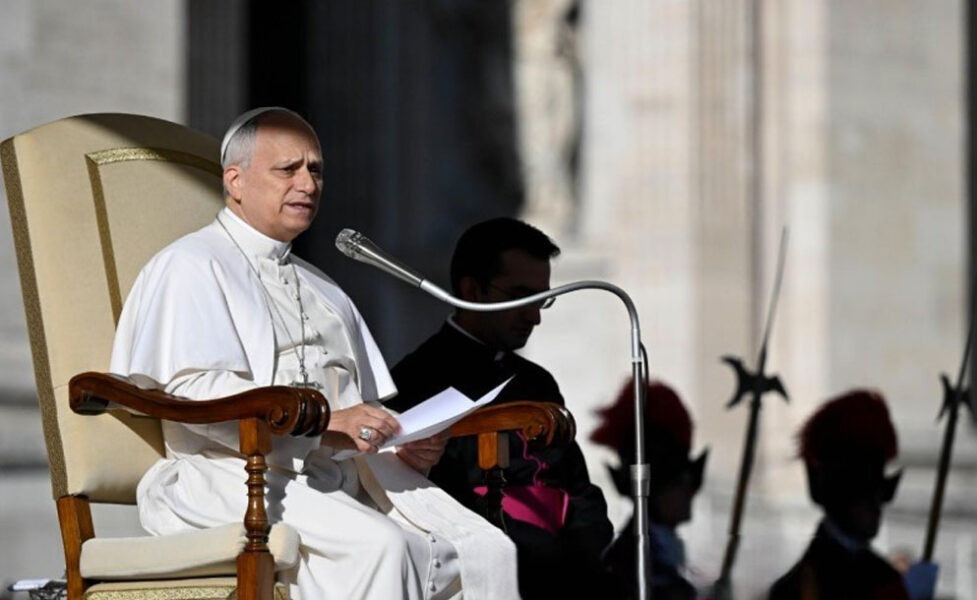
Pope Leo XIV dedicated this Wednesday’s general audience to the Constitution Sacrosanctum Concilium, the first document promulgated by the Second Vatican Council, thus resuming the cycle of catechesis on the conciliar texts with a reflection centered on the place of the liturgy within the mystery of the Church.
During the gathering held in St. Peter’s Square, the Pope explained that the conciliar Constitution on the sacred liturgy should not be understood merely as a reform of ceremonies or external rites, but as a call to rediscover the living bond that unites the Church with Christ.
The liturgy, “source and summit” of the life of the Church
Pope Leo XIV recalled that Sacrosanctum Concilium defines the liturgy as the place where “the work of our redemption is carried out” and emphasized that the entire life of the Church converges in it.
“The liturgy touches the very heart of the mystery,” the Pontiff affirmed, explaining that in it the Church continually receives its own life from Christ.
The Pope insisted that Christ continues to act in the liturgy through the proclaimed Word, the sacraments, the ministers, the gathered community, and, in a supreme way, in the Eucharist.
In this regard, he recalled the well-known conciliar expression that defines the liturgy as “the summit toward which the action of the Church tends and, at the same time, the source from which all its strength flows.”
The liturgy is not reduced to a reform of rites
Pope Leo XIV pointed out that the conciliar fathers did not intend merely to modify liturgical practices, but to help the Church to delve deeper into the paschal mystery of Christ.
The Pontiff explained that the passion, death, and resurrection of the Lord are made sacramentally present in the liturgy and that, therefore, each celebration introduces the faithful into the mystery of redemption.
He also highlighted that liturgical participation cannot be limited to an external or ceremonial dimension, but must concretely transform the daily life of the Christian.
“The liturgy celebrated is translated into life,” the Pope affirmed, recalling that Christian worship requires an existence consistent with what is celebrated.
Rites, symbols, and ecclesial communion
The Pope further emphasized that the liturgical rites, gestures, silences, and symbols express the faith of the Church and at the same time shape its identity.
In this context, he recalled the ancient principle lex orandi, lex credendi, according to which the form of praying expresses the faith of the Church.
Pope Leo XIV explained that each liturgical celebration constitutes a true manifestation of the Church at prayer and a concrete experience of communion.
“Let us allow ourselves to be inwardly shaped by the rites, the symbols, the gestures, and, above all, by the living presence of Christ in the liturgy,” he exhorted at the conclusion of his catechesis.
Greetings to Catholicos Aram I
Before the catechesis, Pope Leo XIV extended a special greeting to Catholicos Aram I, head of the Armenian Apostolic Church of Cilicia, who was present at the audience together with the delegation accompanying him during his official visit to the Vatican.
The Pope expressed his gratitude for the personal commitment of Aram I to ecumenism and to the theological dialogue between the Catholic Church and the Eastern Orthodox Churches.
He also asked for prayers that this visit may constitute “a further step” toward the full unity between the Churches and offered a prayer for peace in Lebanon and the Middle East, “once again torn by violence and war.”
We now present the catechesis of Pope Leo XIV:
Dear brothers and sisters, good morning and welcome!
Today we begin a series of catechesis on the first document promulgated by the Second Vatican Council: the Constitution on the Sacred Liturgy Sacrosanctum Concilium (SC).
In drafting this Constitution, the conciliar Fathers wished not only to undertake a reform of the rites, but also to lead the Church to contemplate and delve deeper into that living bond that constitutes and unites it: the mystery of Christ. The liturgy, in fact, touches the very heart of this mystery: it is at the same time the space, the time, and the context in which the Church receives its own life from Christ. In the liturgy, indeed, “the work of our Redemption is carried out” (SC, 2), which makes us a chosen race, a royal priesthood, a holy nation, a people acquired by God (cf. 1Pt 2,9).
As the threefold renewal —biblical, patristic, and liturgical— that has durchlaufen the Church throughout the twentieth century has shown, the Mystery in question does not designate an obscure reality, but the saving plan of God, hidden from eternity and revealed in Christ, according to the assertion of St. Paul (cf. Eph 3,3-6). Here, then, is the Christian Mystery: the paschal event, that is, the passion, the death, the resurrection, and the glorification of Christ, which precisely in the liturgy is made sacramentally present to us, so that whenever we participate in the assembly gathered “in his name” (Mt 18,20) we are immersed in this Mystery.
Christ himself is the inner principle of the mystery of the Church, the holy people of God, born from his pierced side on the cross. In the holy liturgy, with the power of his Spirit, he continues to act. He sanctifies and associates the Church, his bride, to his offering to the Father. He exercises his absolutely unique priesthood, he who is present in the proclaimed Word, in the sacraments, in the ministers who celebrate, in the gathered community, and, in the highest degree, in the Eucharist (cf. SC, 7). Thus, according to St. Augustine (cf. Serm., 277), when celebrating the Eucharist, the Church “receives the Body of the Lord and becomes what it receives”: it becomes the Body of Christ, “a dwelling place of God in the Spirit” (Eph 2,22). This is “the work of our redemption,” which configures us to Christ and builds us up in communion.
In the holy liturgy, this communion is realized “through the rites and prayers” (SC, 48). The rituality of the Church expresses its faith —according to the famous saying lex orandi, lex credendi— and, at the same time, shapes the ecclesial identity: the proclaimed Word, the celebration of the Sacrament, the gestures, the silences, the space, all this represents and gives form to the people called by the Father, the Body of Christ, the Temple of the Spirit. Each celebration thus becomes a true epiphany of the Church at prayer, as Saint John Paul II recalled (Apostolic Letter Vicesimus quintus annus, 9).
If the liturgy is at the service of the mystery of Christ, it is understood why it has been defined as “the summit toward which the activity of the Church tends and at the same time the source from which all its strength flows” (SC, 10). It is true that the action of the Church does not limit itself only to the liturgy; however, all its activities (preaching, serving the poor, accompanying human realities) converge toward this “summit.” In the reverse direction, the liturgy supports the faithful by immerging them always and anew in the Paschal Mystery of the Lord and, through the proclamation of the Word, the celebration of the sacraments, and the common prayer, they are strengthened, animated, and renewed in their commitment of faith and in their mission. In other words, the participation of the faithful in the liturgical action is at the same time “inner” and “outer.”
This means also that it is called to develop concretely throughout the daily life, in an ethical and spiritual dynamic, so that the liturgy celebrated is translated into life and requires a faithful existence, capable of making concrete what has been lived in the celebration: it is so that our life becomes “a living sacrifice, holy and pleasing to God,” realizing our “spiritual worship” (Rom 12,1).
In this way, “the liturgy builds up day by day those who are within the Church to be a holy temple in the Lord” (SC, 2), and forms a community open and welcoming to all. In fact, it is inhabited by the Spirit of God, introduces us into the life of Christ, makes us his Body, and, in all its dimensions, represents a sign of the unity of all humanity in Christ. As Pope Francis said: “The world still does not know, but all are invited to the wedding banquet of the Lamb (Ap 19,9)” (Apostolic Letter Desiderio desideravi, 5).
Dearly beloved, let us allow ourselves to be inwardly shaped by the rites, by the symbols, by the gestures, and, above all, by the living presence of Christ in the liturgy, which we will have the opportunity to deepen in the next catecheses.