


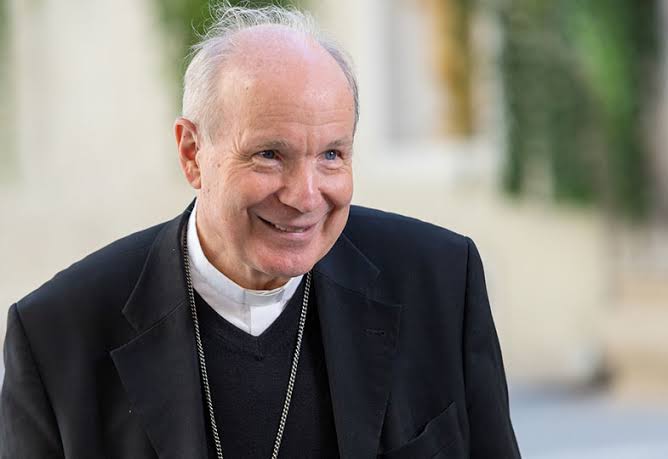
Cardinal Christoph Schönborn has recalled the deep theological and ecclesial tensions that marked his early years of formation after the Second Vatican Council, a period that, as he confessed, even put his own faith in crisis.
In a reflection published by Vatican News, the Archbishop Emeritus of Vienna especially reviewed his time as professor of Dogmatics at the University of Freiburg (Switzerland), where he taught from 1975 onward, as well as the theological climate that dominated the decades following the Council.
Schönborn explained that during his theological studies in Cologne, begun in 1967, he was deeply affected by certain theological currents that relativized central elements of the Christian faith.
“I experienced with astonishment what was being defended there; partly fascinated, and partly feeling that the ground was slipping from under my feet,” the cardinal stated.
The Resurrection of Christ Called into Question
Among the aspects that most affected him, Schönborn mentioned certain theological interpretations that reduced the Resurrection of Christ to a mere symbolic continuation of Jesus’ intentions in his disciples.
According to his account, that reinterpretation of one of the fundamental pillars of Christianity led him to seriously question his own path of faith and priestly vocation.
The then-young Dominican even conveyed to his religious superiors that, under those circumstances, he risked losing his faith if he remained in Germany.
Tensions at the University of Freiburg
His subsequent time at the University of Freiburg was not without conflicts either. Schönborn assumed teaching duties at barely thirty years of age and had to face criticism and confrontations with some students and professors due to his theological stance.
The cardinal acknowledged that those tensions were difficult, though he assured that they also helped him mature intellectually and deepen his appreciation of the Creed as a stable foundation for theological reflection.
Despite the controversies, Schönborn recalled his years in Switzerland positively and highlighted the interest his classes aroused among numerous students.
Reflection on Crises in the Church
In his biographical review, the Archbishop Emeritus of Vienna also addressed the ecclesial challenges experienced in Austria after his appointment as auxiliary bishop of Vienna in 1991.
Asked about the institutional crises and cases of abuse in the Austrian Catholic Church, Schönborn highlighted the preventive and transparency measures promoted during those years.
In that context, he especially praised the collaboration of his former vicar general Helmut Schüller, to whom he attributed an important role in the implementation of clarification and prevention mechanisms within the Austrian Church.