


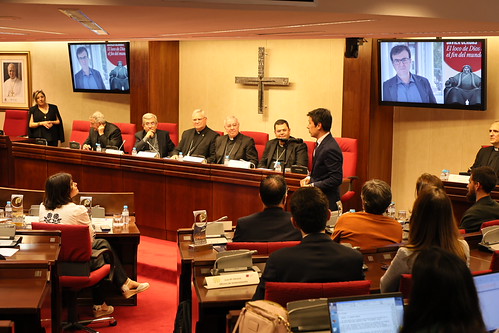
The Spanish Episcopal Conference awarded the ¡Bravo! 2025 Prizes on Monday, honors with which the Church annually recognizes professionals and projects in the field of communication. Among the recipients of this 56th edition are names such as Rosalía, Javier Cercas, Fernando Ónega, José Luis Pérez, and the COPE Foundation.
The event took place at the headquarters of the Episcopal Conference and was presided over by Monsignor José Manuel Lorca Planes, president of the Episcopal Commission for Social Communications (CECS).
As the Episcopal Conference itself recalled, these awards aim to distinguish communicators and proposals “that have stood out for their service to human dignity, human rights, or evangelical values.”
Rosalía and Javier Cercas, among the awardees
One of the awards that attracted the most attention was the ¡Bravo! Music Prize awarded to Rosalía for Lux, a work the Episcopal Conference described as a proposal capable of uniting “artistic sensitivity, spiritual depth, and a carefully crafted contemporary sound proposal.”
Read also: Evangelical values? The Episcopal Conference awards Rosalía at the ¡Bravo! 2025
The Catalan singer thus joins the list of artists recognized in recent years by the Episcopal Conference within these awards dedicated to the fields of communication and culture.
The ¡Bravo! Press Prize was awarded to writer and columnist Javier Cercas, a contributor to El País since 1998. The jury especially highlighted both his journalistic career and his recent book The Madman of God at the End of the World, focused on the figure of Pope Francis during his trip to Mongolia.
Recognitions for COPE, TRECE and Fernando Ónega
The ¡Bravo! Television Prize went to José Luis Pérez, a journalist at TRECE, for a career the Episcopal Conference defined as “rigorous and committed to the service of information.”
The COPE Foundation received the ¡Bravo! Radio Prize for its work in training communication professionals for nearly three decades. According to the Episcopal Conference, more than six hundred students have passed through its training programs in these 29 years.
On the other hand, the Special ¡Bravo! Prize was awarded to veteran journalist Fernando Ónega for his career in radio, television, and print media. The Episcopal Conference especially highlighted his style based on “rigor, responsibility, and truth.”
Awards for film, podcast and digital communication
In the Film category, the prize went to Alauda Ruiz de Azúa for the film Los domingos, focused on the vocational process of a teenager in a family environment far removed from religious practice.
The Digital Communication Prize was awarded to the campaign Adopt a Shop, promoted by the Siberia agency after the DANA floods in Valencia, while the Podcast Prize went to Carlos Roca for Roca Project, a proposal aimed especially at a young audience.
Also recognized were Eva Cañas and María Criado, communications officers for the diocese of Salamanca, for their work in the field of diocesan communication.
The CEE advocates communication as service
During the ceremony, Monsignor José Manuel Lorca Planes stated that these awards represent “an outstretched hand from the Church to the world of communication” and highlighted the importance of communication as an essential dimension of human life.
The president of the Episcopal Commission for Social Communications also warned about some of the current challenges in the communication field, mentioning polarization, hate speech on social media, and the development of artificial intelligence “without the presence of the human.”
In his intervention, Lorca Planes also praised the ability of communicators to build spaces of encounter and “look people in the face, recognize their joys and their pains.”
For his part, José Luis Pérez spoke on behalf of the awardees and defended a communication centered on human dignity, truth, and service to people.