


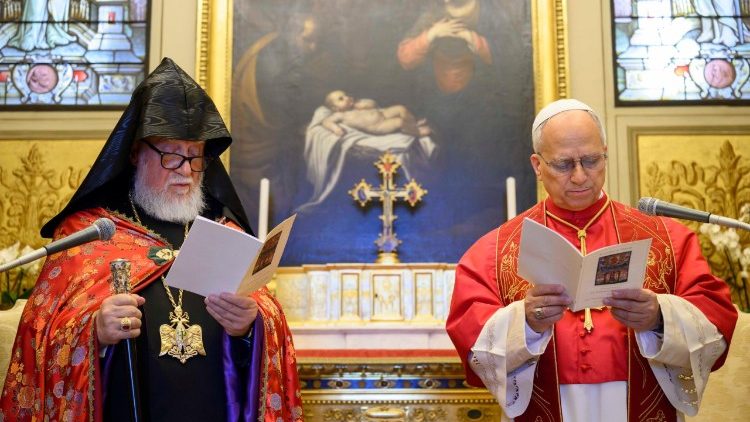
Pope Leo XIV received His Holiness Aram I, Catholicos of the Armenian Apostolic Church of Cilicia, in audience at the Vatican on Monday, in a meeting marked by the promotion of ecumenical dialogue and shared concern for the situation of Christians in the Middle East.
The meeting took place in the Apostolic Palace of the Vatican and included a private conversation, the presentation of the Armenian delegation, the exchange of speeches, and a moment of common prayer in the Urban VIII Chapel.
During his address, Leo XIV highlighted the historical and spiritual bonds between the Catholic Church and the Armenian Apostolic Church, especially recalling the figure of Saint Paul and the historical role of Cilicia in the life of Eastern Christianity.
“There can be no restoration of communion between our Churches without unity in the faith,” the Pontiff stated, in one of the most significant phrases of a speech focused on the ecumenical question.
Leo XIV insists on reactivating theological dialogue
The Pope expressly thanked Aram I for his commitment to ecumenism and highlighted the work carried out since 2003 by the Joint International Commission for Theological Dialogue between the Catholic Church and the Oriental Orthodox Churches.
This dialogue, explained Leo XIV, has allowed the publication of joint documents on the nature of the Church, communion in early Christianity, and the sacraments.
However, the Pontiff also recognized the existence of recent difficulties and expressed his wish that the conversations “continue with renewed vigor.”
The Pope recalls the historical role of the Armenian Church
During the meeting, Leo XIV also recalled the historical dimension of the bond between Rome and the Armenian See of Cilicia, particularly intense during the Middle Ages and reactivated after the Second Vatican Council.
The Pontiff also praised the figure of Saint Nerses the Gracious, the Armenian Catholicos recently added to the Roman Martyrology, presenting him as a “pioneer of ecumenism.”
Likewise, he highlighted Aram I’s trajectory in international ecumenical bodies and his role in the World Council of Churches and the Council of Churches of the Middle East.
Concern for the future of Lebanon
A significant part of the papal speech was devoted to the situation of Lebanon, the country from which Aram I originates and whose stability once again openly concerned the Pontiff.
Leo XIV described Lebanon as a nation that for decades showed the world the possibility of coexistence between different cultures and religions, but warned that its “unity and integrity” are once again threatened.
The Pope also assured that he prays daily for the Lebanese people and for the Churches of the Middle East.
Finally, the meeting concluded with a joint prayer to the Holy Spirit on the eve of Pentecost, asking for unity among Christians and peace for the Middle East.