


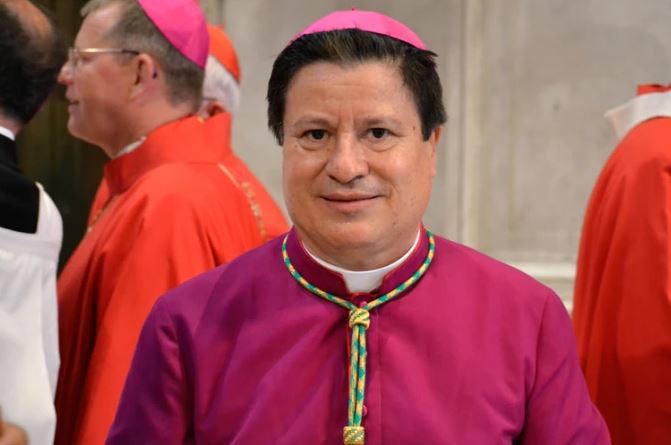
The Archbishop of San José, Costa Rica, Monsignor José Rafael Quirós Quirós, has ordered that no kneelers be placed in churches for the distribution of Holy Communion, in a decision that represents a new obstacle for the faithful who wish to receive the Eucharist kneeling.
The measure is included in a circular dated May 13 and signed by the Episcopal Delegate for Liturgy, Father Francisco Morales González, at the express instruction of the Archbishop himself.
The document responds to inquiries raised in recent weeks regarding the installation of kneelers for the faithful who wish to receive Communion kneeling.
“No kneelers shall be placed”
After recalling that the Church allows receiving Communion both standing and kneeling, as well as on the tongue or in the hand, the circular expressly states:
“Accordingly, the Archbishop orders that from now on, no kneelers shall be placed in churches for the distribution of Communion.”
The text maintains that the presence of kneelers could lead some faithful to think that receiving Communion kneeling is “the only form established by the Church.”
Additionally, it argues that these elements could hinder access for elderly people or those with mobility issues who are accustomed to receiving Communion standing.
The Archdiocese reminds that kneeling for Communion remains allowed
The circular also emphasizes that no minister can impose a single form of receiving Communion and recalls that the faithful retain the right to receive it both standing and kneeling.
The document cites expressly the instruction Redemptionis Sacramentum and the apostolic exhortation Sacramentum Caritatis of Benedict XVI, reminding that it is not licit to deny Communion to a faithful person for wishing to receive the Eucharist kneeling.
However, the decision to eliminate the kneelers has been interpreted by numerous faithful as a clearly discouraging measure toward this practice, which is increasingly widespread in circles linked to the recovery of liturgical reverence.
They recall a request from the nuncio in 2012
The decision of Monsignor Quirós has also revived the memory of a request made in 2012 by the then Apostolic Nuncio in Costa Rica, Monsignor Pierre Nguyen Van Tot.
At that time, the papal representative formally requested the Costa Rican Episcopal Conference to resume distributing Communion on the tongue and kneeling, following the universal norms of the Church.
The request, according to various ecclesiastical sources, did not come to be applied in a widespread manner.
A liturgical debate that is increasingly visible
The issue of kneeling and receiving Communion on the tongue has become one of the most visible liturgical debates of recent years within the Church.
While numerous priests and faithful have recovered this practice as an expression of adoration and eucharistic reverence, some ecclesiastical sectors continue to view it with suspicion or attempt to limit it through practical norms.
The decision adopted now by the Archbishop of San José, Costa Rica, has generated discomfort among the faithful who consider it contradictory to formally recognize the right to receive Communion kneeling while eliminating the means that facilitate that possibility in the parishes.