


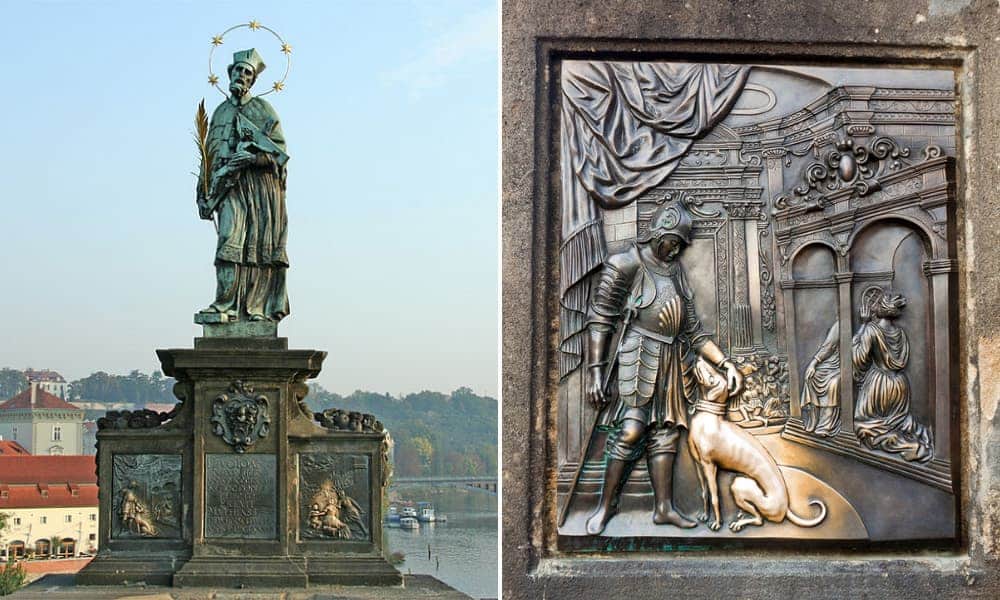
His silence shines like a crown because it was not born of fear, but of love. Saint John of Nepomuk was a martyr of the priestly seal that guards the soul like an inviolable sanctuary: a silence sealed by fidelity, not by cowardice or human prudence, but by the fear of God. The Church celebrates him on May 16, and his figure on the Charles Bridge in Prague, over the dark waters of Central Europe, is a stone sentinel that reminds the modern world that there are principles that are never sold, negotiated, or betrayed.
The sacredness of conscience
He was born around 1345 in Nepomuk, in the present-day Czech Republic, in the heart of ancient Bohemia. The beautiful medieval Prague, filled with bells, monasteries, and damp alleyways, would be the main stage of his life. He studied canon law and theology, and became vicar general of the archbishop of Prague.
The oldest historical sources, although later mixed with legendary and devotional elements, agree in presenting John as a cultured, prudent, upright priest, extraordinarily faithful to the Church in difficult times. The tension between political power and ecclesiastical authority marked much of Europe at that time. Kings often wanted to govern consciences as well. And there, in that invisible place where human power ends and the mystery of the soul begins, the drama arose. Because the king wanted to enter a conscience. The tradition rooted in Catholic piety affirms that King Wenceslaus IV wished to know what his wife had confessed sacramentally. John of Nepomuk, confessor of Queen Sophia, firmly refused.
What greatness in that refusal! Today, in the strange format of not a few ecclesiastical movements, there are words, testimonies, public confessions, tears and cries in common… even prophecies and strange tongues. Everything is exposed, souls are exhibited, the spiritual modesty seems to have evaporated. However, for the Church, the secrecy of confession is not a mere disciplinary norm: it binds the confessor to give his life rather than break it. In the sacrament, the priest listens, knows, but cannot use what he knows. Human words are forever buried in the abyss of the divine mercy: after the absolution, those miseries of sin no longer belong even to the penitents or their history, as now we say: they were erased by God Himself. For this reason the confessor cannot reveal anything. Never. Under no pretext.
As the current Code of Canon Law provides: «983 § 1. The sacramental seal is inviolable; therefore, the confessor is strictly forbidden to disclose the penitent, by word or any other mode, and for any reason. § 2. The interpreter, if there is one, and all those who, in any way, had knowledge of the sins through confession are also obliged to keep the secret». But long before the law formulated it, the martyrs had already sealed it with blood.
The elegance of keeping secret
The refusal of John triggered the king’s wrath: he was imprisoned, cruelly tortured, and finally thrown from the Prague bridge into the Moldau River, the night of March 20, 1393.
The iconography represents him with five stars over his head. The tradition says that they appeared over the waters when his body fell into the river. Those celestial bodies express the invisible glory of who preferred to lose his life before profaning a sacrament. Because John of Nepomuk did not die defending a human secret, nor a political conspiracy, nor a banal privacy. He died defending the right of the sinner to open his soul to God without fear. He died defending the sacred character of conscience. He died to make the penitents able to kneel in tranquility.
How many tears have not been shed in the confessionals, when they were used, and gratis, not yet supplanted by the consultations of psychologists! How many confessed miseries trembling, how many sins said in a low voice, how many shames thrown into the Heart of Christ! Because there was the absolute guarantee that no one could ever pull those words from the silence of God.
The priest can forget many things of the life; what he hears in confession is obliged not only to silence it, but to not use it ever, even indirectly. Saint Thomas Aquinas teaches that the priest knows the sins “non ut homo, sed ut Deus”, not as man, but as minister of God (cf. Supplementum, q. 11, «De sigillo confessionis», a. 1). For this reason the sacramental seal is superhuman: it does not depend on sympathies, friendships or psychological prudence; it always obliges, even in the face of threats or persecution. Even in the face of death.
Every so often, voices emerge that consider the secrecy of confession to be intolerable. Some see it as a legal anomaly, others as an impossible privilege. The Church knows well that, if the penitents suspected that it could be revealed, many (of the few who today still do it) would never again approach the court of divine mercy.
In reality, the sacramental seal protects something far greater than a confidence: it protects the freedom of the soul in front of God. In a civilization where everything is recorded, everything is filtered, and everything becomes a spectacle, the confession remains as one of the last truly inviolable places in the world. A small enclosure of humility where the man can drop his masks.
The saint of the bridge and the stars
Who walks in Prague on the Charles Bridge encounters the ancient image of Saint John of Nepomuk, the most famous of the thirty baroque sculptures on the bridge. The worn and bright bronze of its pedestal, touched for centuries by thousands of hands, keeps something of the simple faith of those who still see in that priest thrown into the waters of the Moldau a silent protector. Today the travelers, perhaps without knowing his history, instinctively approach to touch the image of a saint whose life was associated forever with the mystery of conscience, the consolation of forgiveness, and the priestly fidelity. The five stars of his aureole continue to reflect over the waters as a small constellation of hope in the night.
John of Nepomuk, lord of the bridge, reminds the priest that he is also precisely that: a bridge, between human misery and divine mercy, between guilt and forgiveness, between the night of sin and the peace of God.
The baroque image of the saint—with surplice, ermine mozzetta, biretta, and crucifix pressed against the chest—seems to transmit the bullfighter’s shame and the serenity of one who knows that fidelity and grace are worth more than life.
The five stars of Saint John of Nepomuk continue to shining over the river of history, with a brilliance that today is more necessary than ever: to remind the priests the immense dignity and gravity of the confessional; to remind the faithful that the confession is not a psychological conversation, but a sacrament; to remind the world that the human soul possesses an interior sanctuary where only God can enter.
And those celestial bodies also flicker to teach us that the silence born of fidelity is a form of martyrdom. Because there are many words that a priest takes with him to the grave.