


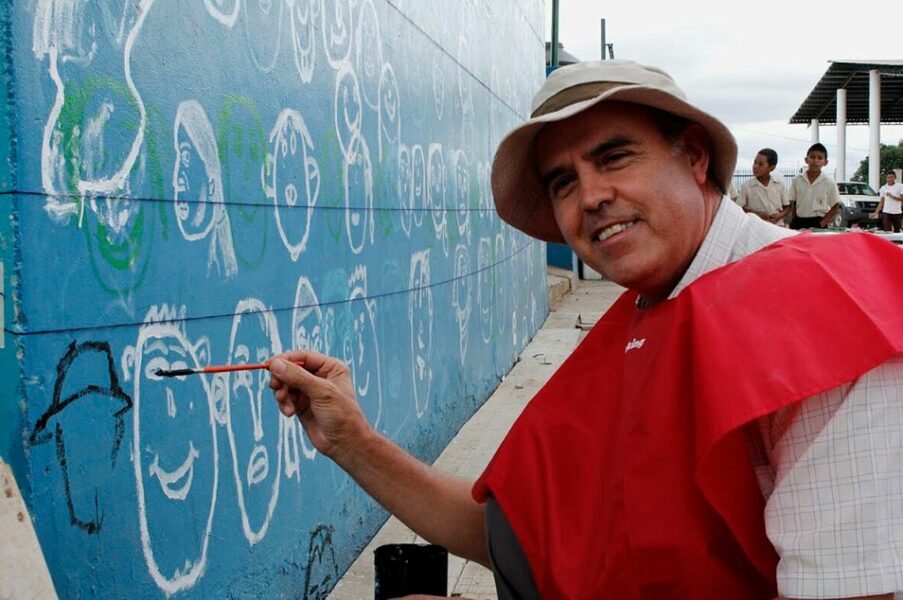
Pope Leo XIV has appointed Spanish priest Patricio Larrosa Martos, from the clergy of Guadix and Fidei Donum missionary in the Central American country since 1992, as bishop of Danlí, in Honduras. Until now, he served as vicar general of the Archdiocese of Tegucigalpa.
The Holy See made the appointment public on May 15. Larrosa arrives at the episcopate with a very defined profile: more than a desk theologian or a curia man, he is known for having built over more than three decades a wide educational and welfare network in Honduras through ACOES, the Collaboration and Effort Association.
A priest from Guadix established in Honduras since 1992
Patricio Larrosa was born on January 21, 1960, in Huéneja, in the Diocese of Guadix. He studied Philosophy and Theology at the San Torcuato Major Seminary of Guadix and at the Faculty of Theology of Granada.
He was ordained a priest on July 6, 1985, and was incardinated in the Diocese of Guadix. During his first years, he was parish priest in Villanueva de las Torres, Dehesas de Guadix, and Alicún de Ortega.
In 1992, he was sent to Honduras as a Fidei Donum priest. Since then, he has developed practically his entire priestly life there, especially in popular areas of Tegucigalpa marked by poverty, violence, and social exclusion.
ACOES, the work that defines his public profile
Larrosa’s name is linked to ACOES, a network of educational, health, food, and social projects born in Honduras around his missionary work. The organization began by helping young people without resources so they could study and ended up becoming a structure with a presence in poor neighborhoods, rural communities, and support networks from Spain.
ACOES supports schools, scholarships, dining halls, student residences, child centers, health projects, and training programs. Its own public figures speak of thousands of children and young people accompanied each year, although the data vary according to sources and periods considered.
The network linked to ACOES also includes associations and delegations in Spain, an officially registered foundation, and a collaboration network with entities such as Manos Unidas, universities, health foundations, and public administrations.
Awarded by Felipe VI for his humanitarian work
One of the most relevant recognitions of his work came in 2020, when ACOES received the King of Spain Human Rights Award, granted by the Ombudsman and the University of Alcalá.
The award was presented by Felipe VI and recognized the work developed by the organization in favor of education, social assistance, and the promotion of vulnerable people in Honduras.
Larrosa has also received recognitions in Honduras and has been presented in various media and institutions as a reference for social and educational work in the country.
A more social than doctrinal profile
The new bishop of Danlí has a trajectory marked mainly by popular education, human promotion, community organization, and volunteering.
In his public interventions, he insists that education must serve to form people capable of working, organizing, and helping others. His usual language revolves around poverty, youth, disability, social peace, and community responsibility.
The Diocese of Danlí
The Diocese of Danlí was created in 2017 with territory detached from the Archdiocese of Tegucigalpa. According to the Diocese of Guadix, it has eleven parishes and a population of more than half a million inhabitants.
Larrosa will be the second bishop of this particular Honduran Church. His appointment places at the head of Danlí a priest with strong local roots and a wide social network.