


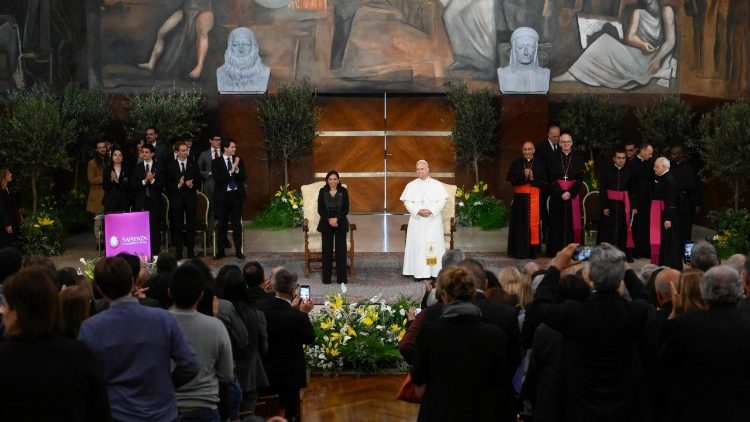
Pope Leo XIV made a pastoral visit this Thursday to the University of La Sapienza in Rome, where he delivered a lengthy speech addressed to students and professors in which he addressed issues such as war, European rearmament, the spiritual crisis of young people, artificial intelligence, and the educational mission of universities.
During his intervention in the Aula Magna of the historic Roman university center, the Pontiff launched an explicit criticism of the increase in military spending in Europe and called for building an “unarmed and disarming peace.”
“Do not call ‘defense’ a rearmament that increases tensions and insecurity, impoverishes investments in education and health, undermines trust in diplomacy, and enriches elites to whom the common good means nothing,” affirmed Leo XIV.
First pastoral visit to the great Roman university
The Holy Father arrived at La Sapienza at 10:20 a.m. and was received by rector Antonella Polimeni, Cardinal Baldo Reina—Vicar General of Rome—and university officials.
The visit began with a moment of prayer in the university chapel “Divina Sapienza,” where the Pope explained that he had wanted to start his tour there because every authentic search for truth ends up finding God.
“Whoever seeks, whoever studies, whoever seeks the truth, in the end seeks God,” said the Pontiff to students and professors.
Later, Leo XIV toured the university campus, greeted students and academic authorities, and visited the exhibition La Sapienza and the Papacy before the main meeting held in the Aula Magna.
The malaise of young people and the “dictatorship of performance”
The Pope reflected on the existential crisis that many young people are going through and denounced the pressure of a system that reduces people to numbers and results.
“Today this depends more and more on the blackmail of expectations and the pressure of performance,” he affirmed.
Leo XIV warned against a culture dominated by extreme competitiveness and anxiety, emphasizing that “we are not an algorithm” nor “the sum of what we possess.”
“We are a desire, not an algorithm,” the Pope insisted.
The Pontiff also encouraged university students not to resign themselves to the difficulties of the current world and invited them to transform their unease into a force capable of generating hope and social renewal.
War, artificial intelligence, and international crisis
The Pope devoted a significant part of his intervention to the international situation and the impact of new technologies on armed conflicts. He explicitly mentioned the wars in Ukraine, Gaza, Lebanon, and Iran as examples of a “spiral of annihilation” aggravated by the use of new military technologies.
In addition, he called for monitoring the development of artificial intelligence in both civil and military spheres to avoid dehumanizing human decisions or irresponsibly delegating them to technological systems.
“It is necessary to monitor the development and application of artificial intelligences in the military and civil spheres so that they do not irresponsibly shift human decisions,” he stated.
Defense of integral ecology and education
In continuity with the encyclical Laudato si’ of Francis, Leo XIV also addressed the ecological issue and lamented that the global climate situation has not improved significantly in the last decade.
The Pope encouraged young people to commit to justice, the care of creation, and the building of a culture of peace.
Addressing university professors, the Pontiff also defined teaching as “a form of charity” and asked educators to truly believe in their students and to form not only competent professionals, but also people with moral conscience and a sense of justice.
“Be builders of peace”
Before leaving La Sapienza and returning to the Vatican, Leo XIV addressed a brief final greeting to the students from the rectory steps, where he again insisted on the need to work for peace.
“Let us collaborate together, let us all be builders of peace in the world,” the Pope exhorted.