


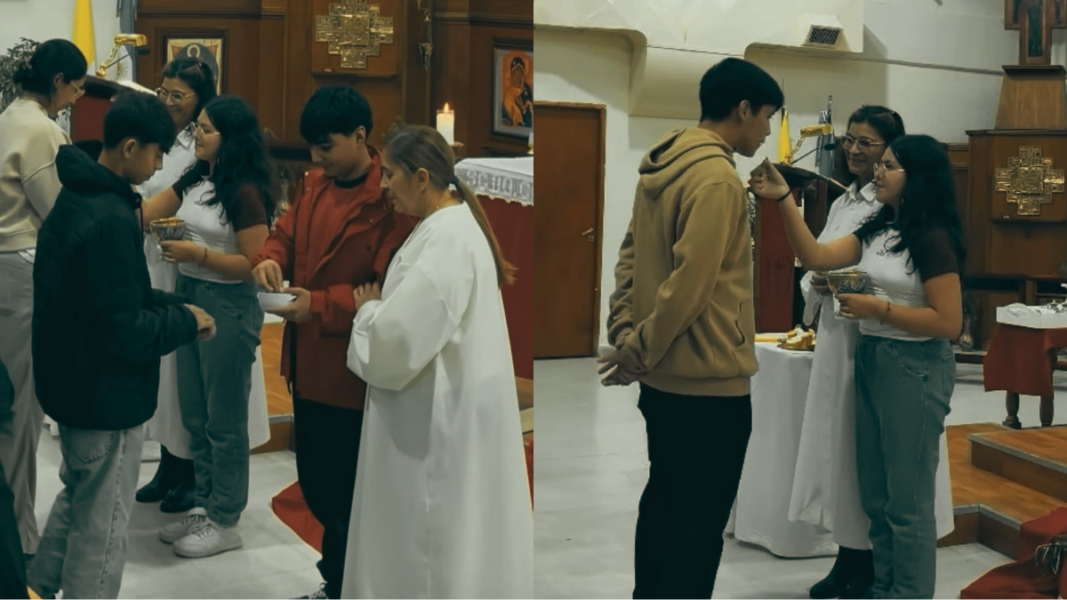
The dissemination of images taken during the Palm Sunday Mass at the Sagrado Corazón de Jesús parish in Río Grande, in Tierra del Fuego (Argentina), has sparked strong controversy after several teenagers were seen distributing communion to the faithful using plastic containers to hold the consecrated hosts.
The photographs show young people distributing the Eucharist during the parish celebration of the last Palm Sunday, showing a worrying banalization of the sacrament of the Eucharist and a loss of the sense of the sacred within the Holy Mass.
Criticism for the Treatment Given to the Eucharist
One of the most questioned aspects has been the use of plastic containers to hold the consecrated hosts, in addition to the participation of minors in the distribution of communion.
Scenes of this type are difficult to reconcile with the Church’s faith in the Real Presence of Christ in the Eucharist and convey a desacralized vision of the sacrament.
The ordinary distribution of communion corresponds to priests and deacons, while extraordinary ministers of the Eucharist can only act in specific circumstances provided for by liturgical norms.
Silence from Ecclesiastical Authorities
The events occurred in a parish belonging to the Diocese of Río Gallegos, headed by Monsignor Ignacio Medina, and to date, no public pronouncements or eventual disciplinary measures related to the episode are known.
The absence of official explanations has increased the discomfort of numerous faithful, who lament what they consider a growing tolerance toward liturgical practices far removed from the Church’s tradition.
A Liturgical Debate That Is Increasingly Intense
The case also occurs in a context of growing discussion within the Argentine Church about norms related to the reception of communion and respect for liturgical provisions.
In recent months, controversies have arisen in various Argentine dioceses regarding restrictions on the manner of receiving the Eucharist, especially in relation to communion on the tongue.
According to various reports disseminated in Argentine Catholic media, officials from the Dicastery for Divine Worship have recently reminded some bishops in the country that the faithful have the right to receive communion according to the forms recognized by the Church and that this freedom cannot be arbitrarily restricted.
Concern for the Loss of the Sense of the Sacred
Beyond the specific case of Río Grande, the controversy has once again brought to the table the debate on the way liturgy is celebrated in certain parishes and on the respect due to the Eucharist.
Many faithful consider that situations like this are the consequence of years of liturgical improvisation and a progressive loss of reverence toward the Most Holy Sacrament.
The episode has also reopened discussions on the limits of certain pastoral practices and on the need to recover greater solemnity and care in everything related to the celebration of Mass and the distribution of communion.