


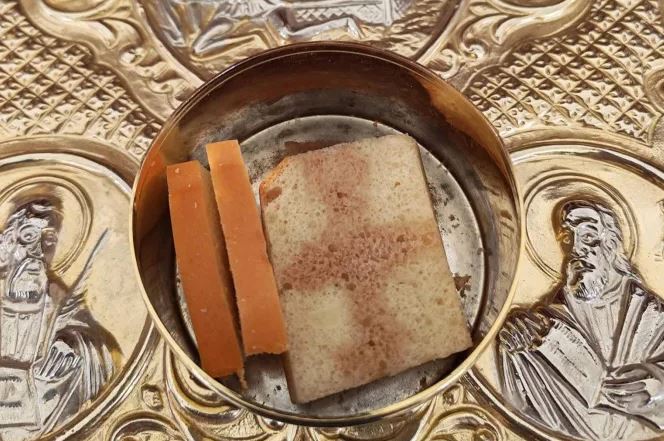
In the midst of the devastation caused by the war in southern Lebanon, a small Greek-Catholic Melkite church in the town of Tibnin became a symbol of hope for Christians in the region. Priest Marios Khairallah assured that he found the consecrated Eucharistic bread intact after 47 days of the temple’s abandonment due to the bombings.
Khairallah explained to ACI MENA—the Arabic agency of EWTN News—that the Eucharistic bread remained unaltered despite the church being closed and without human presence for 47 days.
“After 47 days, there is no scientific explanation for why the bread did not spoil,” the priest stated. However, he recalled that for Eastern Catholics, this is not interpreted simply as an extraordinary fact, but from the faith in the real presence of Christ in the Eucharist.
Unlike the Latin tradition, in the Greek-Catholic Melkite Church the consecrated bread is prepared with leaven, following the Byzantine tradition. Therefore, the fact that it remained intact for weeks in extreme conditions was received by many faithful as a providential sign.
The priest described the episode as “a message of hope for the parish,” especially in a region marked by fear, forced displacement, and material destruction.
The image of the Virgin remained standing
Another element that impacted the inhabitants of Tibnin was that an image of the Virgin Mary remained intact amid the rubble of the temple and the damaged buildings.
Khairallah described the scene as that of “a mother waiting for her children,” in reference to the numerous neighbors who still had not been able to return definitively to their homes.
The war forced around 55 Melkite Catholic families to abandon the town. Many of them continued living temporarily with relatives, friends, or in schools and monasteries adapted as improvised shelters.
Without water, electricity, or sufficient aid
The priest also denounced the critical situation that Tibnin was going through. As he explained, the town was practically without basic services: there was no running water, electricity, or internet connection, while low temperatures further aggravated living conditions.
Khairallah also pointed out that the humanitarian aid received up to that point had been very limited. The main assistance came through a papal mission and some private initiatives related to medicines and basic products.
The priest especially praised the role of the apostolic nuncio in Lebanon, Archbishop Paolo Borgia, whom he defined as “a true shepherd and father” for visiting the affected areas even during the bombings.
A sign for Christians in southern Lebanon
The situation of Christians in southern Lebanon remains especially delicate. The majority of Tibnin’s inhabitants belong to working classes: farmers, teachers, retirees, and military personnel, without sufficient resources to face the consequences of the war and the economic crisis
In that context, the discovery inside St. George’s church was interpreted by many faithful not only as an extraordinary fact, but also as a spiritual reminder amid uncertainty and destruction.