


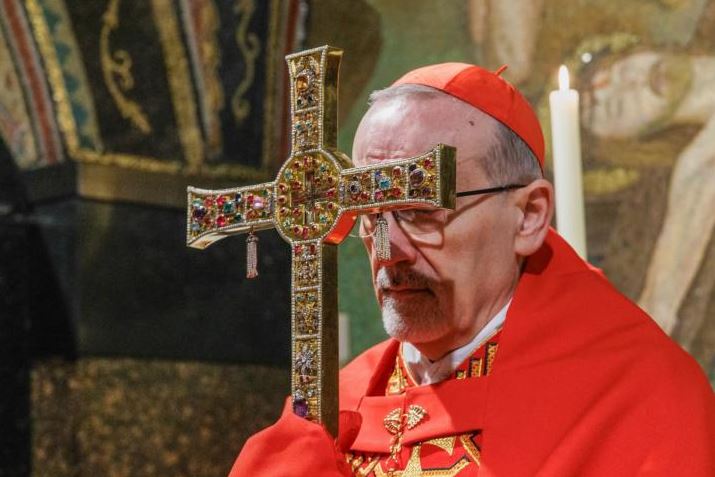
The Church of Jerusalem celebrated the traditional feast of the Finding of the Holy Cross on May 7 in the Basilica of the Holy Sepulchre, recovering this year much of the liturgical solemnity that had been limited in recent months due to the conflict that began on February 28 in the Holy Land.
According to the Custodia of the Holy Land, the celebrations were able to take place again with greater normality and with all the liturgical honors provided for this solemnity.
The feast, traditionally known as Inventio Crucis or Finding of the True Cross, commemorates the discovery of Christ’s cross by Saint Helena, mother of Emperor Constantine, in the 4th century. According to Christian tradition, the finding took place near Calvary, in the place where the chapel of Saint Helena is now located within the Basilica of the Holy Sepulchre.
A tradition that Jerusalem preserves on its original date
Although the liturgical reform after 1969 removed this celebration from the universal calendar on its traditional date, the Church of Jerusalem continues to celebrate it every May 7 due to its close connection with the places of Christ’s Passion, death, and Resurrection.
The celebration began in the afternoon of the previous day with a solemn procession of Franciscan friars through the interior of the basilica, which is still affected by restoration and renovation works on the pavement.
The procession proceeded to the chapel of Saint Helena, the place traditionally associated with the finding of the Cross, where solemn Vespers were sung.
Subsequently, the religious continued in procession to Calvary and the Holy Sepulchre, symbolically uniting the memory of the finding of the Cross with the central places of Christ’s Passion and Resurrection.
The Custos of the Holy Land presided over the solemn Mass
The Custos of the Holy Land, Friar Francesco Ielpo, presided over the solemn Mass in the Holy Sepulchre. In his homily, he reflected on the passage from the Book of Numbers that recounts the salvation of the people of Israel by gazing upon the serpent raised by Moses in the desert.
Friar Ielpo explained that, “every time our projects stray from God’s promises,” human obstinacy itself ends up “poisoning the heart.” In the face of this, he recalled that only by turning one’s gaze toward the crucified Christ can man find “salvation and full life in his merciful love”.
Triple blessing with the relic of the Holy Cross
At the end of the Eucharist, a solemn procession took place around the tomb of Christ. During the procession, religious and faithful knelt on three occasions before the relic of the Holy Cross to receive the blessing imparted by the Custos of the Holy Land.
The blessings were performed in front of the Holy Sepulchre, before the altar of Saint Mary Magdalene, and in the chapel of the Most Holy Sacrament of the Franciscan friars.
The Custodia of the Holy Land emphasized that this solemnity is not merely a historical remembrance of the discovery of a relic, but an invitation to contemplate the mystery of the Cross as a source of hope, conversion, and salvation for Christians.