


Pope Leo XIV continued his pastoral visit to the Campania region this Friday with an intense day in Naples, where he held a meeting with priests, religious, and consecrated persons in the city’s cathedral. The Pontiff’s visit—carried out precisely on the first anniversary of his election as Pope—was marked by a strong message on the need to care for the spiritual life of the clergy, combat priestly loneliness, and overcome a merely “preservationist” pastoral approach to recover the Church’s evangelizing impulse.
The Pope described the fatigue, isolation, and inner weariness that many priests suffer today, especially in difficult social contexts like the Neapolitan one, marked by poverty, violence, and youth disorientation. In response, Leo XIV insisted on prayer, priestly fraternity, and pastoral closeness as essential elements to prevent the ministry from being reduced to a bureaucratic or purely organizational function.
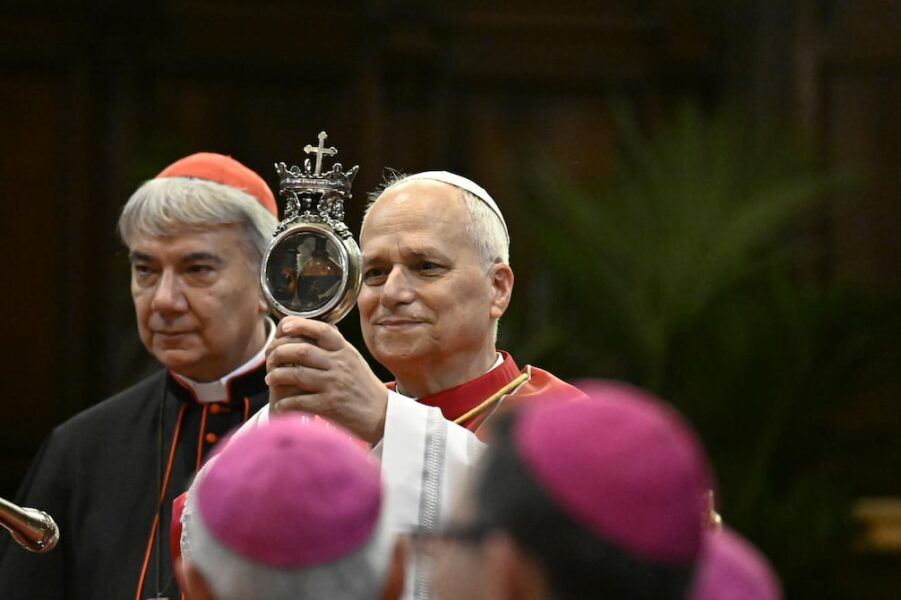
The visit was also accompanied by a particularly significant event for Neapolitan popular religiosity. Although not directly linked to the Pontiff’s presence, the blood of San Gennaro—patron of Naples—liquefied again in the Neapolitan Duomo before Leo XIV’s arrival at the cathedral.
According to the Italian newspaper Il Mattino, when the Pope arrived at the Duomo, the relic was already in a liquid state, and Abbot Vincenzo De Gregorio showed the vial to the faithful present amid scenes of enthusiasm and popular emotion. The newspaper also specified that the phenomenon had already occurred days earlier, specifically last Saturday, although the relic was likewise presented to the Pontiff during the day.
Below is the speech of Leo XIV to the clergy, religious, and religious sisters of Naples:
Brothers and sisters, thank you for your warm welcome!
This embrace from this square is a bit like the colonnade of St. Peter’s in Rome: you know how to welcome with this warmth! Thank you very much!
I thank the mayor for the words he addressed to me, I greet all the civil and military authorities present, and I renew my gratitude to His Eminence the archbishop and to all of you who have gathered here.
Against the background of the Gospel scene of the disciples of Emmaus, some voices have alternated that have introduced us to this beautiful encounter of ours. They are the voices of Naples, pearl of the Mediterranean contemplated from on high by Vesuvius; voices in which the ancient beauty of this city bathed by the sea and kissed by the sun resounds, and in which wounds, poverty, and fears also find space. These voices speak of a Naples that often walks tired, disoriented, and disappointed, like the two disciples of the Gospel, and that needs that closeness that Jesus offered them; voices of a people that, even today, feels the need to stop and ask: what is it that truly matters?
Brothers and sisters, in this city there runs a longing for life, for justice, and for good that cannot be crushed by evil, discouragement, or resignation. That is why it is necessary that—we not alone, but together—we ask ourselves: what is it that truly matters? What is necessary and important to resume the journey with the impulse of commitment and not with the fatigue of indifference; with the courage of good and not with the fear of evil; with the care of wounds and not with indifference?
Naples today lives a dramatic paradox: the remarkable growth of tourism struggles to correspond to an economic dynamism capable of truly involving the entire social community. The city remains marked by a social gap that no longer separates only the center from the peripheries, but even appears within each area, with existential peripheries hidden also in the heart of the historic center. In many areas, a true geography of inequality and poverty is perceived, fed by long-unresolved problems: income inequality, scarce job prospects, lack of adequate structures and services, the invasive action of criminality, the drama of unemployment, school dropout, and other situations that make life heavier for many people.
Faced with these realities, which sometimes take on worrying dimensions, the presence and action of the State are more necessary than ever to offer security and confidence to citizens and to take space away from organized crime.
In this context, many Neapolitans cultivate the desire for a city rescued from evil and healed of its wounds. Often, these are true social heroes, women and men who dedicate themselves every day with commitment, sometimes simply by faithfully fulfilling their duty, without appearing, so that justice, truth, and beauty may open paths in the streets, institutions, and human relationships.
These people must not remain isolated, and for their commitment to permeate the deep fabric of the city, it is necessary to create connections, work in networks, and build community.
I am pleased to be able to say that the Church in Naples is a “glue” that contributes significantly to this networking, keeping individual efforts united and connecting energies, talents, and aspirations of many. It has done so by promoting an Educational Pact that has found a generous response in institutions—the City Hall, the Region, the Government—and also in numerous ecclesial realities and from the third sector.
For this reason, I would like to make an appeal to all of you: may this network that unites you not break, may this light that you have begun to kindle in the midst of darkness not go out, may this dream that you are realizing for a better and more beautiful Naples not lose its color!
Continue with this Pact, unite forces, work together, walk united—institutions, Church, and civil society—to lift up the city, protect your children from the threats of marginalization and evil, and restore to Naples its vocation to be the capital of humanity and hope.
I also wish to recall the path undertaken by this city to rediscover its millennial vocation: to be a natural bridge between the shores of the Mediterranean. Naples must not remain as a mere “postcard” for visitors, but become an open workshop where concrete peace is built, visible in the daily life of people.
Peace is born in the heart of man, passes through relationships, takes root in neighborhoods and peripheries, and expands to embrace the entire city and the world. That is why we feel an urgent need to work, first of all, within the city itself. Here, peace is built by promoting a culture alternative to violence through everyday gestures, educational processes, and concrete decisions of justice.
We know, in fact, that there is no peace without justice and that justice, to be authentic, can never be separated from charity. From this perspective, experiences like the House of Peace, which welcomes children and mothers in difficulty, and Casa Bartimeo, a place of accompaniment for young people and adults in situations of fragility, are born and develop: concrete signs of a peace that becomes welcome, care, and possibility of reconstruction.
Moreover, together—the ecclesial community and the civil community—you are striving to turn Naples into a “platform” for intercultural and interreligious dialogue. Through congresses, international awards, and welcome projects, even for young people coming from conflict contexts—like Gaza—you can continue to give voice, from below, to a culture of peace, opposing the logic of confrontation and the force of arms as a supposed solution to conflicts.
In this sense, Naples continues to show its deepest heart in the welcome of immigrants and refugees, lived not as an emergency but as an opportunity for encounter and mutual enrichment. And this is possible above all thanks to the work of the diocesan Caritas, which has also transformed the port of Naples from a simple place of arrival into a living sign of welcome, integration, and hope.
Brothers and sisters, Naples needs this impulse, this overflowing energy of good, this evangelical courage that makes us capable of renewing all things. May it be a commitment of all: take it on and carry it forward together!
Do it especially with the young people, who are not only recipients but protagonists of change. It is not just a matter of involving them, but of recognizing space, trust, and responsibility for them so that they can contribute creatively to the building of the good.
In a reality often marked by distrust and lack of opportunities, young people represent a living and surprising resource. This is demonstrated by the experience of the Museo Diocesano Difuso, where many of them commit themselves to safeguarding and transmitting the cultural and spiritual heritage of the city with new and accessible languages.
It is also demonstrated by the young people who, in the oratories, dedicate themselves with passion to the education of the little ones, becoming credible points of reference and witnesses of healthy relationships. And it is equally shown by the numerous volunteers who give themselves in works of charity, social initiatives, and accompaniment of vulnerable people.
These experiences are not marginal: they are already concrete signs of a young Church and of a city that can regenerate itself. I am sure that you will not fail to continue cultivating them with courage, passion, and enthusiasm, traits that distinguish you.
I thank you, dear brothers and sisters, for your welcome and I entrust you all to the intercession of the Most Holy Virgin Mary and of San Gennaro. May the Lord keep you always faithful to the Gospel and bless the city of Naples!
Final greeting from Pope Leo XIV before leaving Piazza del Plebiscito:
So, before we go, let us thank the choir and all the musicians of this evening. Thank you! And thanks also to all the sick who have accompanied us this evening: a special blessing for you! Thank you, thank you… Thank you to everyone and long live Naples!