


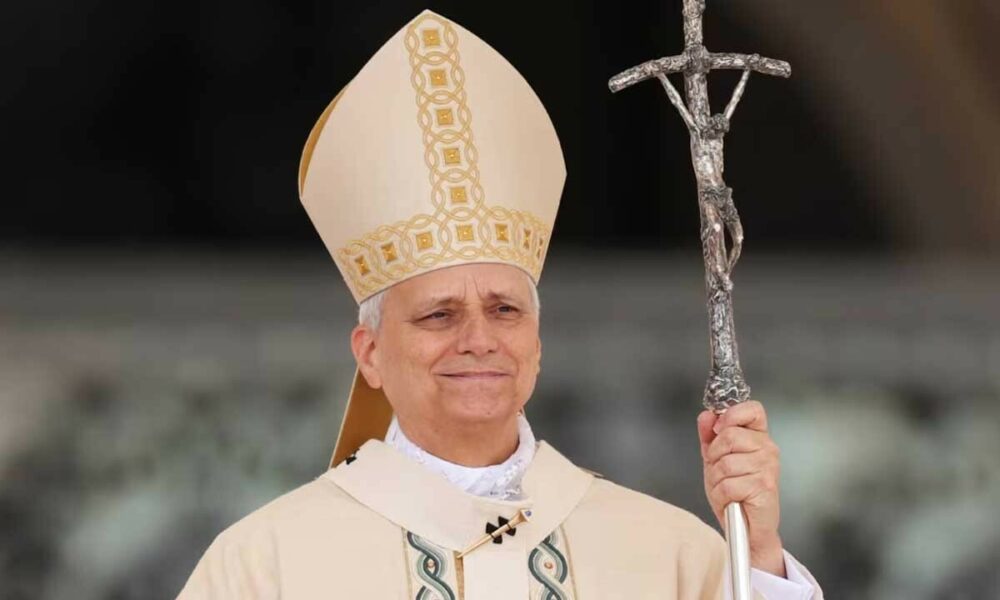
Pope Leo XIV presided this Friday in Pompeii over the traditional celebration of the Supplication to the Virgin of the Rosary in a day loaded with spiritual symbolism and marked by a strong message about the need to recover prayer, the Eucharist, and interior life amid a world increasingly battered by wars, secularization, and the loss of faith.
The visit also coincided with the first anniversary of his election as Successor of Peter, a circumstance that the Pontiff himself wished to emphasize during the homily. “Exactly one year ago, the ministry of Peter was entrusted to me precisely on the day of the Supplication to the Virgin of Pompeii,” recalled Leo XIV, thus linking the beginning of his pontificate to the protection of the Virgin of the Rosary.
Before the Mass, the Pope venerated the relics of Saint Bartolo Longo—the founder of the Sanctuary and recently canonized by him—and greeted priests, bishops, the sick, and people with disabilities present at the event.
The Rosary as a response to a society that is losing faith
The homily was deeply focused on the value of the Rosary, presented by the Pope as a prayer capable of restoring to contemporary man the sense of God and salvation.
Leo XIV recalled the words spoken by Saint John Paul II in Pompeii more than twenty years ago, when he already warned of a society “that moves away from Christian values and even loses its memory.” The Pontiff took up that idea to describe a crisis that he considers even more evident today.
In the face of that scenario, the Pope defended the Rosary not as a secondary or sentimental devotion, but as an authentic synthesis of the Gospel and Christian life. Citing Bartolo Longo and Saint John Paul II, he insisted that this prayer possesses “a Christological and Eucharistic heart” and continually leads the believer toward Christ.
At a time when much of Catholic pastoral care seems to have relegated traditional forms of popular piety, the words of Leo XIV sounded like an explicit vindication of classical Marian spirituality and the centrality of contemplation in the life of the Church.
The Eucharist and supernatural life at the center
The Pontiff also wished to emphasize that true Christian renewal does not arise primarily from human strategies or social projects, but from grace and supernatural life.
“The world will not be saved by any earthly power,” he affirmed during one of the strongest moments of the homily, insisting that only “the divine power of love” can truly transform history.
The phrase did not go unnoticed in an international context marked by wars in the Middle East, Ukraine, and other regions of the world, as well as by the growing sense of global instability.
Leo XIV once again asked for prayers for peace and implicitly criticized an international logic dominated by the arms trade and power interests. However, unlike other more diplomatic speeches habitual in the Vatican, the Pope placed the problem above all on the spiritual plane: peace is born first in the heart of man reconciled with God.
That deeply supernatural tone ran through the entire celebration. The insistence on the Eucharist, the contemplation of the mysteries of Christ, and the centrality of grace marked a homily very different from the predominantly sociological language that has characterized numerous ecclesial discourses in recent years.
Bartolo Longo and the union between faith and charity
The figure of Saint Bartolo Longo also occupied a central place during the day. Leo XIV recalled how the founder of Pompeii transformed a land marked by poverty and abandonment through an inseparable combination of prayer, Marian devotion, and concrete charity toward the most needy.
The Pope especially highlighted the attention that Bartolo Longo devoted to orphans and children of prisoners, underscoring that authentic Christian charity always arises from faith and union with Christ.
The message seemed to respond indirectly to one of the tensions present today within the Church: the risk of reducing Christianity to a mere humanitarian discourse detached from its supernatural dimension.
For Leo XIV, charity cannot be separated from prayer or from the truth of the Gospel. That is why he insisted that the Rosary is not a practice of the past, but a living source of spiritual—and also social—transformation.
Pompeii as a symbol of the new pontificate
The choice of Pompeii for one of the first major celebrations of the pontificate also confirms some of the lines that are beginning to define Leo XIV: a recovery of classical spiritual language, a special sensitivity toward popular religiosity, and an effort to restore centrality to prayer and the sacraments.
From Pompeii, Leo XIV thus launched a message that goes beyond a simple Marian devotion: he recalled that the crisis of the modern world will not be resolved solely with structures, consensuses, or human projects, but by returning to Christ through prayer, conversion, and a life of grace.