


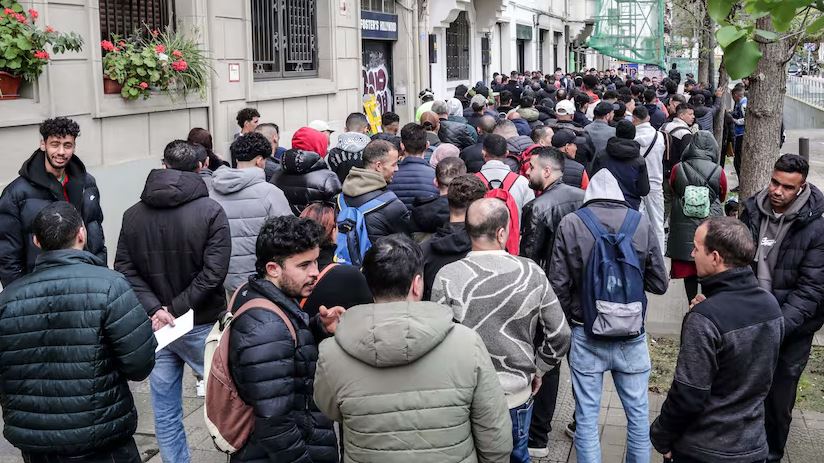
The headquarters of the Spanish Episcopal Conference hosted this week the presentation of a joint report from various Christian denominations that claims the role of churches in welcoming immigrants and calls for addressing the migratory phenomenon from a “prejudice-free” perspective.
The document, promoted by the Interfaith Dialogue Table of Spain, was presented by the president of the Episcopal Conference, Monsignor Luis Argüello; the president of the Table and executive secretary of FEREDE, Carolina Bueno Calvo; and the Romanian Orthodox bishop Timotei Lauran. The text brings together Catholic, Evangelical, Orthodox, and Anglican representatives under a single idea: defending the welcome of immigrant people from the Christian commitment.
The phrase chosen as the axis of the report—“I was a stranger and you welcomed me”—summarizes the general tone of the document. Its authors argue that attention to immigrants does not respond to an ideological or political issue, but to an evangelical demand directly linked to the Christian mandate of hospitality.
The Church calls for prudence in language on immigration
Throughout the report, the signing denominations warn about the risk of dehumanizing the migration debate and demand prudence in the language used on immigration. The text warns that words “can build bridges or raise walls” and calls for avoiding approaches that foster prejudices or stigmatizations toward immigrants, a commitment that seeks to strengthen welcome, direct assistance, and integration policies, insisting that many Christian communities have been working for decades where public institutions do not always reach.
More than 22,000 parishes involved in migrant care
The Catholic Church underscores in the document the extensive welfare deployment it maintains in Spain through parishes, congregations, schools, healthcare centers, and social entities.
According to the data collected, more than 22,900 parishes participate in some way in primary care tasks, human support, or integration of immigrants and refugees. This is added to by thousands of religious communities, educational centers, hospitals, and care centers spread throughout Spain.
The report also highlights the 484 migration-related projects launched during 2024 in various Spanish dioceses: from social dining rooms and legal advice to job insertion programs, welcome for vulnerable women, or care for immigrant minors.
In addition, the Episcopal Conference emphasized initiatives such as the “Hospitality Corridors” between the Canary Islands and the Peninsula or the programs promoted to connect immigrant families with towns affected by depopulation.
A discourse that generates debate inside and outside the Church
The text presented by the Interfaith Dialogue Table reflects a line increasingly present in a large part of the European episcopate: insisting on welcome, integration, and the defense of immigrants, often leaving aside the primacy of the common good, good cultural integration, public order, or the right of nations to control their borders.
Immigration is one of the great fractures of the West, and the Church cannot forget that Christian charity cannot be separated from prudence, order, and responsibility toward the common good. The Church’s social doctrine has historically defended both principles: the dignity of every migrant person and the legitimate right of States to regulate migratory flows in a prudent and orderly manner.