


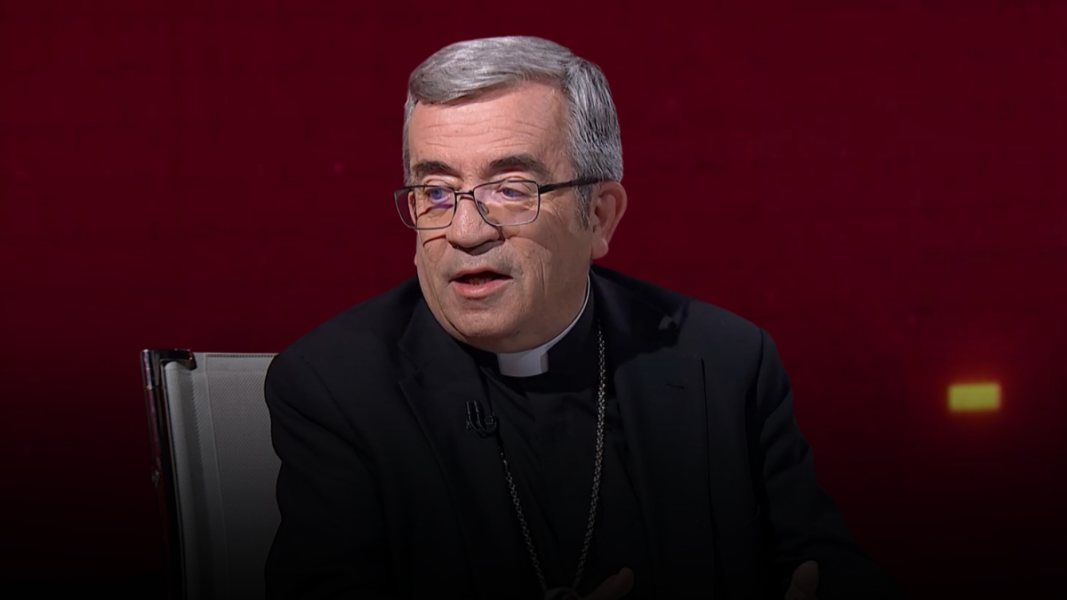
The president of the Spanish Episcopal Conference (CEE), Monsignor Luis Argüello, assured this Wednesday that the upcoming visit of Pope Leo XIV to Spain will mean “a boost” for the Church and an opportunity to strengthen dialogue and trust in Spanish society.
During an extensive interview on the program La Noche en 24 Horas on RTVE, the same day that the complete itinerary of the apostolic journey was made public, Argüello linked the Pontiff’s visit to the current social, political, and spiritual context facing Spain and Europe.
“It will constitute an event that for the life of the Church will mean a boost,” affirmed the Archbishop of Valladolid.
A visit marked by secularization and the search for spirituality
Argüello acknowledged that the Church currently faces important challenges in an increasingly secularized society, although he noted that at the same time a renewed spiritual interest is perceived, especially among young people and adults.
As he explained, Spanish dioceses are observing an increase in adult baptisms, confirmations, and processes of approaching the faith.
“Yes, it can be said that Spanish society appreciates a special search,” he assured.
The president of the CEE indicated that Leo XIV’s visit can serve to offer responses to that spiritual unease and to publicly present “the sources from which the Church draws.”
He also recalled that there has been a strong desire for years for a new papal visit to Spain, especially after Francis was unable to make the planned trip to the Canary Islands due to health reasons.
Leo XIV will speak before the Congress of Deputies
One of the central moments of the trip will be the Pope’s address before the Cortes Generales, an event that Argüello described as especially significant.
The president of the Spanish bishops highlighted that both the Congress and the Senate unanimously approved the invitation to the Pontiff and emphasized the role that Leo XIV is acquiring on the international stage.
“The Pope appears as a moral authority and as a leader in favor of peace,” he affirmed.
Argüello also defended the fact that Western democracies are going through a crisis of ethical foundations and argued that the Pope’s presence can help introduce into the public debate issues related to the common good, human dignity, and the search for social agreements.
Canary Islands and the migratory focus of the trip
The migration issue will occupy a central place in the papal visit, especially during the stage planned in the Canary Islands.
Argüello explained that the Pontiff wants to focus on both the reception of immigrants and the root causes that provoke migratory movements from Africa to Europe.
“It is not just about reception, but also about the right not to have to leave one’s own country to be able to live,” he summarized.
The archbishop also pointed out that behind the migration crisis there are complex economic and demographic factors, including international inequalities and the need for labor in Europe.
Response to Vox’s criticisms
During the interview, Argüello was asked about Vox’s criticisms of the Episcopal Conference and Caritas for their support of the extraordinary regularization of immigrants.
The president of the CEE described it as “offensive” to claim that the Church “makes business” with immigration and defended the welfare work carried out by Caritas and other ecclesial institutions.
He also insisted that the Church recognizes the right of States to regulate migratory flows, although he emphasized that human dignity constitutes a “red line” that cannot be ignored.
“The priority is that of the Gospel,” he affirmed.
Argüello also explained that Caritas carries out much of its work thanks to contributions from the faithful and defended the fact that the Church’s social organizations can also access public aid under mechanisms of control and transparency.
Expectation ahead of Leo XIV’s visit
During the conversation, the president of the Episcopal Conference also referred to other current issues, such as the possibility of private meetings between Leo XIV and victims of sexual abuse during the visit to Spain, the reparation system agreed between the Church and the Government, Donald Trump’s recent criticisms of the Pope, and the use of Christian references in certain political movements in the United States.
Argüello also spoke about the growing international prominence of Leo XIV, whom he described as a figure with great intellectual capacity, international experience, and sensitivity for dialogue in a world context marked by conflicts and geopolitical tensions.