


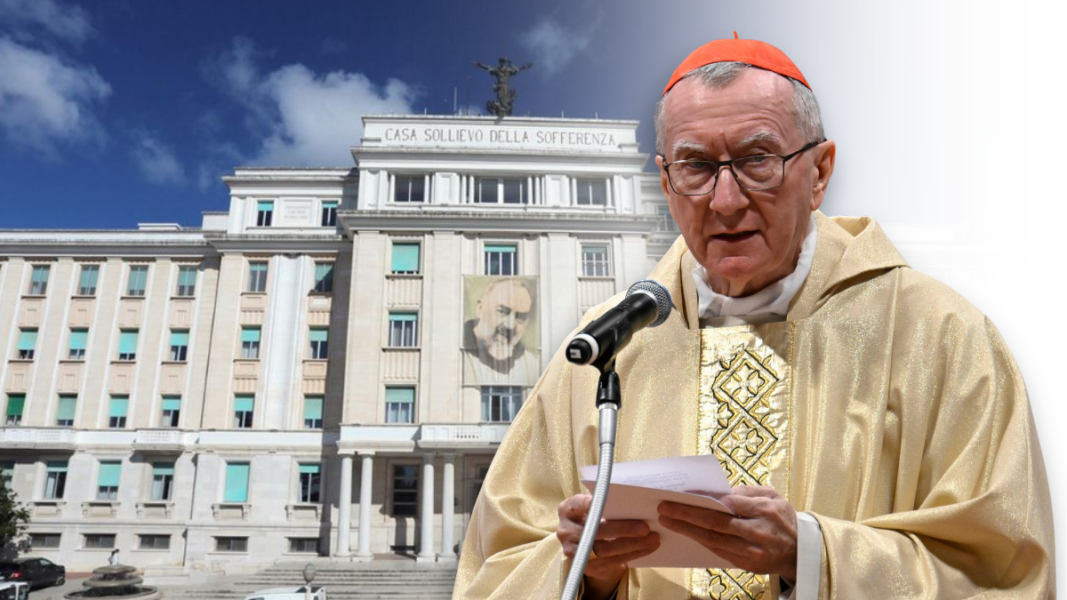
The Cardinal Secretary of State, Pietro Parolin, presided over the celebrations on May 5 for the 70th anniversary of the Casa Sollievo della Sofferenza, the hospital founded by Saint Pio of Pietrelcina in San Giovanni Rotondo, emphasizing that this work represents “an example of love that can be born from pain.”
More than a thousand faithful, priests, religious, and authorities participated in the celebration, held in the same place where the Capuchin saint delivered his inaugural speech on May 5, 1956, as reported by Vatican News.
A work born from suffering transformed into charity
In his homily, Parolin explained that the institution has its roots in the spiritual experience of Father Pio, who knew how to transform suffering into a concrete work of mercy. Quoting the Gospel—“Come to me, all you who are weary and burdened, and I will give you rest”—the cardinal stated that the Casa Sollievo is born “from the infinite tenderness of Christ,” welcomed in a singular way by the saint.
“From the mysterious experience of pain, a great love for the poor and those who suffer had to emerge,” noted the Secretary of State, highlighting that the hospital is the fruit of that spiritual intuition turned into service.
The love that relieves in the face of suffering
Parolin emphasized that, in the face of suffering—which “often generates disorientation, irritation, and dejection”—love has the capacity to uplift and offer consolation. For this reason, he recalled that the hospital remains today a place where “many people alleviate the suffering of others through medical care, care for the sick, and a high level of professional competence.”
The celebration included a procession with the relic of Father Pio to the hospital atrium, at the exact spot where the saint inaugurated the institution seven decades ago.
The support of Pope Leo XIV
During the ceremony, the cardinal also conveyed the support of Pope Leo XIV, who expressed his closeness to the work and to those who work in it. Parolin noted that the Pontiff “wishes to reaffirm his confidence in Father Pio’s work and in all those who work in it,” for the benefit of the thousands of patients treated each year.
Recalling words from Saint John Paul II, the Secretary of State highlighted that the “relief of suffering” synthesizes one of the essential dimensions of Christian charity, understood as a distinctive sign of Christ’s disciples.
From a charitable work to a reference hospital
Founded with 250 beds as a charitable work, the Casa Sollievo della Sofferenza has become one of Italy’s leading polyclinics. In 2025 alone, it recorded more than 35,000 hospital admissions and over 1.1 million outpatient services, in addition to an annual average of more than 30,000 surgical interventions.
The center employs more than 2,500 workers and conducts intensive research activity in fields such as neurology, oncology, and regenerative medicine. In recent years, it has been recognized among the world’s best hospitals and ranks among the country’s leading healthcare hubs.
“Advance with humility and the heart held high”
In the final part of his homily, Parolin recalled the words spoken by Father Pio at the hospital’s inauguration, inviting to continue his legacy: “Forward with humility of spirit and with the heart held high.”
The cardinal warned of the risk of fatigue after decades of work, but emphasized that the consolation promised by Christ remains necessary both for those who suffer and for those who care for them.
A mission that continues
The president of the institution, Father Franco Moscone, highlighted that the mission begun 70 years ago remains relevant, recalling that the sick must be welcomed as Hospes Christi, that is, as “Christ’s guest.”
“The prophecy of the Casa Sollievo has not ended; it still has many pages to write, many lives to care for, and many stories to tell,” he affirmed, underscoring the continuity of a work he defined as “God’s work destined to endure in time.”