


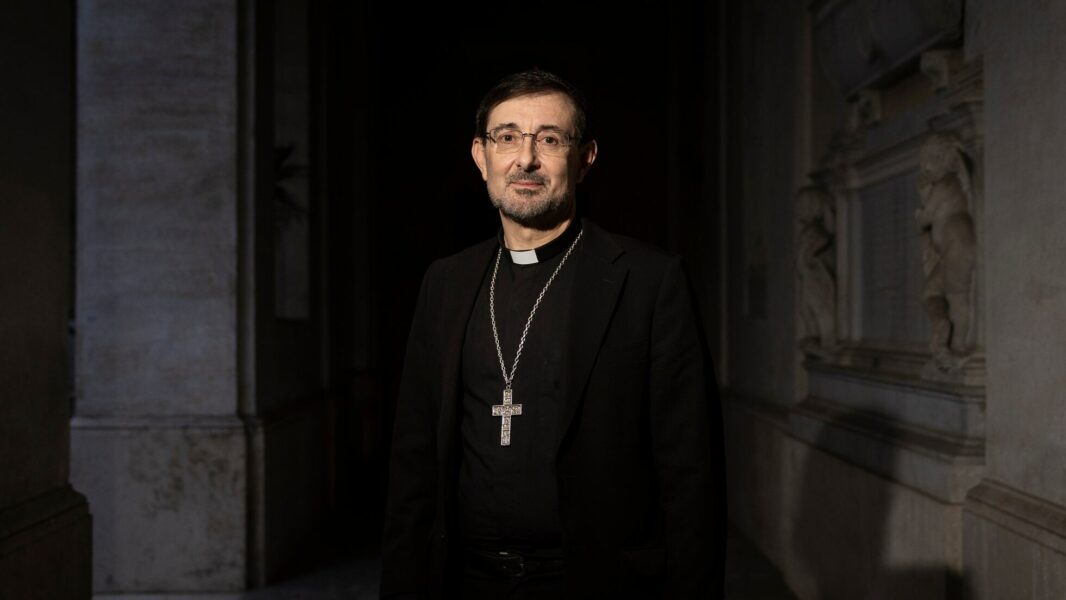
Nearly a dozen judicial appeals have challenged the agreements on the Valley of the Fallen signed in March 2025 by Cardinal José Cobo and the Government, questioning their validity for a central reason: the Archbishop of Madrid would not have legitimacy to sign them in a site that is not under his direct jurisdiction.
As revealed by Religión Confidencial, the appeals—already in judicial proceedings—coincide on a single thesis: the Valley constitutes a “exempt” and “sui iuris” abbey, which limits the Archbishop of Madrid’s capacity to sign an agreement that directly affects the basilica and the entire complex.
Among the appeals filed, those promoted by Abogados Cristianos and by an individual stand out, both focused on the lack of legitimacy of the signatory. To them is added the appeal filed by the Benedictine community of the Valley itself, which reinforces that same line of argument.
From administrative irregularities to legal challenge
The new appeals add to those already raised by several architects against the resignification contest, which denounced formal defects in the specifications and in 2025 achieved the precautionary suspension of the procedure.
However, the conflict has evolved. It no longer discusses only the legality of the administrative process, but the validity of the agreement that sustains it. The challenge now targets the origin: if the signer lacked competence, the entire subsequent development is compromised.
A documented and accepted agreement
The publication of the correspondence between Cardinal Cobo and Minister Félix Bolaños has confirmed that the agreement was formally assumed by both parties and set a framework for intervention in the basilica, including the delimitation of the space dedicated to worship and the opening of the rest to non-liturgical actions.
This point reinforces the scope of the now-challenged document: it is not a generic framework, but a specific agreement that directly affects the use of the temple.
No Vatican signature or institutional backing
In parallel, the Spanish Episcopal Conference has reiterated that the Vatican was not a signatory party to the agreement. This was confirmed by its spokesman, Monsignor Francisco César García Magán, who emphasized that no representative of the Holy See has signed the document.
Nor does the Episcopal Conference itself appear as a party to the agreement. The signature is limited to Cardinal Cobo, whose competence is precisely what is now being questioned in the courts.
Read also: Arguello accepts dividing the Valley of the Fallen with an “independent entrance”
A prior legal report sets clear limits
The documentation on which several of the appeals rely includes a report from the Episcopal Council on Legal Affairs of the Spanish Episcopal Conference, dated December 16, 2020, in which the legal implications of any intervention in the Valley were already analyzed.
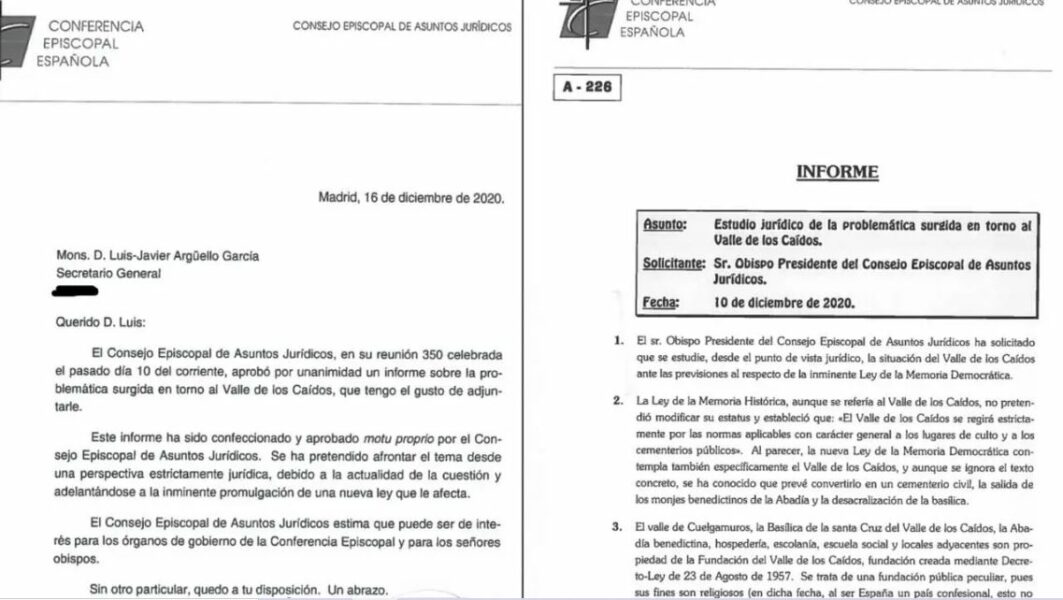
That report establishes that the basilica is a sacred and inviolable place, subject to ecclesiastical authority; the Benedictine abbey has its own legal personality, recognized civilly and canonically, and the presence of the monastic community is guaranteed in perpetuity by commitments assumed by the State.
The document also states that any eventual desacralization would require authorization from the Holy See and that conversion into a civil cemetery would imply prior requirements that exceed the decision-making capacity of political power.
The legal nature of the Valley, at the center of the conflict
The appeals coincide in emphasizing that the Cuelgamuros complex belongs to a public foundation with religious purposes and that its legal configuration prevents unilateral actions or agreements signed by authorities without direct competence.
In this framework, the status of “sui iuris” abbey is decisive: since it does not depend on the Archbishop of Madrid, any decision taken without the competent authority is legally compromised. Therefore, what has so far been presented as a political and ecclesiastical agreement must be subjected to judicial review.