


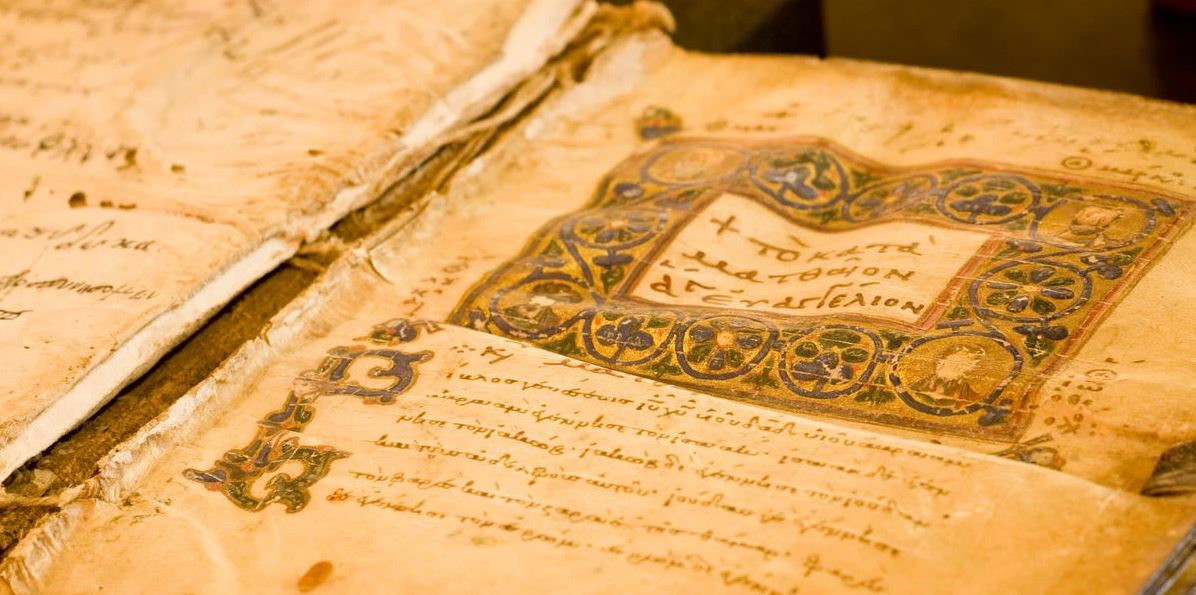
An international team of researchers has managed to reconstruct dozens of lost pages from one of the oldest manuscripts of the New Testament, offering new data on how early Christians read and transmitted the Scriptures.
The discovery, announced on April 28, 2026, by a team led by the University of Glasgow, has allowed the recovery of 42 missing pages from an ancient Greek codex containing the letters of the Apostle Saint Paul. The information was revealed by the research itself, which relies on cutting-edge technology applied to the study of ancient manuscripts.
The document in question is known as Codex H, also cataloged as GA 015, a 6th-century manuscript considered key to understanding the textual transmission of the New Testament.
A Dismembered and Reused Codex in the Middle Ages
The history of the manuscript partly explains its fragmentation. In the 13th century, in the monastery of the Great Laura of Mount Athos, the codex was dismantled. Its parchment pages were reused to bind other books, a common practice in an era when writing materials were scarce and expensive.
Over time, the surviving fragments became scattered in various European libraries, including those in Italy, Greece, Russia, Ukraine, and France, making their comprehensive study difficult.
Modern Technology to Recover Invisible Texts
The key to the reconstruction has been the use of multispectral imaging, a technology that allows detecting ink remnants invisible to the human eye. The researchers took advantage of a particular phenomenon: when rewriting the parchments in the Middle Ages, the new inks left chemical traces on the facing pages.
These so-called “ghost texts”, visible through different wavelengths—from ultraviolet to infrared—have allowed the recovery of passages that had remained hidden for centuries.
New Keys to the Transmission of the Scriptures
The reconstructed texts include known fragments from Saint Paul’s letters, but they also provide relevant information on how the Scriptures were organized and read in the early centuries.
Among the findings, ancient reading structures stand out, such as some of the earliest chapter lists, different from the current ones. Likewise, the manuscript reveals the work of 6th-century scribes, with corrections, annotations, and methods for studying the biblical text.
The Codex H also contains the so-called “Euthalian apparatus”, a set of prologues, references, and explanatory notes designed to facilitate the understanding of the sacred texts, showing the early interest of the Church in guiding the reading of the Holy Scripture.
Scientific Confirmation and Public Access
To verify the antiquity of the manuscript, radiocarbon analyses were conducted with experts in Paris, confirming its origin in the 6th century. The project has had the collaboration of the Early Manuscripts Electronic Library and the support of the Great Laura monastery, which still holds part of the folios.
The researchers have already made available to the public an open-access digital edition of the manuscript, while a printed publication is being prepared.