


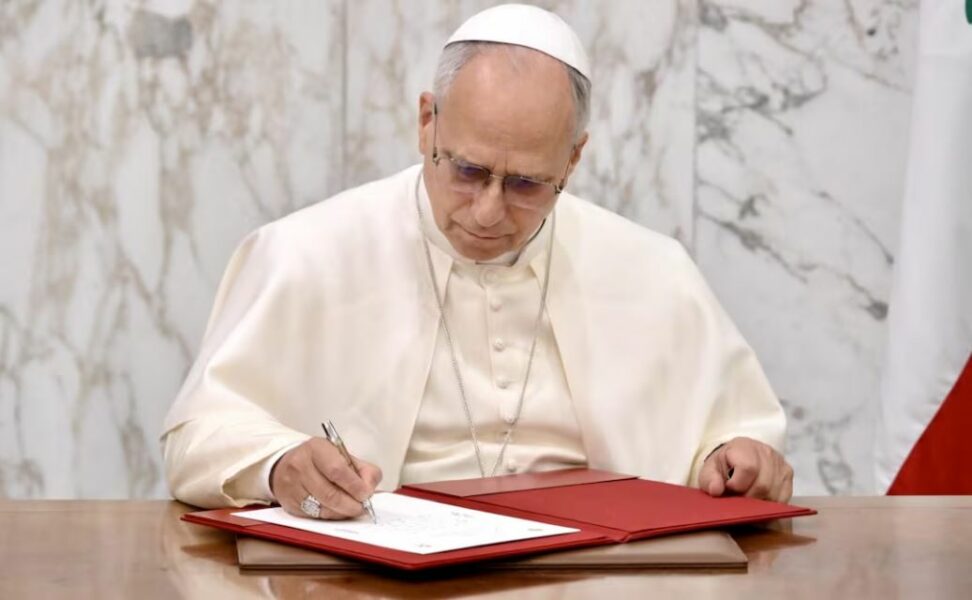
Pope Leo XIV is expected to sign his first encyclical on May 15, a social document that, according to Vatican sources cited by the German agency KNA, will address some of the main contemporary challenges, including artificial intelligence, peace, and the crisis of international law.
The text, which is circulating under the provisional title Magnifica humanitas, will mark a decisive step in shaping the magisterium of the new Pontiff, expanding a doctrinal work on artificial intelligence that has been underway since the beginning of the year.
From Artificial Intelligence to a Broad-Reaching Social Encyclical
At the beginning of February, various reports pointed to the Vatican preparing a high-level document specifically focused on artificial intelligence, with an ethical and anthropological approach. Leo XIV himself had warned about the risks of uncontrolled technology, insisting on the need to preserve human dignity in the face of possible drifts that blur the boundary between the human and the artificial.
Read also: Leo XIV prepares an encyclical on AI reviewed by Tucho
The future encyclical will not be limited to the technological issue, but will place it within a global reflection on the great challenges of the 21st century, in line with the tradition of the Church’s social doctrine.
A Gesture with Strong Historical Weight
The choice of May 15 for signing the document is not casual. In the Vatican, it is interpreted as a direct reference to Rerum novarum, the encyclical of Leo XIII published on that same day in 1891, which marked the beginning of the modern social doctrine of the Church.
Since then, other milestones of social magisterium have reinforced that tradition: Quadragesimo anno (1931), which developed the principle of subsidiarity; Mater et magistra (1961), focused on the social question in the industrial world; and Centesimus annus (1991), where St. John Paul II offered a decisive assessment of the role of the market economy after the fall of communism.
New Challenges for a New Stage
In this context, Leo XIV’s encyclical is shaping up as an update to that tradition in the face of a global scenario marked by profound transformations. Artificial intelligence appears as one of the main axes, but linked to broader issues such as international stability, the weakening of global legal frameworks, and the risks of dehumanization in contemporary societies.
The approach that had already been outlined in recent doctrinal documents—where it is emphasized that technology must serve the person and not replace them—now points to acquiring magisterial rank, offering clearer criteria for the Church’s pastoral and social action.
A Text Destined to Mark the Pontificate
For the moment, there is no official confirmation on the definitive content, but if these elements are confirmed, the Pope would not only be addressing technological challenges, but placing them within a broader vision of the moral and social order, with an eye on the tensions specific to the 21st century.