


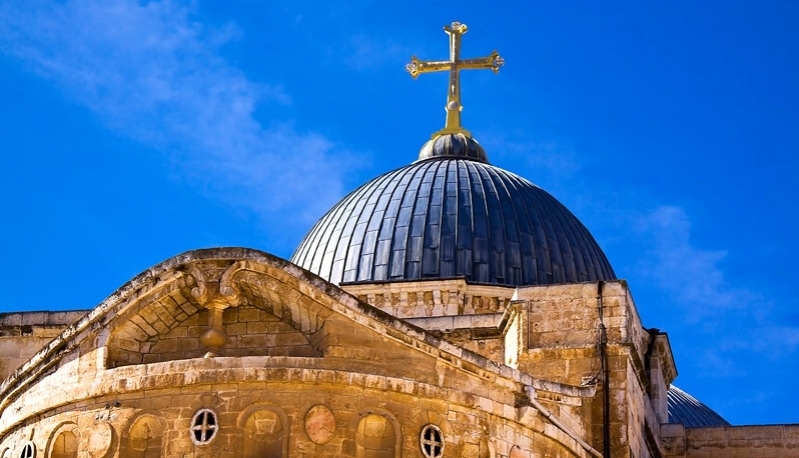
The Christian presence in the Holy Land has fallen to critical levels and could disappear if the current trend is not reversed. This was warned by Benedictine abbot Nikodemus Schnabel in a meeting with representatives of Aid to the Church in Need (ACN), where he denounced that Christians now represent less than 2% of the population and continue to abandon the region due to war, the economic crisis, and lack of future.
“The place where the central events of our faith were born runs the risk of losing its native Christians,” warned the abbot, who described a situation marked by constant exodus and the growing invisibility of these communities.
Exodus, Precariousness, and Loss of Future
The main factor pushing Christians to leave is economic. As Schnabel explained, nearly 60% of Arab Christians depend on tourism, a sector that has not recovered since 2019 after the pandemic and subsequent conflicts. Without stable income, many families choose to emigrate.
“People leave because they see no future,” he stated, pointing to the lack of housing and employment as the two major obstacles to the permanence of Christian communities.
A Nearly Invisible Minority
Although Jerusalem retains a notable ecclesial diversity—with 13 Churches between Catholic and other historic confessions—this richness hides a much more fragile reality: a very reduced community.
The abbot emphasized the paradox that the Holy Land has fewer Christians than some of the most secularized regions of Europe. “Dreaming of reaching 5% or 6% would already be a lot,” he acknowledged.
The Risk of a “Holy Land Without Christians”
Schnabel warned of an increasingly plausible scenario: the permanence of holy places without living communities to sustain them. “The shrines, monks, and priests could remain, but without families or ordinary Christian life,” he noted.
This process would turn the Holy Land into a kind of symbolic or tourist space, disconnected from lived faith.
Three Groups, the Same Fragility
The abbot identified three major realities within the local Church.
On one hand, Palestinian Christians who speak Arabic, historically rooted in the region, but today affected by political restrictions, insecurity, and, in places like Gaza, a situation he described as “double pressure”: external conflict and internal control by Hamas.
In second place, a small community of Hebrew-speaking Catholics, growing, integrated into Israeli society.
Finally, the largest group: migrant workers and asylum seekers, who exceed 100,000 faithful and sustain much of the ecclesial life.
Denunciation of Conditions Close to “Modern Slavery”
The abbot denounced that many of these migrants live in undignified conditions: passports withheld, labor restrictions, family separation, and legal vulnerability. In some cases, he said, the system even penalizes motherhood.
“For the system, the most ‘criminal’ act can be saying yes to life,” he pointed out, alluding to women who refuse to abort and end up in irregular situations.
Between War and Fidelity to the Gospel
In the midst of the conflict, Schnabel defended the Church’s position: “We are neither pro-Israel nor pro-Palestine, but pro-humanity” and also recalled the testimony of migrant caregivers who died after refusing to abandon elderly people in their care during the attacks of October 7, 2023, highlighting their fidelity as an example of Christian life.
The abbot also denounced attacks against Christians by Jewish extremist groups, including harassment, vandalism, and profanations, and stated that these episodes can no longer be considered isolated. At the same time, he indicated that there are also Jewish sectors that defend Christian communities and denounce these abuses.
Schnabel concluded that, without concrete measures, the disappearance of Christians in the Holy Land will be inevitable. “There is no Annunciation without Nazareth, no Christmas without Bethlehem, no Easter without Jerusalem,” he affirmed, warning that without living communities the holy places run the risk of being reduced to spaces without Christian life.