


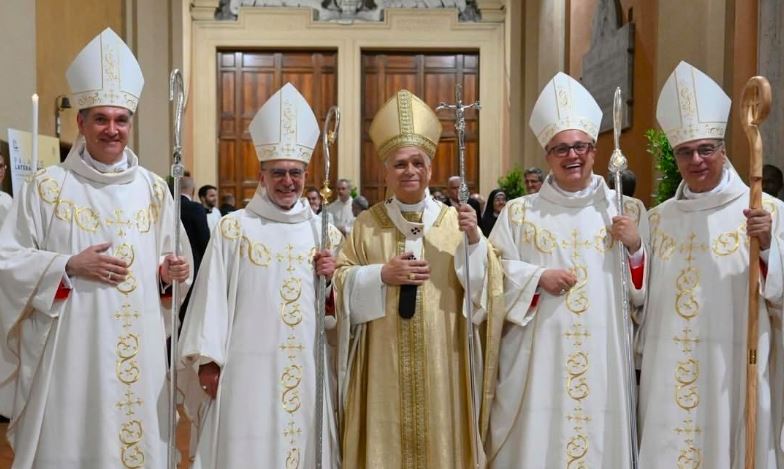
Pope Leo XIV presided this Saturday, May 2, 2026, in the Basilica of St. John Lateran, over the Mass with the episcopal ordination of four new auxiliary bishops of the Diocese of Rome—Stefano Sparapani, Alessandro Zenobbi, Andrea Carlevale, and Marco Valenti—all of them from the Roman clergy and appointed by the Pontiff himself on February 25 past.
The celebration, framed within the Fourth Week of Easter and marked by the invocation of the Holy Spirit, highlighted the communion of the Church around its bishop and the shared mission in pastoral service. In his homily, the Pope issued a clear warning against the logic of power: the Church must go out to meet the “discarded,” reminding that “no one, absolutely no one, should think themselves excluded by God.”
A Church Built on the “Rejected Stone”
During the ceremony, Leo XIV developed a reflection centered on the biblical image of the “rejected stone,” taken from the First Letter of Peter and the Psalms. As he explained, this symbol summarizes the core of the Christian message: Christ himself was rejected, but chosen by God as the cornerstone.
The Pope emphasized that this divine logic directly contradicts human criteria of power and success. In the face of a society that discards the weak and rewards the strongest, Christ presents himself as the one who restores dignity to the marginalized. “When we draw near to Christ, we also draw near to one another and grow in unity,” he affirmed.
A Warning Against Worldly Mentality
Leo XIV did not shy away from clearly pointing out the internal risks in ecclesial life. Addressing the new bishops directly, he exhorted them not to be seduced by privileges or the pursuit of positions of power. “Do not settle into the privileges that your condition might offer you, nor follow the worldly logic of the first places,” he warned.
The Pontiff insisted that the episcopal ministry can only be understood from service, following the example of Christ, who “did not come to be served, but to serve.” In this sense, he asked the new prelates to be men of peace and unity, capable of harmonizing differences and supporting the communities entrusted to them.
The Mission: Go Out to Meet the Discarded
One of the clearest axes of the homily was the call to go out to meet those who have been relegated by society. Leo XIV expressly asked the new bishops to “reach the discarded stones of the city” and announce to them that in Christ there is a place for everyone.
In this line, he took up an idea already present in the previous pontificate—the Church as a “field hospital”—to insist on a pastoral approach that does not enclose itself in structures, but reaches out to the peripheries, both material and existential.
Rome, Called to Be a Sign of Universal Welcome
The Pope also situated this mission in the specific context of Rome, emphasizing its universal vocation. In a city that receives pilgrims from all over the world, he asked that both the faithful and the institutions and pastors reflect the maternal face of the Church.
“The poor, the pilgrims, and the visitors must find here that motherhood which is the authentic face of the Church,” he noted, in a final confident reference to the protection of the Virgin under the invocation of the Salus Populi Romani.