


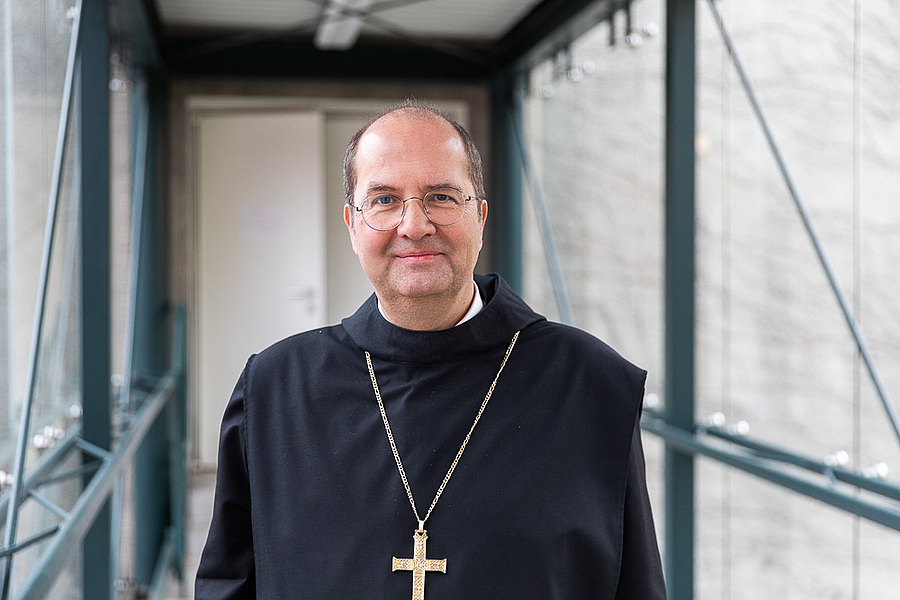
The Primate Abbot of the Benedictines, the German Jeremias Schröder, has defended the idea that Benedictine communities can serve as a model for coexistence between the traditional and reformed liturgy within the Church. He states this in an interview granted to Katholisch.de, in which he emphasizes that both forms coexist “in a reconciled manner” within the order.
Schröder maintains that this coexistence does not generate internal conflicts and that, on the contrary, it reflects a real integration between different liturgical sensitivities. In this sense, he points out that the Benedictine experience could offer a reference for the Church as a whole.
Liturgical Coexistence and Consolidated Presence of the Ancient Rite
As he explains, about ten abbeys within the Confederation celebrate according to the ancient rite—especially in France—while the majority uses the reformed missal. Far from seeing a problem, he insists that both forms are fully integrated.
The Primate Abbot also recognizes that the traditional liturgy has acquired a “right of citizenship” in the Church, making its disappearance difficult. The existence of communities that have built their spiritual life around this form obliges, in his view, to acknowledge its roots.
Monasteries in Decline and Communities That Are Resurging
Schröder points out that the reality of monastic life is marked by two opposing dynamics: on one hand, communities that are aging and slowly disappearing; on the other, monasteries that manage to revitalize themselves after having been considered practically closed. “There are communities that are dying out, and it is a challenge to accompany that process well. But there are also others that, when they were thought to be lost, begin to receive vocations again,” he explains.
In this way, he avoids speaking of crisis in absolute terms and prefers to describe an uneven situation. As he points out, the future of each community depends to a large extent on factors such as the continuity and quality of common life.
“It is not so much about whether an order is stricter or less so, but about whether there is a solid community life, with shared goals,” he states. In his view, monasteries that maintain internal cohesion continue to be capable of attracting new vocations, even in a context of growing secularization.
Technology, Formation, and Current Challenges
The Primate Abbot also addresses the impact of new technologies, which each monastery manages according to its own charism. In the formation of novices, however, emphasis is placed on the practice of detachment, including limitations on mobile phone use.
Regarding artificial intelligence, he highlights its practical utility—as in simultaneous translation in international meetings—although he defends the value of learning languages as an essential part of monastic formation.
A Model That Prioritizes Internal Life
Schröder’s approach insists on strengthening community life as a response to current challenges. Liturgical coexistence, discipline in the use of technology, and the quality of common life appear as central elements of that model.
In a context of weakening of many communities in Europe, his proposal emphasizes internal cohesion more than a thorough review of the external causes of decline.