


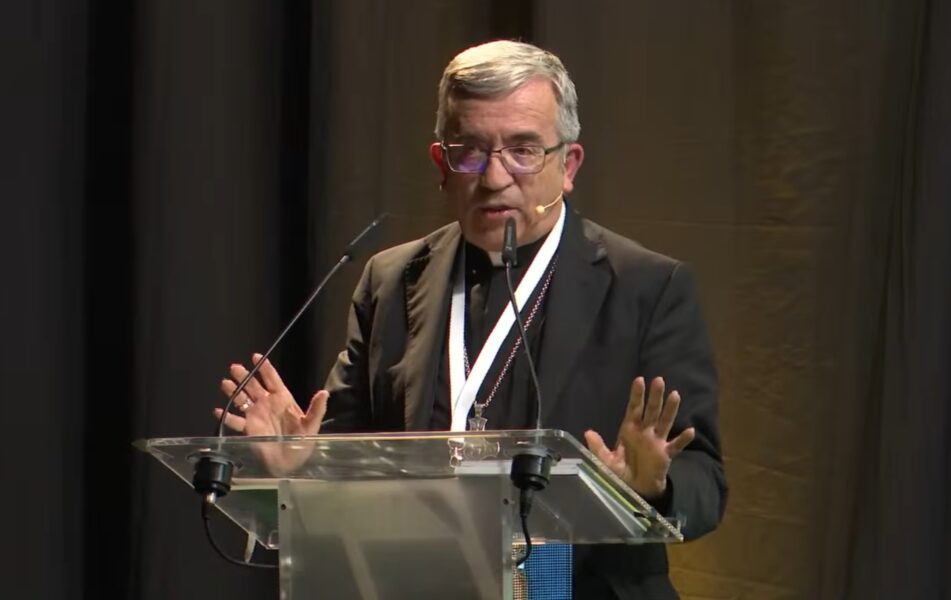
In a previous article, InfoVaticana made an error by mixing the content of a pastoral letter on immigration with the inaugural speech of the Ecclesial Assembly of the Church in Castile. Upon noticing the confusion, we proceed to rectify and offer the text corresponding to Monsignor Luis Argüello’s intervention in said Assembly.
Monsignor Luis Argüello García, Archbishop of Valladolid and President of the Spanish Episcopal Conference, spoke at the opening of the Ecclesial Assembly of the Church in Castile, held in Ávila, framing this meeting within the synodal process and the work developed in recent years in the dioceses of the region.
“We gather here as the fruit of a work, a grateful work, I say now, to so many and so many who for decades have tried, have attempted to walk together in the Church in Castile.
These are the minutes of the meetings that have served as preparation for this Ecclesial Assembly of the Church in Castile. Right here, in Ávila, in February 2023, at the meeting of bishops, vicars, and archpriests, in its 40th edition, we spoke of synodality and discernment, synodal realities and dreams of our Church in Castile. And there the decision was made to launch this process, which had a meeting dedicated to recognizing in 2024 and another to interpreting in March 2025.
This gratitude for the work of these years is important for us to hold in our hearts to say from there: we continue walking.
As also the saying that all this walking is situated within the communion of the Churches, of the universal Church. We have already referred to the Synod and this is the final document of the Synod: For a Synodal Church: Communion, Participation, and Mission, which in October 2024 was sealed and signed by Pope Francis with a note of accompaniment in his own hand.
It is in this current that we are situated, as the Church in Spain is also situated, which now tells us in its pastoral lines: set out on the way.
And so, in this way we are: the way of our particular, local Churches; the way of the Church in Spain; the way of the synodal Church; a way of pilgrims of hope who open the gaze of the heart to discover the signs of the presence of the Kingdom of God in our world, so that from there, with that light, we realize in what we must renew ourselves: renew our style, our way of relating, our pastoral structures. For what? To dispose ourselves for the mission.
But all this, all this walking of the Church in recent years, has a reference. Pope Leo XIV, in the first catecheses of his pontificate, is commenting on the Second Vatican Council. In reality, synodality is nothing other than the welcoming of the missionary communion that the Council sows in the life of the Church as a Pentecost of the life of the Church.
A Church that reads the Word to make us missionary disciples, that celebrates the Eucharist to realize where our assembly springs from and the mandate that we receive in the Eucharist: go, set out on the way, announce the Gospel. A Church that is of the Lord and for the world.
And so, from this Pentecost, in this Easter time, we want to walk.
But all these documents that speak to us of the walking of the Church must always be read from the Word of God. The Word that is situated there, the Paschal candle, which speaks to us of the face of the Risen Christ.
Documents, our own meetings, the faces we bring from the way lead us to the Word and, from the Word, we return to the texts for a deeper gaze and, above all, we return to our heart and our hands so that from there we advance and live the experience of being renewed for the mission, renewed by the Holy Spirit.
And as the Pope told us in the message he has addressed to us, this Church of saints—how not to cite Teresa of Ávila, Teresa of Jesus, patroness of the ecclesiastical province of Valladolid; how not to cite Saint Segundo, whom we are also going to celebrate in these days; how not to cite John of the Cross; how not to cite Saint Toribio of Mogrovejo—, John of the Cross and Toribio of Mogrovejo are living the third centenary of their canonization.
Or of young people of this hour, like Carlo Acutis, and above all the saints of the door next door, whom we recognize in the walking of our life.
May they and the impoverished, may they and the faces that in some way cry out for us to convert, live in communion and carry out a mission in which the witness of bringing the merciful love of the Lord to the most fragile is our saint and our sign.
Happy encounter in the name of the Lord.”