


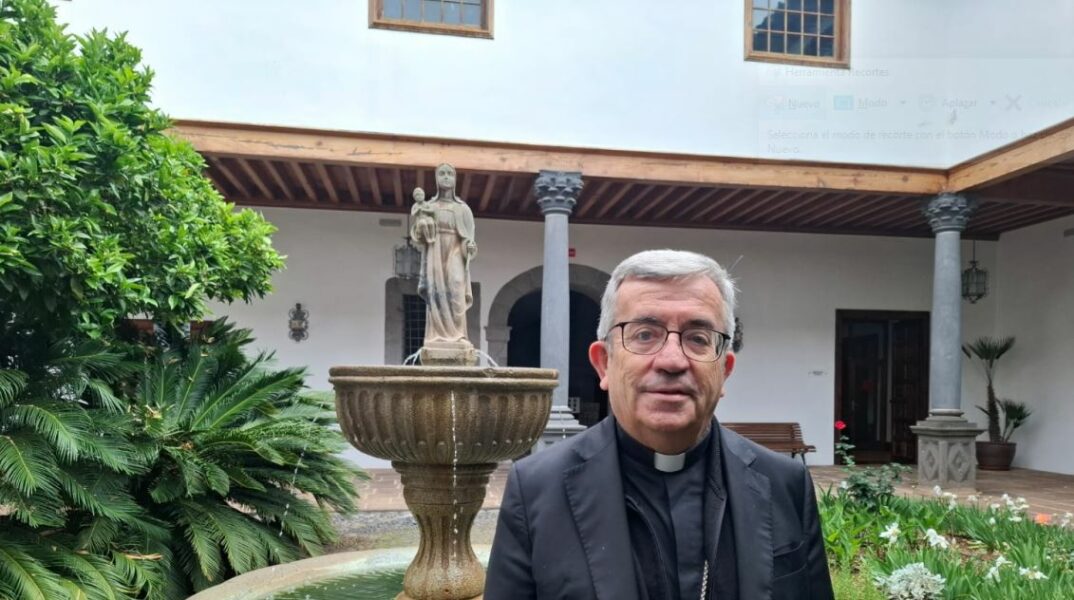
The Archbishop of Valladolid and president of the Spanish Episcopal Conference, Luis Argüello, inaugurated the Ecclesial Assembly held in Ávila on April 30 with a speech centered on the migration issue, in which he warned of the risk of addressing this phenomenon from ideological polarization. The meeting, which ends this Saturday, brought together nearly 300 delegates from various dioceses as part of the synodal process in Spain.
Read also: Ávila hosts the first Ecclesial Assembly in a synodal key with nearly 300 delegates
In his intervention, disseminated by the Archdiocese of Valladolid, Argüello stated that “many issues are debated in the public square that require evangelical illumination […] one of them is that of migrations.” From this idea, he articulated his reflection on two key principles of the Church’s Social Doctrine: human dignity and the common good.
Human dignity as a fundamental principle
The archbishop developed his speech based on the Church’s Social Doctrine, pointing out that human dignity is a central principle that must be respected in all cases. “Dignity is […] a red line, which must be respected in all cases,” he affirmed.
In this sense, he enumerated various situations contrary to that dignity, such as “inhuman living conditions, arbitrary detentions, deportations, slavery, prostitution, human trafficking” or working conditions that reduce the worker “to the rank of mere instrument of profit”
The common good and its relationship with dignity
Along with dignity, Argüello pointed out the common good as the second great principle to illuminate social life. He defined it as the “set of conditions of social life that make possible […] the fuller and easier achievement of one’s own perfection”.
He also emphasized that both principles are closely linked: “Human dignity and the common good must be conjugated simultaneously”.
The Catechism’s teaching on immigration
When addressing the migration issue directly, the archbishop quoted the Catechism of the Catholic Church, recalling that “the more prosperous nations have the duty to welcome, to the extent possible, the foreigner seeking security and the means of livelihood”.
At the same time, he added that “civil authorities […] may subordinate the exercise of the right to immigration to various juridical conditions,” especially in relation to the duties of immigrants toward the country that receives them.
Criticism of slogans
Argüello also referred to the causes behind migratory flows, pointing out that the interdependence between peoples is “unequal and asymmetrical” and generates situations of “violent and unjust impoverishment.” He also indicated that the mobility of people responds in many cases both to these situations and to the “need for labor in rich but aging countries”
In the final part of his intervention, the archbishop issued an explicit warning: “Let us dialogue […] without letting ourselves be trapped by polarizing slogans or by the even more polarizing interpretation that some make in favor of their power interests”.
Synodal context and message from the Pope
The Ávila Ecclesial Assembly was presented as a milestone in the implementation of the synodal process in Spain, with the aim of reflecting on the life and mission of the Church in the current context.
In this framework, the participants also received a message from Pope Leo XIV, who encouraged them “to be one in Christ” and to rekindle the missionary vocation, reinforcing the evangelizing dimension of the meeting.