The Sanctuary of Our Lady of Lourdes commemorates this month of May the 150 years of the Virgin’s coronation with a gesture that refers to the essential: replacing gold with flowers, external solemnity with the simple expression of faith.
The proposal is not decorative. The faithful who come to the sanctuary are invited to deposit yellow carnations, evoking those golden roses that, according to the testimony of Saint Bernardette Soubirous, appeared at the feet of the Virgin during the apparitions. Each flower has a concrete meaning: an intention, a supplication, a thanksgiving. A small gesture, but loaded with meaning.
From the humility of the grotto to the glory of the esplanade
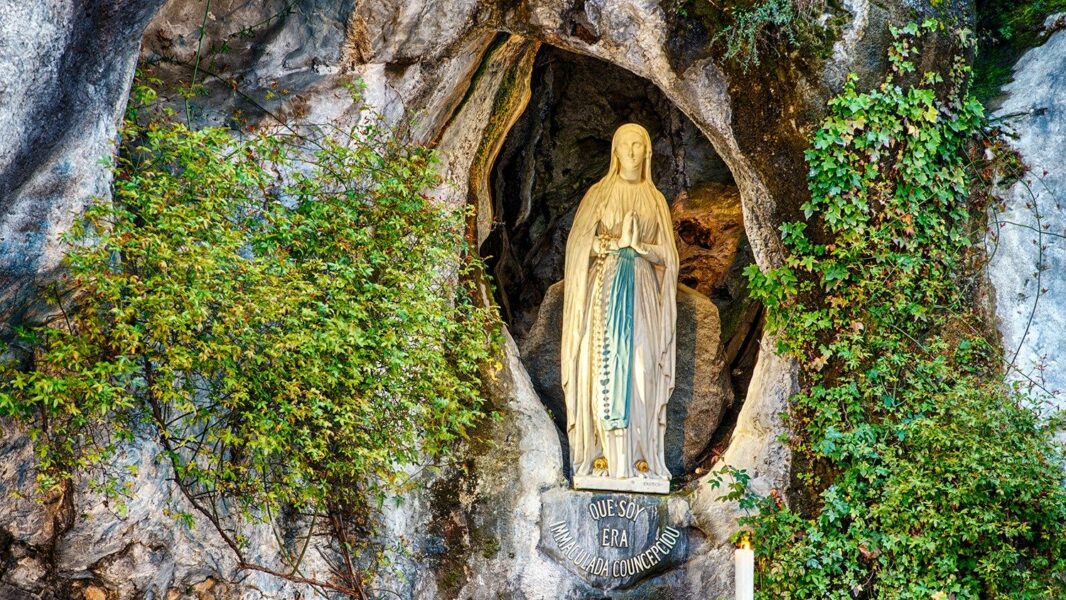
The commemoration places at the center one of the most emblematic images of the sanctuary: the statue of the Crowned Virgin, located in front of the Basilica of the Rosary since 1876. Made in bronze by the sculptor Joseph-Hugues Fabisch, this image—more than two meters tall—does not represent the apparition as Bernadette saw it, but rather the exaltation of Mary as Queen of Heaven.
While the figure of the grotto conveys recollection and simplicity, the statue of the esplanade expresses the glorious dimension of the Virgin, in coherence with the doctrinal tradition of the Church.
It is precisely in this space where every night thousands of pilgrims participate in the torchlight procession, one of the most characteristic acts of Lourdes, in which the prayer of the Rosary unites the faithful from different languages and origins.
A sanctuary born from the apparitions
The roots of Lourdes are not in a diffuse tradition, but in a precise fact: the 18 apparitions of the Virgin between February 11 and June 16, 1858. In them, Mary presented herself as the Immaculate Conception, confirming a truth proclaimed by the Church a few years earlier.
After an investigation, the apparitions were officially recognized in 1862. From then on, the Church acquired the land and began to organize the sanctuary, facilitating access to pilgrims and building the first places of worship.
Today, the complex occupies 52 hectares, with basilicas, chapels, a monumental way of the cross, and the well-known pools where the faithful immerse themselves in the water. Lourdes has not stopped growing, but has kept its core intact: the grotto.
The memory of a golden crown
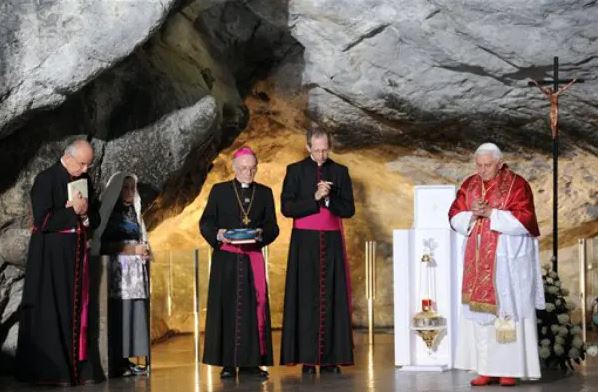
It is not the first time that the Virgin of Lourdes is crowned. There is a golden crown, made in the 19th century through popular subscription, which was placed in 2007 by Benedict XVI during the World Day of the Sick.
Today it is preserved in the sanctuary’s archives. Its presence is not annulled by the current initiative, but it does take a back seat. Lourdes seems to remember, with this commemoration, that authentic devotion does not depend on the value of the material, but on the intention with which it is offered.