


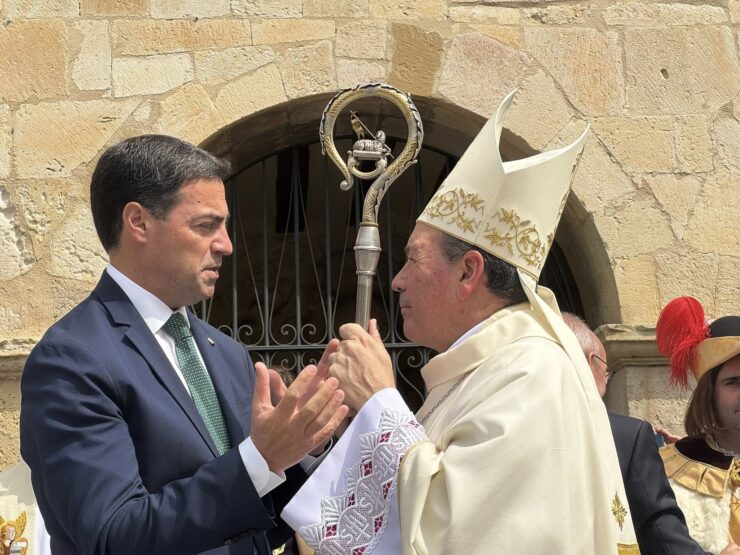
The Bishop of Vitoria, Monsignor Juan Carlos Elizalde, launched a direct criticism at the Government during the homily of the Pontifical Mass in honor of San Prudencio, denouncing its ideological intervention in key issues such as life, family, or sexuality. His words thus add to the recent warnings from the president of the Spanish Episcopal Conference, Luis Argüello, who had already alerted to an “ideological drift” of the Executive in these same areas.
The celebration, held on April 28 in the basilica of Armentia before civil and regional authorities, ceased to be a mere festive act to become an intervention with a clear social and political background.
“Confessional stances” in life, family, and sexuality
Elizalde was especially clear in denouncing the contradiction between the State’s non-confessionality and the Government’s actions. “The State is non-confessional, but the Government tends to take ‘confessional’ stances in anthropological matters”, he stated, directly pointing to political intervention in the beginning and end of life, marriage, or human sexuality.
According to him, these decisions are adopted with “criteria of ideological faith, aside from science and the most basic human experiences”. A statement that directly targets the legislation promoted in recent years on issues such as abortion, euthanasia, or gender identity laws.
Criticism of interventionism and the “double standard”
The bishop also denounced a broader political trend: “It manifests an excessive desire to intervene in civil society and control institutions”, he warned, adding the existence of “a double standard, depending on who is affected by issues of abuse of power or corruption.”
Elizalde placed these policies within a broader context of growing social polarization. In his analysis, he warned that today’s society experiences a phenomenon in which the political adversary ceases to be someone with whom one disagrees to become a threat.
This dynamic, he explained, generates hostility, dehumanization, and breakdown of dialogue, weakening social bonds and favoring a constant struggle for power. A situation that, far from being resolved from institutions, seems to be fueled by them.
Immigration: between emotionalism and ideological manipulation
The prelate emphasized that welcoming immigrants is “an undeniable evangelical sign”, but insisted that it cannot be understood in isolation, detached from the common good. In this sense, he denounced the ideological tensions that arise when one pole—the human dignity—is absolutized without taking into account the other—the responsibility of States to order migratory flows.
As he explained, a reading based solely on “compassionate humanitarianism” can lead to emotional reactions that end up being used politically. Likewise, he alerted to the opposite reaction: discourses that, in the name of the common good, end up closing off to the human reality of those who arrive.
Elizalde was clear in pointing out that both stances can be ideologically manipulated, generating a climate of confrontation that distorts the real problem. In response, he called for an integral vision that takes into account both the dignity of the person and the demands of social order, without falling into reductionisms.
Call for peace in a context of conflict
The homily was marked by a constant call for peace, in line with the figure of San Prudencio, patron saint of Álava. Elizalde recalled that believers are called to be “sowers of peace” in a world marked by wars, tensions, and confrontations.
He also referred to the recent history of the Basque Country, underscoring the need not to reopen wounds or foster permanent confrontation, but to build coexistence from truth and respect.