


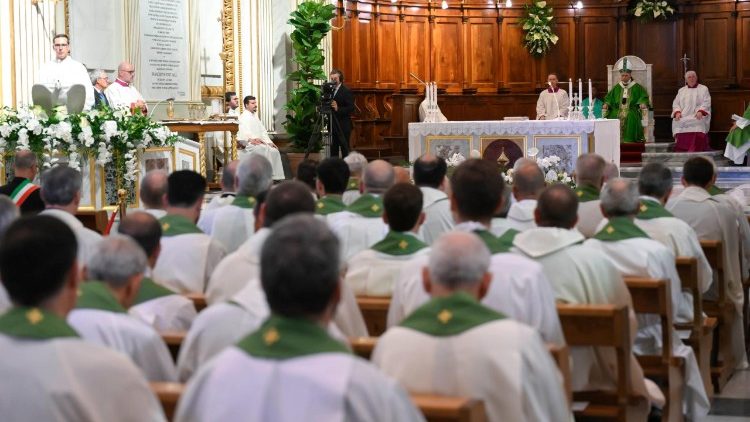
The extension of concelebration in the Latin Church was not, in its origin, a peaceful decision free from objections. During the debates of the Second Vatican Council, some conciliar fathers clearly warned of the risks of expanding this practice beyond very specific contexts.
Among them stood out the Dominican Paul-Pierre Philippe, later a cardinal, whose intervention has recently been recovered by Bishop Athanasius Schneider and analyzed by theologian Peter Kwasniewski in New Liturgical Movement.
A precise critique from the Council itself
Philippe did not reject concelebration itself. He accepted its use in celebrations that visibly express the unity of the priesthood, such as the Chrism Mass or those presided over by the bishop. However, he opposed its extension as a habitual practice with theological arguments.
His starting point was clear: the unity of the priesthood is not manifested primarily by the simultaneous action of several priests at the altar, but by the union of each one with Christ. Therefore, he maintained that the Mass celebrated by a single priest expresses more directly the action of Christ who offers himself in sacrifice.
The risk of weakening priestly identity
One of the most delicate aspects of his intervention was the warning about the priest’s interior life. Philippe pointed out that frequent concelebration could lead to a progressive loss of the priest’s consciousness as “alter Christus”.
It was not a disciplinary objection, but a spiritual one: if the priest stops habitually experiencing the personal celebration of the Mass, his direct relationship with the Eucharistic sacrifice may suffer, which constitutes the center of his life.
Fewer Masses, less expression of the sacrifice
Another of the arguments developed—and later expanded by authors like Enrico Zoffoli—is the practical consequence of habitual concelebration: the reduction in the number of Masses celebrated.
From Catholic doctrine, each Mass has its own value as a sacrifice offered for the salvation of the living and the dead. Therefore, it is not indifferent that several priests celebrate a single Mass together instead of each offering the Eucharistic sacrifice.
At this point, the critique is direct: concelebration does not multiply the number of sacrifices, but constitutes a single sacramental act, which implies an effective decrease in the number of Masses celebrated.
The danger of obscuring the sacrificial sense
The theological reflection goes beyond the concrete practice. Some authors have warned that the extension of concelebration can favor an incomplete understanding of the Mass, shifting the emphasis toward its dimension as a gathering or banquet.
In response, the Church’s tradition has insisted that the Mass is, above all, the sacrifice of Christ that becomes present on the altar. When this aspect ceases to occupy the forefront, there is a risk of altering the very perception of the Eucharistic mystery.
A warning that has not lost its relevance
Philippe’s intervention was not an isolated opinion, but part of a real discussion within the Council on the limits and meaning of concelebration. However, the subsequent evolution of liturgical practice has gone beyond what some of these fathers considered prudent.
The reflections recovered by Schneider and Kwasniewski do not introduce a novelty, but rather bring back to the forefront warnings formulated at the very moment of the liturgical reform.
The underlying issue: the centrality of the Mass
What is at stake is not a disciplinary preference, but the centrality of the Mass in the life of the Church and the priest. The tradition has always considered it fitting for each priest to celebrate daily, precisely because of the infinite value of the Eucharistic sacrifice.
In light of these considerations, the extended practice of concelebration raises a question that the Council itself did not consider closed: whether its habitual use helps to express the mystery of the Mass more clearly or, on the contrary, ends up weakening some of its essential elements.