


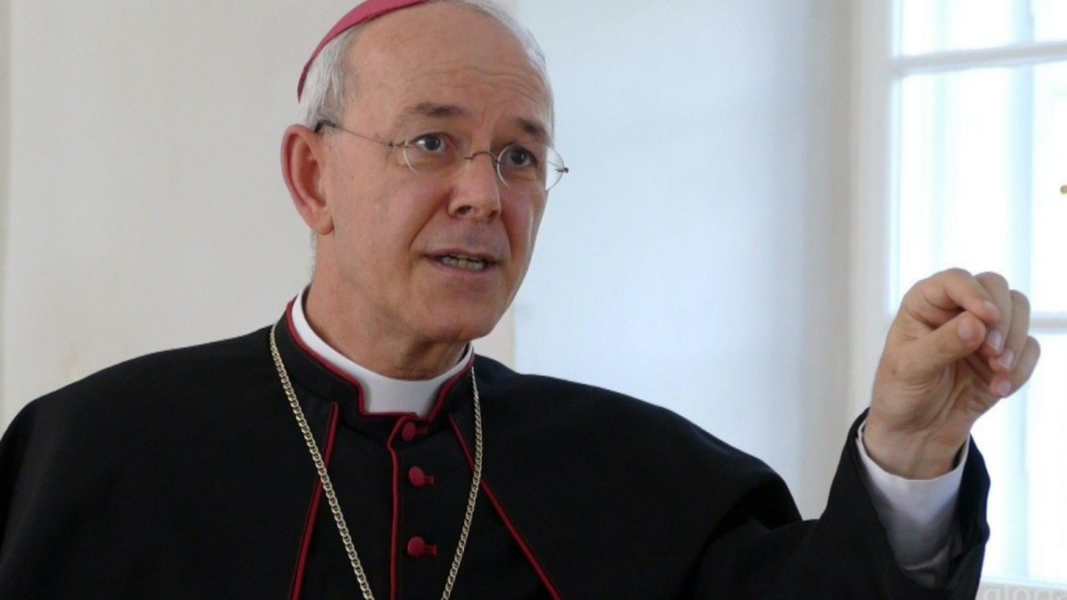
The recent initiatives promoted in Germany regarding blessings for same-sex couples continue to generate reactions within the Church. The auxiliary bishop of Astana, Monsignor Athanasius Schneider, has launched harsh criticisms against Cardinal Reinhard Marx for promoting this type of practices, while denouncing what he considers a process of “Protestantization” in ecclesial life.
In statements to Gloria TV, Schneider described the instruction to allow or perform blessings for homosexual couples as “completely irresponsible,” understanding that these imply a public validation of behaviors contrary to Catholic doctrine.
Criticisms of the blessings and accusation of “blasphemy”
The prelate was especially forceful when referring to the possibility of this type of blessings becoming normalized in pastoral life. In his view, turning them into habitual practice implies a serious distortion of the meaning of blessing in the Church.
“Making this almost an obligation is a mockery and a blasphemy,” he stated, adding that it is “a grave sin” when promoted by a cardinal.
Denunciation of double standards in the Church
Beyond this issue, Schneider pointed out what he considers an uneven application of ecclesiastical discipline. As an example, he mentioned the participation of a U.S. bishop in an Anglican episcopal consecration, which he described as invalid.
According to the bishop, this type of actions receive no sanction, while other situations—such as episcopal consecrations in traditional settings—are treated with greater severity. “Everything that is too traditional is scrutinized under a magnifying glass, while other facts go without consequences,” he maintained.
The spread of irregular liturgical practices
The auxiliary bishop of Astana also warned about the proliferation of practices that, in his opinion, blur the Catholic liturgical identity. He referred, among other aspects, to the growing presence of women leading celebrations that resemble the Mass, as well as the confusion between different types of rites.
This phenomenon, he noted, could lead to a progressive loss of the faithful’s ability to distinguish between the Eucharist and other forms of community prayer.
“Protestantization” and Rome’s responsibility
In this context, Schneider stated that the Church is undergoing a process of adaptation to the modern world that, in his view, implies doctrinal relativism and religious syncretism. “This is a clear Protestantization of Catholic faith and life,” he affirmed.
The bishop also emphasized the responsibility of the Holy See, considering that it is aware of these situations but does not adopt sufficient disciplinary measures in the face of certain behaviors.
Germany, epicenter of the crisis
Finally, Schneider placed Germany as one of the main foci of this dynamic. In his view, the weight of the structures of the Episcopal Conference and its administrative apparatus has favored the widespread dissemination of these practices.
In other countries, he indicated, the problems would exist, but in a more isolated and less systematic way.