


Ricardo García-Villoslada recounts in the second part of his biography of Martin Luther (“In Struggle Against Rome”) how, after being excommunicated, Luther remained in Wartburg Castle, Germany, until March 1522. And that, while he was there, Satan appeared to him in a vision and revealed how the Mass should be reformed.
Luther himself described the scene as follows: “It happened to me once that I suddenly awoke around midnight and Satan began to dispute with me.” The three points with which the demon attacked the Mass are the same ones that Luther would end up defending: 1) the real presence of Christ in the Eucharist; 2) the ministerial priesthood, in favor of the common priesthood of all the faithful; 3) the denial that the Holy Mass is a sacrifice: the Mass, according to the devil and after him, Luther, would be nothing more than a commemorative supper.
It is terrifying to think that the so clearly Protestant intention of abolishing the ministerial priesthood comes so directly from the evil one. Terrifying, but not surprising, because without priesthood there is no Eucharist and, without Eucharist, there is no Church. That is why it is much more terrible that the Catholic Church begins to accept these ideas as its own as part of its process of Protestantization, and that the hierarchy dedicates itself to innovating with the diabolical objective – conscious or unconscious – of the destruction of the ministerial priesthood.
Subtlety in the lie is proper to the demon. It would be too crude and counterproductive to openly present harmful things as such. In the Catholic Church, a historically habitual practice, such as the reforms of religious orders at all times, always consisted of a return to the origins. For it is through here, through some crack, that the demon’s subtle lie has been introduced, and many innovations and breaks with tradition have adopted this concept of “rediscovery” of forgotten traditions and vocations that were part of the first centuries of the Church and then fell into disuse. My hypothesis, easy to see, is that such “recoveries” are actually contemporary interested inventions, Protestantized, using a concept existing in the early Church and completely changing its content and meaning. Peter Kwasniewski recognizes, as I have also intuited for a long time, that there exists a preternatural intelligence behind the liturgical, doctrinal, and moral revolution of the second half of the 20th century in the Church. Everything that has been inserted into the Church is anti-Catholic and seeks to destroy it. Two clear cases of this are the permanent diaconate and the Ordo Virginum (Order of Consecrated Virgins).
Both, like other concepts and practices, are introduced following the pattern of the Overton window, a theoretical model of political communication that defines the range of ideas and practices acceptable to the public at a given time. It describes how proposals considered unthinkable or radical can become “popular” and turn into law by gradually shifting social perception through stages: unthinkable, radical, acceptable, sensible, popular, and politically legislable.
And that pattern would be followed after the Second Vatican Council, according to my hypothesis, in the introduction of both the permanent diaconate and the Ordo Virginum. Let us try to explain it.
Let us begin with the married permanent deacons.
In the Catholic Church, there have traditionally been seven clerical orders, always received by men: 4 minor orders (porter, lector, exorcist, and acolyte) and 3 major orders (subdeacon, deacon, priest).
And it is true that in the history of the Church there were multitudes of men who were admitted to orders in order to live, for example, from ecclesiastical revenues, since they did not inherit because they were not firstborns, for example. But that historical custom has nothing to do with the current permanent diaconate: those men who had received the minor or major orders up to the diaconate and developed an ecclesiastical career lived celibately, because the diaconate was not in the history of the Church an end in itself, but the last order before receiving the priesthood. It had nothing to do with the current image of a man who practices any profession in the world and is a happily married man and father who on Sundays dedicates himself to substituting for the ordained priest wherever he is insufficient and celebrates paraliturgies.
While it is true that the post-conciliar Church has maintained the figure of the deacon in the celebration of Mass by a bishop, as well as in many monasteries, at the level of diocesan organization and liturgical celebrations it has introduced a radical novelty. There lies the subtlety of the demon, in that mixture of wheat and tares, in the confusion in the forms, in mixing what is part of the tradition and what is not, in an Overton window process of accustoming the faithful to see a kind of priest (permanent deacons can wear a clerical collar) who is married while, in the texts and laws, the content is changed.
In this sense, it is fundamental to take into account the fundamental break with tradition that occurred on August 15, 1972, when Pope Paul VI transformed through the motu proprio Ministeria quaedam the sacred orders into ministries, making them partially accessible to the laity according to the principle of the common priesthood of the faithful of the Second Vatican Council. He reduced the ministries derived from minor orders to two: the lectorate and the acolytate, to which he attributed all the functions reserved to the subdiaconate, which was previously one of the major orders. He also interrupted the concatenating relationship that linked the minor orders to the priesthood, and decreed that the ministries of lector and acolyte would be oriented – but not ordained – toward the priesthood as the diaconate still was in 1972.
Today, it is common on any diocesan website to find an explanation of the permanent diaconate of the type: “the word deacon comes from a Greek term that, in the language of the New Testament, means ‘service’ or ‘ministry.’ The deacon is ordained to the ministry of the word, liturgy, and charity. The permanent diaconate is a reality that is reborn after the Second Vatican Council because the Church becomes aware that the dimension of Christ the Servant who offers himself for his Church continues to be present today (…). A dedication in charity, in service to the most needy, in the proclamation of the Word and in the preparation of the table (sic) of the Eucharist.” This text is taken from the official website of the Diocese of Málaga, which continues by stating that “for those responsible for formation and vocational process of the permanent diaconate in that diocese, (the permanent diaconate) is ‘a sign of the times and of the Spirit’.
A key element of the new permanent diaconate of the Second Vatican Council is that they are married men, “for the diaconate does not annul the vocation to marriage, but their families are a gift to the local Church”: on the day of signing the oath and the profession of faith of the permanent deacon, before ordination, the wives also sign a consent, without which one cannot proceed.” Go read on this website of the Diocese of Málaga the text I paraphrase: it has no waste in ambiguity and emptiness: “permanent deacons are not second-order priests nor super laity; they are a blessing from God that is wanting to be present in the Church of Málaga as a servant of God”.
The Second Vatican Council deals with deacons in the Constitution Lumen Gentium (LG), #29, in the following terms: “At the lower degree of the Hierarchy are the deacons, who receive the imposition of hands ‘not for the priesthood, but for the ministry’. Thus, strengthened by sacramental grace, in communion with the Bishop and his presbyterate, they serve the People of God in the ministry of liturgy, word, and charity. It is proper to the deacon’s office, according to what is assigned to him by competent authority, to solemnly administer baptism, reserve and distribute the Eucharist, assist at marriage and bless it in the name of the Church, bring Viaticum to the dying, read Sacred Scripture to the faithful, instruct and exhort the people, preside over the worship and prayer of the faithful, administer sacramentals, preside over the rite of funerals and burial (…). Dedicated to offices of charity and administration (…). Now, since these offices, so necessary for the life of the Church, according to the currently prevailing discipline of the Latin Church, can hardly be fulfilled in many regions, the diaconate can be restored in the future as a proper and permanent degree of the Hierarchy. It belongs to the different territorial Conferences of Bishops, in agreement with the same Supreme Pontiff, to decide whether it seems opportune and where to establish these deacons for the care of the faithful. With the consent of the Roman Pontiff, this diaconate may be conferred on men of mature age, even if married, and also on suitable young men, for whom the law of celibacy must remain firm’.
From this mixture of tradition and novelty and ambiguous language, everyone who wanted to introduce innovative and rupturist elements after the Second Vatican Council has taken advantage. Let us look at this last sentence of the conciliar document Lumen Gentium and compare it with the requirements stipulated to access the diaconate on the website of the Diocese of Málaga that we have been reading: in this one, among the basic elements, the minimum age of 35 years is cited, since before that it is considered that there is a lack of experience in married and family life, and the maximum, 60 years. How much insistence that they be married men and fathers, right? Why must it be an indispensable requirement? Lumen Gentium only says that “this diaconate may be conferred on men of mature age, even if married, and also on suitable young men, for whom the law of celibacy must remain firm’.
On the other hand, it is supposed that this condition of married permanent diaconate is a vocation, a call from God, while in most cases I have known it is “invitations” from parish priests to active laypeople present in the parishes; as if the vocation to be a permanent deacon did not arise from within, from God speaking to the man in his heart, but from outside. Of course, the modernists will reply that the voice of the Church inviting to that “vocation” is also the voice of God, who, curiously, did not call anyone in 2000 years to such a “vocation’.
When a man, meeting the basic requirements stipulated, asks the bishop to be admitted to the permanent diaconate, a process begins by which he receives the ministries of Lector and Acolyte and the rite of Admission. Once the candidate has gone through the discernment process and completed his formation time, he asks the bishop to be ordained a deacon. In the institution ceremony, as we said, his wife must formally sign her consent, which she would have already given from the beginning.
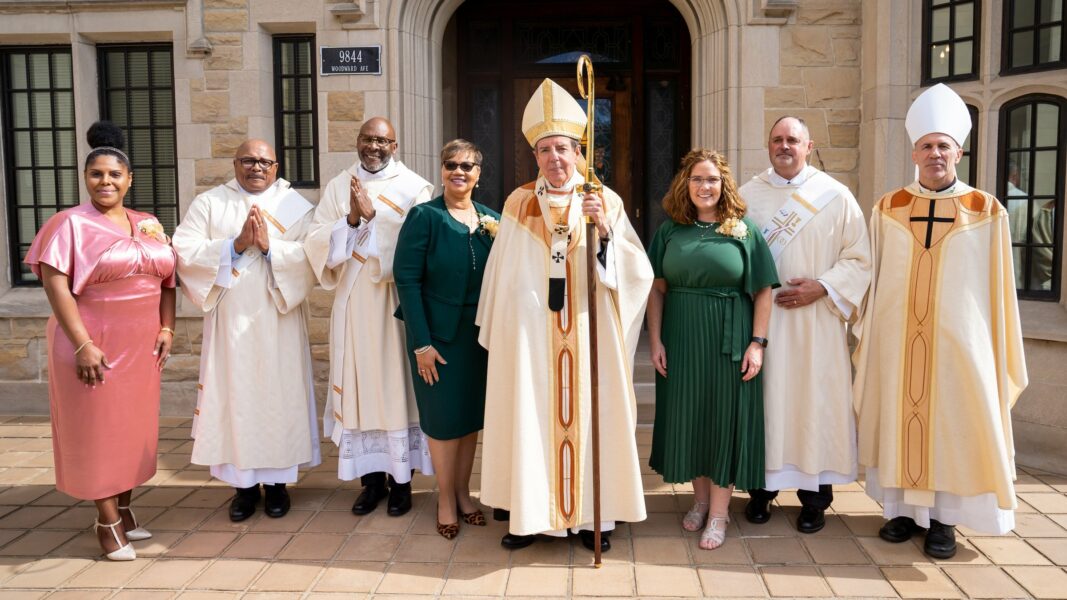
And this is the facet in which the application of the Overton window in the Catholic Church to destroy the ministerial priesthood as instituted by Jesus Christ and transmitted by the tradition of the Church is most clearly shown: introducing the deacon’s wife ostentatiously visibly next to him, so that we get used to the image of the married priest. On the one hand, it was not Jesus Christ who stipulated that priests be celibate, but it is a very important tradition in the Latin Church. And, on the other hand, in this same tradition, as we have seen previously, men who received the three major orders, because they touch the sacred vessels, had to be celibate. Well now, no. Now, the diaconate is a ministry, not an order, and although the permanent deacon touches the sacred vessels, not only does he not have to be celibate, but the post-conciliar Church insists and promotes that they be married. In the image that illustrates this text, for example, we can see in an official image of the Diocese of Detroit Archbishop Allen H. Vigneron with the newest permanent deacons of the Archdiocese of Detroit. From left to right: Deacon Sidney Johnson and his wife, Erinn; Deacon Michael Heard and his wife, Rolanda; and Deacon Alan Pionk and his wife, Darcy; along with Archbishop Michael Byrnes of Agana, Guam. Why do we need to know the names of those ladies? Moreover, why do they have to be in the photo? They have no liturgical role or any kind in the Church… for the moment; because, in this omnipresence of the deacons’ wives, always exposed on the front page, it even comes to speak of the vocation of the wives of permanent deacons.
By the same mechanism, instituting women lectors and acolytes after having accustomed the faithful to women going up to the presbytery to perform these functions, and the fact that there are altar girls (now, even, in the Pope’s celebrations), when the orders are from the beginning of the Church participation in the priesthood and exclusive to men, is part of the same Overton window in the process of destruction of the ordained priesthood and in favor of the ordination of women. And the Ordo Virginum has much to say here. We will see it soon, God willing.