


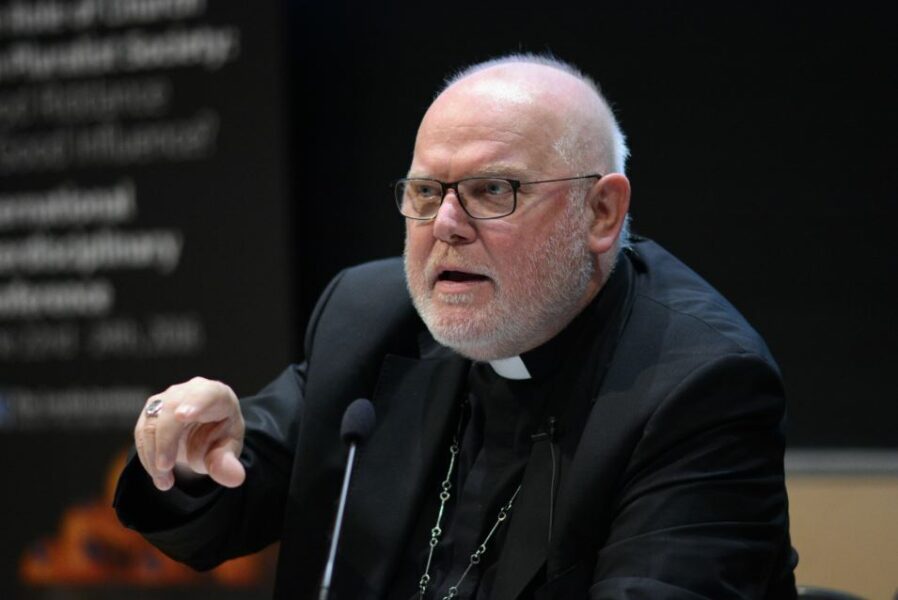
Cardinal Reinhard Marx, Archbishop of Munich, has denounced the existence of what he considers an organized campaign on social media against the so-called German “synodal way,” according to statements gathered by the magazine Herder Korrespondenz. The prelate laments the spread of a “narrative” that presents this process as schismatic and which, in his view, has gained strength in certain ecclesial circles.
Criticism of opposition to the German Synod
Marx expressed his frustration at the way this critical perception of the German synod has taken hold, especially in the digital environment. “This is also a phenomenon of social media, especially among the more reactionary side,” he stated. According to the cardinal, these sectors would be “very well coordinated in their efforts,” particularly in the United States, both in the political and ecclesial spheres.
In contrast, the Archbishop of Munich considers that those who defend the synodal process have not had the same presence or ability to articulate on social networks. “The other side is not as active there,” he added, emphasizing that he has conveyed this concern both to Pope Francis and to the current pontiff, Leo XIV, warning of what he describes as a propaganda effort.
Self-criticism and lack of dialogue
The German cardinal also acknowledged shortcomings in the synod’s own communication strategy. In his view, it would have been preferable to foster greater dialogue from the beginning. “In terms of communication, it certainly would have been better to talk more among ourselves,” he admitted.
Marx went further by assuming personal responsibility for this lack of understanding. “Perhaps we—I included—should have sought dialogue earlier,” he noted. Nevertheless, he justified that attitude by the fear that greater openness to debate would have slowed the progress of the synodal process.
Leo XIV distances himself from blessings for couples
During a flight back from his trip to Africa, the Pontiff emphasized that going beyond the spontaneous blessings allowed by his predecessor Francis “generates more disunity than unity in the Church,” clearly remarking that the Holy See does not approve formal blessing ceremonies for same-sex couples.
Read also: Leo XIV responds to Marx: «The Holy See does not agree with the blessing of same-sex couples»
The German laity defends the blessings
In this context, the Central Committee of German Catholics (ZdK), the main representative body of the laity, has publicly defended the continuation of these practices. Its president, Irme Stetter-Karp, stated that there is no reason to withdraw the document titled “Love receives strength from the blessing”.
As she explained, this text only proposes allowing blessings for couples who do not enter into sacramental marriage or cannot do so, insisting that it is not about equating them to the sacrament of marriage.
These celebrations also include homosexual couples and are part of the proposals that emerged from the synodal way. In some cases, such as in the Archdiocese of Munich, Cardinal Marx himself has promoted provisions along these lines.
Division among German dioceses
Various dioceses have reacted differently to the Pope’s words, although several have reaffirmed their intention to maintain the blessings.
The Bishop of Limburg, Georg Bätzing—until recently president of the German Episcopal Conference—defended this practice by assuring that “it serves people” and does not endanger the unity of the Church, despite the existing differences in the universal Church.
In the same vein, the Diocese of Speyer considered that its stance is compatible with the Vatican document Fiducia Supplicans (2023), which opened the door to non-ritualized blessings in certain cases. From Rottenburg-Stuttgart, they insisted on the need to continue dialogue with Rome, without renouncing a pastoral approach that accompanies people who request the blessing.
On the contrary, from the Archdiocese of Cologne, Cardinal Rainer Maria Woelki welcomed the Pope’s words, emphasizing the importance of acting in communion with the universal Church and avoiding the risk of division.
Integration with the universal Church
Looking to the future, Marx emphasized the need to integrate the German synodal way into the whole Church. “Now the task is to effectively integrate our synodal way with the process of the universal Church,” he affirmed.
In this context, the prelate advocates integrating the synodal way into the universal Church, convinced that under Leo XIV progress is being made toward a new understanding of the Church based on greater participation and dialogue. However, the facts show that this balance between local reforms and universal communion remains far from resolved.