


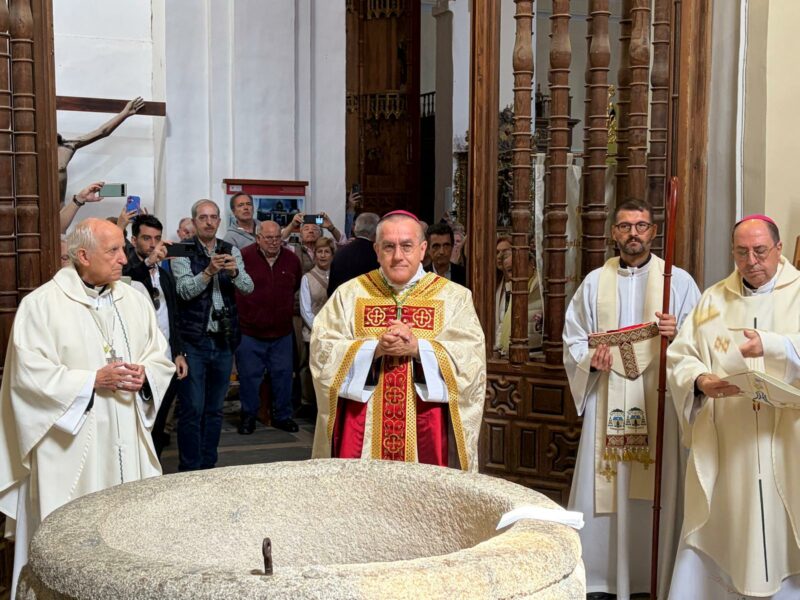
The Apostolic Nuncio of His Holiness in Spain, Monsignor Piero Pioppo, presided over the Eucharist celebrated in the parish of San Nicolás de Bari in Madrigal de las Altas Torres (Ávila) on the occasion of the 575th anniversary of the birth of Isabel I of Castile. In his homily, delivered in concelebration with the Bishop of Ávila and the emeritus bishop, before numerous civil and military authorities from Castile and León, the Nuncio conveyed the greeting and blessing of Pope Leo and placed the figure of the Queen at the heart of the Easter season: born on the afternoon of Holy Thursday in 1451, baptized during the days of Easter, her entire life appears marked—according to the Nuncio—by the mysteries of Christ’s passion, death, and resurrection. The homily reclaimed Isabel’s evangelizing legacy, her Eucharistic devotion, and her ability to present «courageous, innovative, and firm» solutions in defense of human dignity, expressly quoting the words of Pope Francis. The event took place in the church that preserves the Queen’s baptismal font.
FULL TRANSCRIPTION OF THE HOMILY
Dear brothers and sisters, all in the risen Christ and Savior.
I thank the bishop, the emeritus bishop, the parish priest, the priests who are concelebrating this thanksgiving; as well as the most illustrious mayor of Madrigal de las Altas Torres, the mayors, all the authorities, the presidents and councilors who ennoble this community of Castile and León with their esteemed service. And to all of you as well: thank you, thank you from the bottom of my heart. I can say it: thank you all for the kind invitation to join in thanksgiving to God for Queen Isabel, in the place of her cradle. To all of you, the greeting of the Holy Father and his blessing.
From the Holy Father Leo, whom I have the joy and honor of representing, albeit unworthily, in Spain.
The present celebration of the five hundred seventy-fifth anniversary of the birth of the Servant of God, Isabel the Catholic, coincides and takes place in the heart of the Easter season. A time of grace, a time in which the Church ceaselessly repeats with joy the founding and central announcement of its faith, and therefore of its life, throughout all centuries. The announcement is this: Christ has risen. This is the announcement that, full of joy—as we have heard in the first reading—Paul and Philip repeated in the cities of Judea and Samaria, and that believers in Christ have repeated with words, but above all with the example of their lives, throughout history, also the noble and illustrious history of our nation.
This is precisely the case of Queen Isabel, who from this her birthplace, by mysterious designs of Providence, knew how to place herself at the service of the Lord and of the Holy Church, our mother; and with her life, words, decisions, and actions, allowed the risen Christ to pass by, verifying and healing so much humanity in Castile, in Spain, and in the New World, infusing hope, giving strength and constancy, filling the hearts of all with joy and hope.
Not by chance did the remembered Pope Francis—already recalled by Don Jesús, our bishop—highlight Isabel’s action as a restorer of human dignity, capable of presenting, in the face of the human condition enslaved by sin and so many miseries, I quote Pope Francis—from whom yesterday we celebrated the first anniversary of his pious passing, remembering him with affection and love: «Queen Isabel knew how to present courageous, innovative, and firm solutions, reclaiming the fundamental rights of the men and women of her time, of course, in a proactive and integral way.» Pope Francis, who rests in peace, concluded: «a giant step.»
And so: on the afternoon of Holy Thursday, the twenty-second day of April in the year one thousand four hundred fifty-one, the Servant of God Isabel the Catholic was born in this historic municipality. It is a fact that in the hours of her happy birth, the Church was focused on the beginning of the Paschal Triduum. The celebration of the Mass—said in Latin—In Cena Domini: the Mass of the Supper, which recalls and re-presents the Lord’s Supper, the Eucharist. Christ’s love to the extreme, the closeness and intimacy of John, the beloved disciple, the institution of the Eucharist and the priesthood, the washing of the feet: key to interpreting the service of all power and charity. These are all the accents of the afternoon in which Isabel was born, and thus, we see, by designs of God’s mercy, they mark her entire precious life.
Here, moreover, in this same church of San Nicolás de Bari, is the font of her baptism, the sacrament that, according to Christian custom, she received in the first days, the immediate days, which coincided with these same Easter days that, joyfully, we celebrate today.
The celebration of the Paschal event, into which baptism and the Eucharist introduce us, centers us on the substantial event of our holy faith. Christ has risen and lives forever. He, without merit on our part, but because He loves us to the extreme, took upon Himself our sins and sufferings, reconciled us with the Father, healed our wounds. This is what, at every moment, but especially in this Easter season, Christians are celebrating in the ancient world as in the new and in the newest world.
Christ, as then, passes by—that is the meaning of Easter. Christ passes by now as well, doing good, healing the ailments of men and women of all times. He is worthy of faith and adoration. It is not merely a good man, admirable, a great teacher and professor who taught an exquisite ethic of human perfection. It is—as Isabel firmly believed—the Son of God, who saves us, who clothes us with a transforming strength, who makes us be born again to a new life and who renews the world, society, the nations as well.
Brothers and sisters, oh, how many things we can say about Isabel! All her biographers, starting from contemporary testimonies, point out her particular joy for the so-called New World. A whole evangelizing opportunity that departed from Jerusalem—as I heard in the first reading—and that she, Queen Isabel, lived from interior authenticity, always in contact with Christ, the bread of life, as the Gospel has announced to us today.
Bread, rest of the soul. Bread, joy of the home. Bread, security of all peoples. Bread, guarantee of order, pledge of progress, pledge of prosperity. But all this endures when it is solidly anchored in higher realities. That is: we need Christ, bread of life, our good. With Him, and only with Him, civilization and life are made and built, both at the personal and social level.
In Him the good is founded and progresses, which must be in the program of all men and women who want to ensure their own happiness and, fulfilling their mission—as Queen Isabel teaches us—the happiness, well-being, and authentic progress of each one of us, contributing all this spiritual richness to our fellow human beings. To others. We Christians say better: to our neighbor.
Isabel stood out for her life, her prudence, her piety, and her admirable sense of justice. One of the most important characteristics of Queen Isabel was her devotion and her Eucharistic life to the Most Holy Sacrament of the Altar, because—she said—»it is a matter of service to God that every Christian must strive for.»
What more beautiful words these are for us, who, not by our merits, in various and different estates are constituted for service! Queen Isabel, mother of a family in the bosom of the home and woman of government in the kingdom of Spain, provides us with very current lessons. She teaches us wisdom for a Christian citizenship that exercises its rights and obligations for the common good, and that finds in the tabernacle the strength for a selfless task, in which one’s own existence is generously committed in every space.
May the celebration of these holy mysteries grant us abundantly, to us and to all brother peoples, always this capital gift from heaven.
We then invoke, humbly, the powerful intercession of the Blessed Virgin Mary, to whose veneration in the mystery of her Immaculate Conception Queen Isabel contributed, thus keeping the hearts of Christians as a tabernacle, as a clean and worthy temple of the Holy Spirit.
Experiencing this presence of the Lord among us, we will let ourselves be led by Him and undertake new paths in the evangelizing mission, truly sharing, with hope and success, the joys and sorrows, the sufferings and hopes of all humanity.
Amen.