


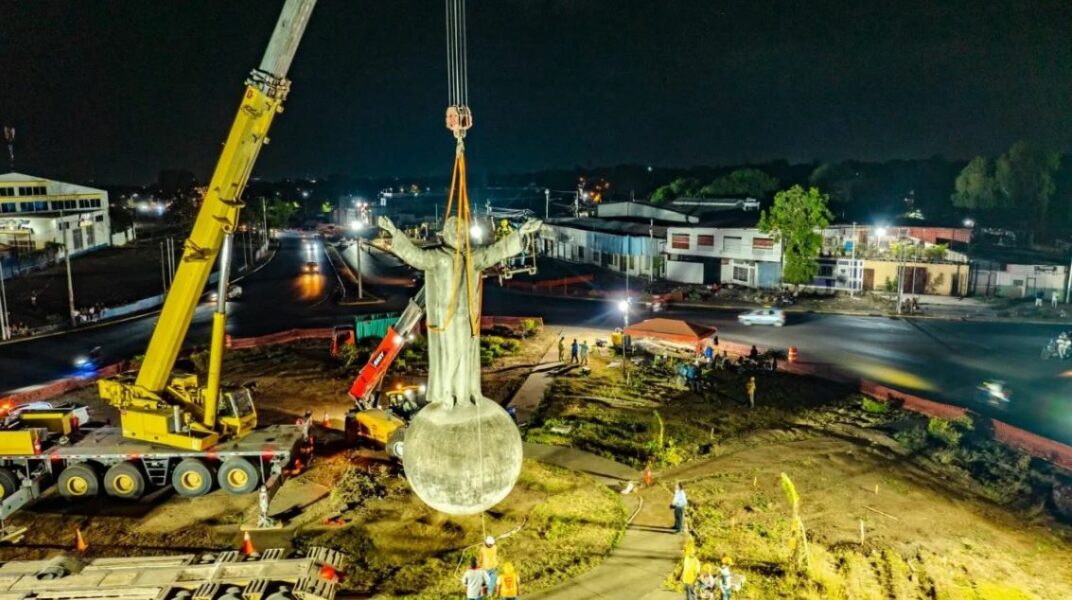
In the capital of Nicaragua, Managua, a sculpture of Christ the King, one of the city’s most visible religious symbols, has been removed as part of a road widening project promoted by Daniel Ortega’s regime. The intervention, presented as a technical measure, occurs in a context of open confrontation between the dictatorship and the Catholic Church, which has raised doubts about its true purpose.
Dismantling of Christ the King Amid Urban Expansion
According to the Nicaraguan newspaper La Prensa, the iconic statue, located at the Cristo Rey roundabout, began to be removed on April 16 as part of the widening works on the Pista Héroes y Mártires de la Insurrección —formerly Pista Juan Pablo II—, specifically in sections two and three of the capital.
The Managua City Hall, controlled by the ruling party, had already announced in March that the image would be removed «temporarily» for restoration. However, the operation was carried out quickly and discreetly, after preparing the logistics hours earlier.
During the night of Thursday, workers cut off the upper part of the sculpture and removed it with the help of a crane, in a scene that was recorded by citizens and disseminated on social media. Some users shared the videos under the slogan «Farewell to the Cristo Rey roundabout,» reflecting the discomfort generated.
Official Promises Without Deadlines or Clear Guarantees
The widening project contemplates a road of up to ten lanes and the construction of overpasses at several points, including the Cristo Rey roundabout itself. According to the official version, the statue will be restored by its creator, the sculptor Noel Flores, and subsequently reinstalled in the same place or integrated into the new urban design.
The authorities assure that the image «will continue to be part of the city,» but they have not offered concrete deadlines or verifiable details about its final location or the conditions of its preservation during the works. The author himself has indicated that the restoration will involve an adaptation of the design, with a «more human and mystical» character.
This lack of precision fuels reasonable doubts about whether the removal will indeed be temporary or if it could become permanent under the cover of an urban intervention.
A Symbol Marked by Recent History
The Cristo Rey roundabout is not only an urban reference point, but also a place loaded with meaning in Nicaragua’s recent history. During the 2018 protests against the Ortega and Rosario Murillo regime, that space served as a meeting point for thousands of citizens demanding justice for the victims of repression.
In that context, the removal of the image acquires a dimension that transcends the merely technical. The prolonged policy of harassment by the regime against the Church —with closures of institutions, expulsions of religious figures, and persecution of bishops— reinforces the suspicion that decisions like this are not neutral.
Without conclusive statements, the truth is that the opacity of the process and the absence of clear commitments about the reinstatement of Christ the King leave an evident question open: whether the road widening is the only reason for its removal or also an excuse to make an uncomfortable symbol disappear from public space.