


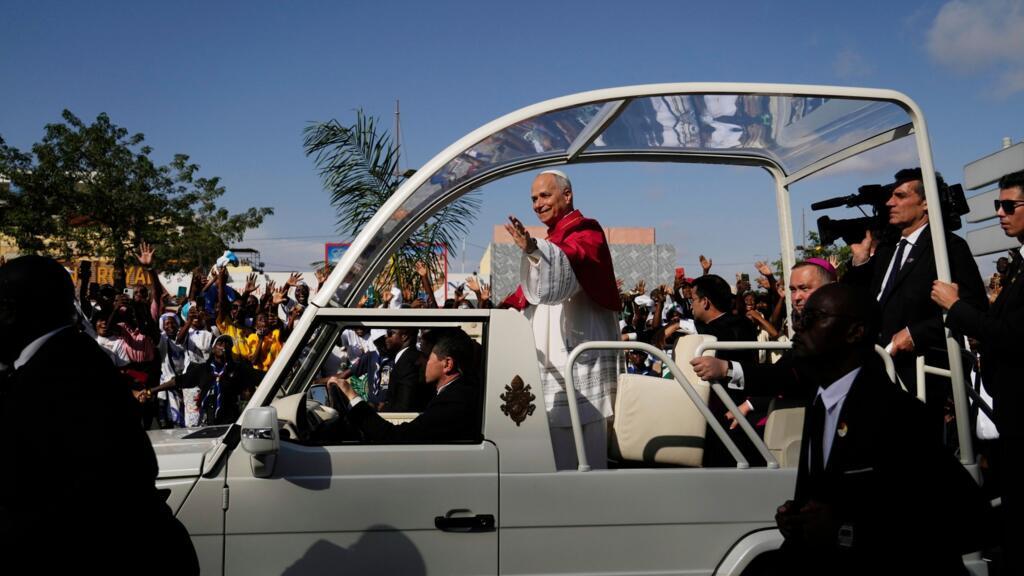
Pope Leo XIV presided over the Holy Mass this Monday on the esplanade of Saurimo, in Angola, as part of his apostolic journey through Africa, with a homily centered on the authenticity of faith and the need to seek Christ not out of interest, but out of love.
The multitudinous celebration was preceded by his visit to a home for the elderly in the same city, where the Pontiff had emphasized the value of the elderly and community life.
A faith that does not seek God out of interest
In his homily, Leo XIV began with a clear warning: there is a risk of deforming the relationship with God when He is sought for convenience. Commenting on the Gospel, he recalled that many follow Christ not for who He is, but for what He gives.
“His words reveal the plans of those who do not desire an encounter with a person, but the consumption of things,” he affirmed, denouncing an attitude that reduces God to a means to obtain benefits.
The Pope was even more direct in pointing out that this occurs when “authentic faith is replaced by superstitious commerce,” in which God becomes a resource to turn to only when it suits.
Christ does not seek clients, but brothers
In contrast to that utilitarian vision, Leo XIV emphasized the true nature of Christian faith: “Christ does not want servants or clients, but seeks brothers and sisters.”
Following Christ, he explained, implies something deeper: it is not enough to listen or see, but it is necessary to welcome His message and live it. Only in this way does faith become a real experience of encounter that transforms life into mission.
The “bread that does not perish” and eternal life
The Pontiff took up the evangelical image of bread to delve deeper into the meaning of the Eucharist: “Do not work for the food that perishes, but for the one that endures for eternal life.”
In this context, he explained that God’s true gift is not something passing, but eternal life, which begins already in the present and gives meaning to existence.
Denunciation of injustice and abuse
The homily also included a reference to social reality, with a critique of the situations of injustice that affect many peoples. Leo XIV warned that “the bread of all becomes the property of a few” when corruption and violence dominate social life.
In the face of this reality, he emphasized that Christ does not remain indifferent, but “hears the cry of the peoples” and renews history, offering hope even in the midst of suffering.
A faith that liberates and transforms
The Pope insisted that Christian faith is not an abstract idea, but a force that frees man from every form of oppression. “We have not come into the world to die,” he affirmed, recalling that Christ’s resurrection is also a promise of new life for each person.
In this sense, he emphasized that every form of violence, exploitation, or lie contradicts that call to freedom that arises from the Gospel.
The Church, a path of hope
Leo XIV defined the Church’s path as a “synod of resurrection and hope,” and invited the faithful to walk with the Gospel in their hearts, beyond “the fashions of the moment.”
Faith, he affirmed, cannot depend on urgencies or trends, but must be rooted in the truth of Christ.
A day marked by closeness
Hours before the Mass, the Pontiff had visited a home for the elderly in Saurimo, where he left a complementary message to that of his homily.
There he recalled that the elderly “must not only be assisted, but above all, listened to,” emphasizing that they are custodians of a people’s wisdom.
Faith, charity, and mission
The Pope’s day in Angola thus left a message of warning about the interested use of God as a superficial practice, calling for a personal response that transforms life.
From the Eucharist to the care of the most vulnerable, Leo XIV once again placed at the center the call to live the Gospel with authenticity, as a path of hope for the Church and for the world.