


Young Catholics are showing a growing interest in more traditional ways of living the liturgy, a trend that is beginning to be recognized even in episcopal circles. In Brazil, a bishop has openly defended the right of these faithful to express their faith in this way within the Church.
Recognition of Interest in Traditional Liturgy
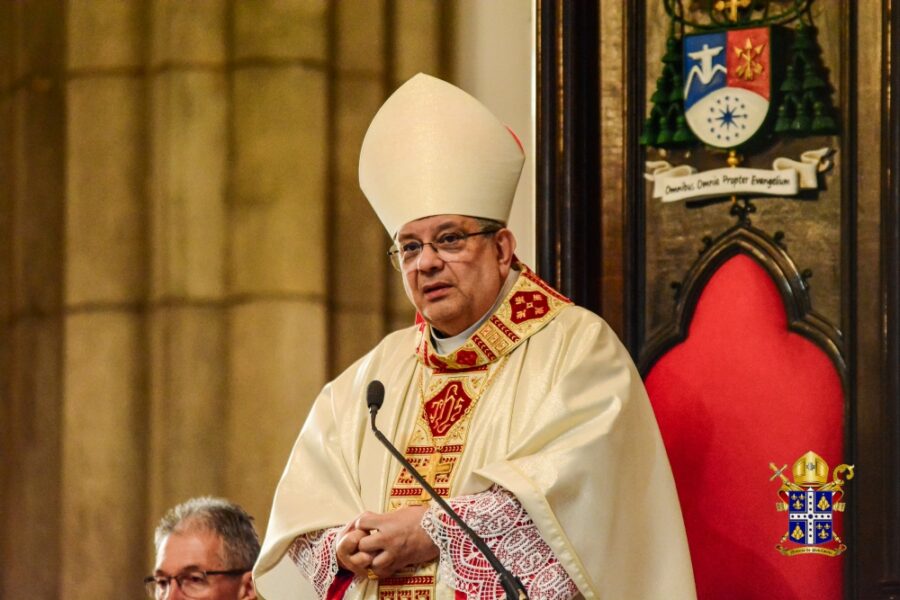
According to Aciprensa, Mons. Joel Portela Amado, Bishop of Petrópolis and president of the Commission for the Doctrine of the Faith of the National Conference of Bishops of Brazil (CNBB), stated that young people who opt for traditional gestures—such as receiving Communion on their knees or the use of the veil—should be welcomed normally.
Far from considering it an anomaly, the prelate emphasized that these expressions are a legitimate part of ecclesial life. In his intervention during the 62nd General Assembly of the CNBB, held in Aparecida, he defended the idea that Catholicism is not uniform, but admits different liturgical sensitivities.
A Response to the Contemporary Spiritual Void
The bishop framed this phenomenon within a broader reality: the distancing of many young people from ecclesial structures. However, far from interpreting it as a loss of faith, he presented it as an ongoing search.
In this context, the attraction to traditional liturgical forms can be understood as a response to the spiritual void experienced by many young people. It is, in the words of the prelate himself, a search for solid references, even in traditions they have not directly known, but which they perceive as bearers of meaning and transcendence.
Tradition and Ecclesial Communion
Mons. Portela Amado insisted that this sensitivity toward the traditional should not be marginalized, but integrated into the life of the Church. At the same time, he recalled that no concrete form of living the faith can be imposed as the only one.
The balance, he pointed out, lies in combining the legitimate freedom of the faithful with charity and ecclesial unity. In that framework, the recovery of traditional signs by young people can be seen as an opportunity to rediscover the richness of the Catholic liturgy in all its depth.