


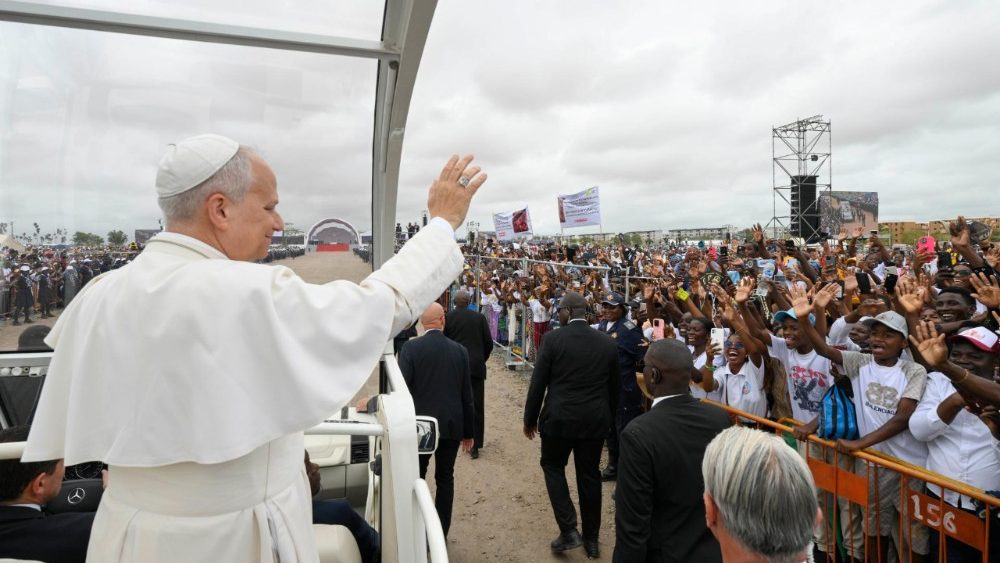
Pope Leo XIV celebrated his first Mass in Angola on April 19, in the Kilamba esplanade, about 30 kilometers from the capital Luanda, where he delivered a message of hope to a country marked by decades of conflict and social difficulties.
A Massive Mass in Kilamba
According to Vatican News, the celebration took place before about 100,000 faithful in a large structure set up as an altar. The Pontiff previously toured the esplanade in the popemobile, greeting and blessing those present.
Kilamba, known as the “ghost city”, is a suburb where numerous residential complexes have been built, in many cases inaccessible to much of the local population.
A Message Addressed to a Country Marked by War
In his homily, delivered during the third Sunday of Easter, the Pope addressed a country “divided and still wounded” by a long civil war that lasted nearly three decades and left around 500,000 victims.
Leo XIV stated that Angola is “a beautiful and wounded country, hungry and thirsty for hope, peace, and fraternity”, and expressed his desire to overcome the divisions of the past.
In this regard, he noted: “We can and want to build a country where the old divisions are overcome forever, where hatred and violence disappear”.
Hope as the Axis of the Message
The Pontiff took the Gospel of the disciples of Emmaus as a reference to describe the situation of the Angolan people, comparing their recent history to the experience of those who feel “disillusioned and defeated”.
In his address, he emphasized that hope does not arise solely from human effort, but is a gift that comes from God: “The Lord becomes a companion on the journey and helps to look beyond the pain”.
Likewise, he encouraged the faithful to live their faith through prayer and the Eucharist, as spaces of encounter with God.
Warning about Religious Practices
During the homily, the Pope also warned about the risk of certain forms of traditional religiosity that may include “magical and superstitious elements”, noting that they do not foster spiritual growth.
In this context, he invited the faithful to trust their pastors and to keep their gaze “fixed on Jesus”.
The Role of the Church in Society
Leo XIV highlighted the role of the Church in accompanying the Angolan people, especially in a context marked by social, economic difficulties, and various forms of poverty.
He indicated that the Church is called to “gather the cry of its children” and to offer itself as “broken bread”, in reference to its commitment to the most needy.
Final Call to Hope
At the end of his homily, the Pope exhorted the faithful to look to the future with hope: “Today there is a need to look to the future with hope and to build the hope of the future. Do not be afraid to do so”.
After the Mass, the Archbishop of Luanda, Monsignor Filomeno do Nascimento Vieira Dias, thanked the Pontiff for his visit and highlighted the importance of working for reconciliation and peace.
The celebration concluded with the presentation of a chalice to the Pope as a sign of gratitude for his presence in the country.