


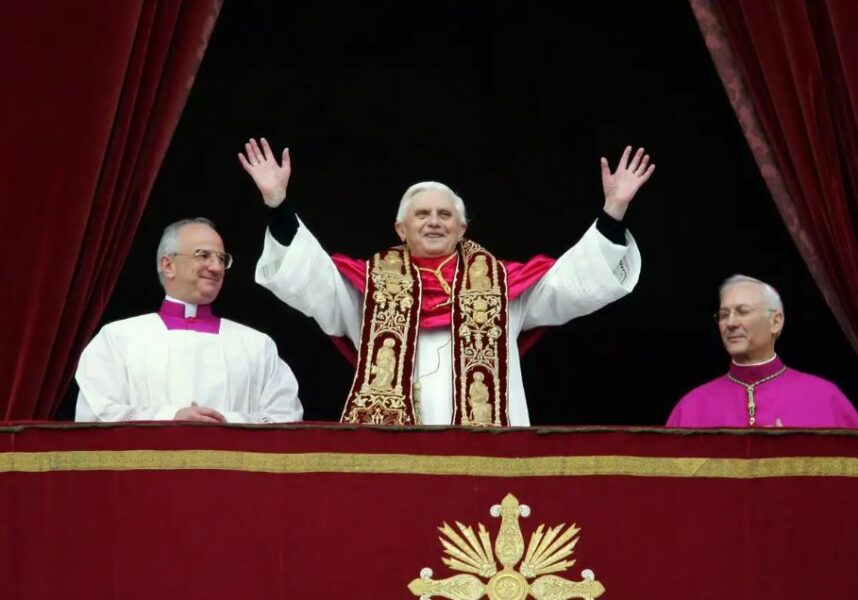
On April 19, 2005, Cardinal Joseph Ratzinger was elected successor of Saint Peter and presented to the world as Pope Benedict XVI, on a day marked by the speed of the conclave and by first words that defined the tone of his pontificate from the outset.
“A humble worker in the Lord’s vineyard”
After the white smoke and his appearance on the central balcony of St. Peter’s Basilica, Benedict XVI addressed the faithful gathered in the square with an expression that has remained as a synthesis of his pastoral identity: “a simple and humble worker in the Lord’s vineyard.”
Before a packed St. Peter’s Square, the new Pontiff acknowledged the magnitude of the mission received and appealed from the first moment to the prayer of the Church. “It consoles me that the Lord knows how to work with insufficient instruments as well,” he stated, showing an attitude of trust in God’s action more than in his own capacities.
Continuity with John Paul II
Elected after the long pontificate of Saint John Paul II, Benedict XVI assumed the government of the Church with a clear will for continuity. During his nearly eight years at the helm of the pontificate, he made 24 international trips and published three encyclicals: Deus Caritas est, Spe salvi, and Caritas in veritate, centered on Christian love, hope, and the social dimension of faith.
His magisterium was characterized by theological clarity and a constant effort to address the cultural and moral challenges of the contemporary world from the Church’s tradition.
A life marked by faith amid darkness
The life of Joseph Ratzinger was deeply marked by the historical context in which he was born. He came into the world on April 16, 1927, a Holy Saturday, a day he himself described as a symbol of “darkness” and God’s silence in history.
Cardinal Kurt Koch, in the homily delivered in St. Peter’s Basilica this Thursday, drew a parallel between that date and the experience of an entire generation that endured the tragedies of the 20th century. Quoting Ratzinger himself, he recalled that after the world wars, concentration camps, and atomic bombs, “our era has become more and more a Holy Saturday.”
In the face of that context, Benedict XVI knew how to offer a reading from faith, convinced that the light of Christ manifests itself with greater force precisely amid the darkness.
The historic resignation of 2013
On February 11, 2013, in an unprecedented decision in the contemporary era, Benedict XVI announced his resignation from the pontificate, citing a lack of strength due to age. The See of Peter became vacant on February 28 of that same year.
After his resignation, Joseph Ratzinger retired to the Mater Ecclesiae monastery in the Vatican, where he led a life dedicated to prayer, study, and reading.
The end of a life in service to the Church
Pope Emeritus Benedict XVI passed away on December 31, 2023, at the age of 95, after a life marked by service to the Church as a theologian, prefect of the Congregation for the Doctrine of the Faith, and finally as successor of Peter.
His figure remains as that of a “great witness to the faith” and a teacher who knew how to illuminate his time from the light of the Gospel, even amid the shadows of history.