


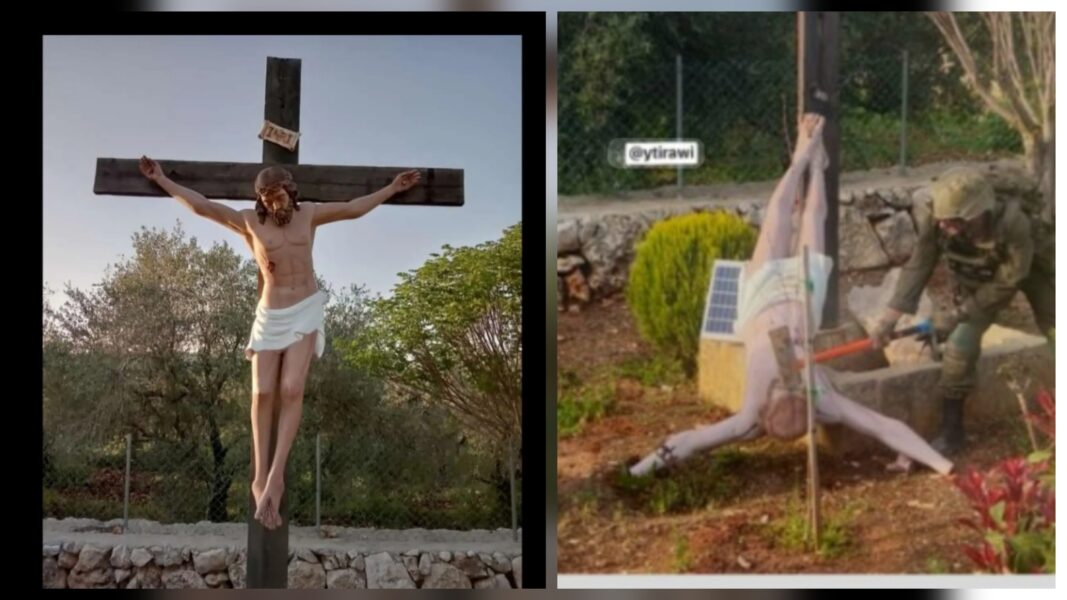
The desecration by hammer blows of an image of Christ in southern Lebanon has sparked outrage among the local Christian community and has ultimately forced the Israeli Army itself to react. The sequence of events, as it has emerged in recent hours, points to an incident that occurred in the town of Debel, in the Nabatieh district, where a soldier from the Israel Defense Forces appears to be striking a statue of the crucified Jesus Christ with a hammer. The seriousness of the case has led the IDF to announce an internal investigation, while a spokesperson has admitted that the disseminated images “are not compatible with the army’s values”.
The first element that triggered the international spread of the case was the publication, by the Palestinian journalist Younis Tirawi, of a frame in which a uniformed military man is seen delivering a blow to the head of the sacred image. His work has been referenced on various occasions by international media; he is a prestigious journalist with no history of fakes, which has contributed to the disseminated material quickly gaining visibility beyond the social media environment.
The dissemination of that frame was followed by a response from the Christian community in the area itself. A local account identified as “Debel Alerts” published the image of the same intact statue, taken in the same location. The landscape setting—the cross, the stone wall, the vegetation, and the terrain layout—fully matches the scenario that appears in the snapshot of the attack, which reinforces the continuity of the scene and places the events in the same location.
The public verification of the case took a qualitative leap when the Israeli newspaper Haaretz, one of the deans of the Israeli press, reported that an IDF soldier had been recorded destroying a statue of Jesus in southern Lebanon. The outlet itself reports the Army’s official response, which acknowledges the incident to the point of announcing that it will be investigated “thoroughly”, while also emphasizing that such actions are incompatible with the conduct expected of its soldiers.
The convergence between the visual material disseminated, the corroboration from the ground by the local community, and the institutional reaction from the IDF places the episode at a high level of plausibility. This is not just a viral image, but a fact that has gained enough substance to provoke an official response and open an investigation process within the Israeli Army itself.
The Israeli Foreign Minister has literally declared the following:
“The damage to a Christian religious symbol by an IDF soldier in southern Lebanon is serious and shameful.
I praise the IDF for its statement, for condemning the incident, and for conducting an investigation into the matter. I am confident that the necessary strict measures will be taken against whoever carried out this ugly act.
This shameful action is completely contrary to our values. Israel is a country that respects different religions and their sacred symbols, and defends tolerance and respect among faiths.
We apologize for this incident and to every Christian whose feelings were hurt.”