


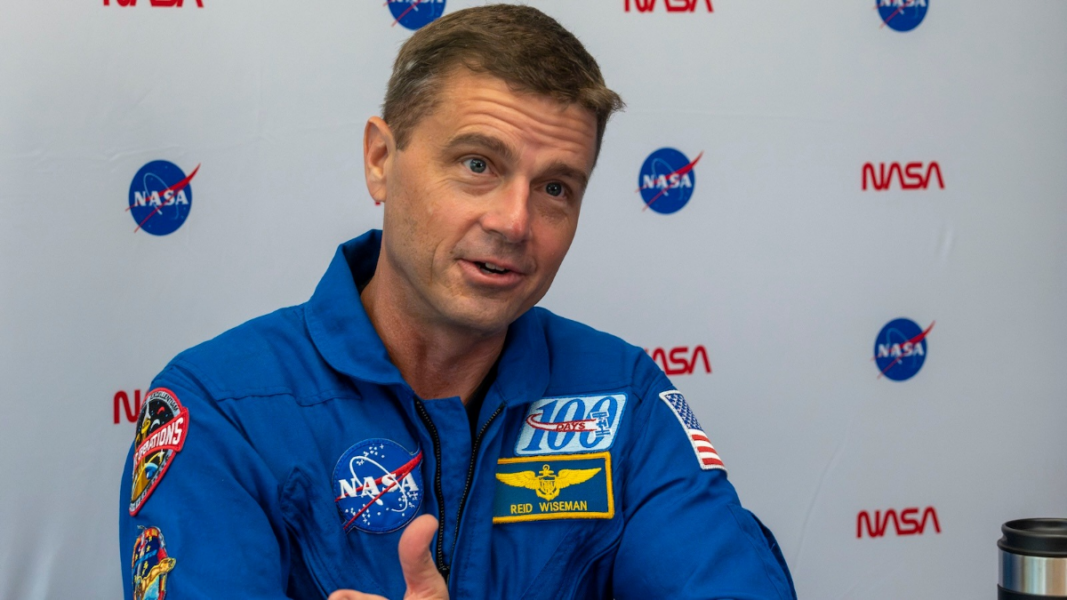
The Artemis II mission, which carried four astronauts to orbit the Moon for the first time since 1972, has left more than just a technical milestone. In the post-return press conference, several of its protagonists admitted the difficulty of processing what they had experienced in the face of the cosmos’s immensity.
Commander Reid Wiseman, who does not consider himself a religious person, described one of the most significant moments after returning to Earth: the visit from a Navy chaplain.
“There was no other way to explain it”
“I’m not really a religious person, but there was no other way to explain anything or to experience what we were going through,” Wiseman explained as he recounted why he asked for the chaplain to come up and visit them.
The reaction was immediate. “I’d never seen him before in my life, but when I saw the cross around his neck, I burst into tears,” he confessed, acknowledging that they still haven’t been able to fully assimilate the experience.
The astronaut himself admitted that, a week after the return, they still haven’t had time to process what happened: “We haven’t had that time for reflection.”
A spectacle that surpasses man
Wiseman also described one of the most overwhelming moments of the journey: the instant when the Sun was hidden behind the Moon.
“I don’t think humanity has evolved to the point of being able to comprehend what we’re seeing,” he noted, describing the scene as “otherworldly.”
The statement is not technical, but existential: even those trained to understand space recognize the limits of that comprehension.
Christ, quoted from lunar orbit
During the mission, pilot Victor Glover starred in another significant moment. In one of the last messages before losing communication while flying over the far side of the Moon, he directly quoted Jesus Christ.
He recalled the main commandment—love God and neighbor—and presented it as key to understanding the essential, even in the midst of universe exploration.
Beyond the technical achievement
The astronauts’ words reflect a constant that runs through history: when man confronts the immense, he doesn’t just measure or calculate; he also questions himself.
In that context, even those who do not consider themselves believers recognize that the experience overflows the usual frameworks of explanation.
The scene recounted by Wiseman—a man who bursts into tears upon seeing a cross after returning from the Moon—is not a minor detail. It is the reflection of a limit: that of an experience that demands more than technical language to be understood.