


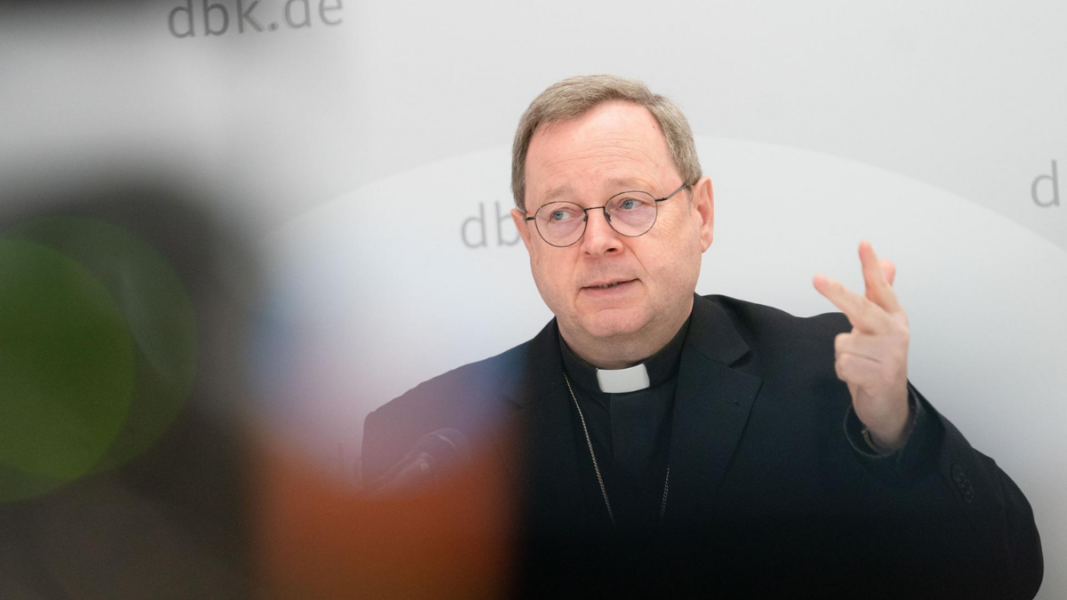
The Bishop of Limburg and former president of the German Episcopal Conference, Georg Bätzing, once again defended the synodal model as a path for the future of the Church, amid an increasingly evident crisis in Germany, marked by the loss of faithful and the weakening of its public presence.
According to Katholisch.de, Bätzing assured that “without real participation from the faithful, the Catholic Church has no future”, emphasizing a vision of synodality that includes transparency, accountability, and shared decision-making.
The prelate went further by stating that “what affects everyone must be decided by everyone”, a formulation that summarizes the approach promoted in the so-called German synodal way and which has raised reservations within the universal Church.
Although he acknowledged that ultimate responsibility lies with the bishops, Bätzing downplayed this principle by pointing out that in his diocese he has never rejected decisions arising from the common process, insisting that he himself is part of those deliberations.
Beyond the synodal debate, the bishop himself recognized the scope of the crisis. “The people’s Church, as we know it, no longer exists”, he stated without nuances.
Far from being a one-off phenomenon, Bätzing admitted that the structural change will continue to accelerate. As evidence, he mentioned the reduction of nearly 30% in the budget of his diocese, reflecting a trend that affects the entire German Church.
In the face of this scenario, the bishop defended the need to focus on the core of the ecclesial mission and make the Christian message understandable in an increasingly secularized society.