


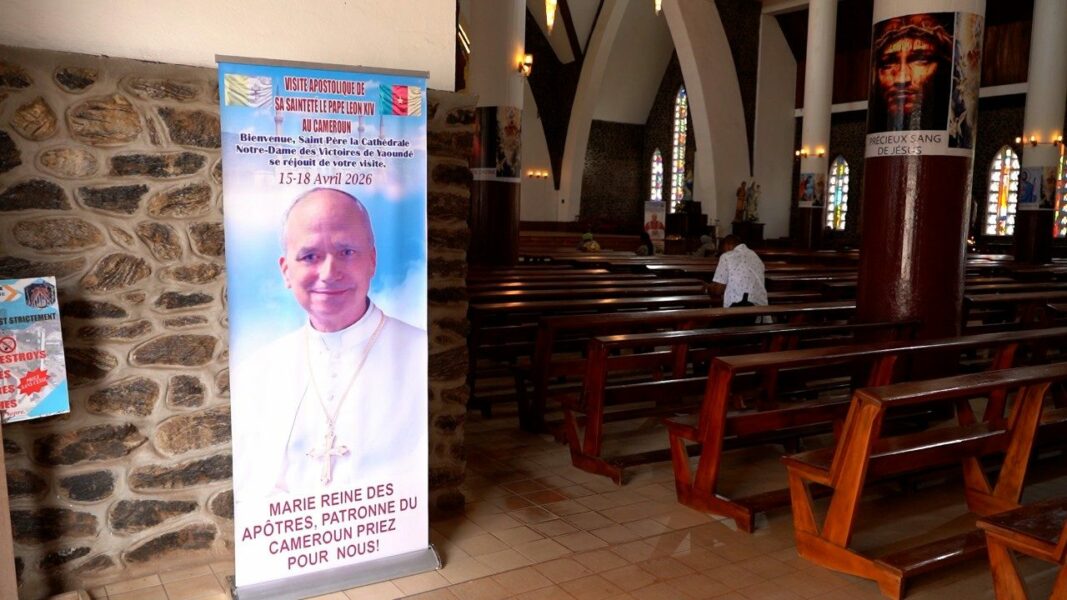
The visit of Pope Leo XIV to Cameroon, which begins today April 15 and will extend until the 18th, starts in a context marked not only by pastoral hope, but also by an evident risk of political instrumentalization. According to Tribune Chrétienne, part of the faithful fears that the Pontiff’s presence will be used by Paul Biya’s regime to bolster its international image after a widely questioned re-election.
This is not a minor concern. The repression of post-election protests, which according to official figures left “several dozen” dead, remains very present. In this scenario, the papal visit is not perceived solely as a spiritual gesture, but as an event with an inevitable political reading.
The fear of indirect legitimization
Since the announcement of the trip, critical voices have emerged within the ecclesiastical sphere itself. Some faithful have openly spoken of a possible “validation of electoral fraud,” alerting to the use that those in power might make of the visit.
The Jesuit Ludovic Lado clearly expressed this concern by denouncing the contradiction involved in accepting the invitation from “a leader accused of staying in power by force.” Although the clergy’s tone has since moderated, the debate has not disappeared.
The risk is well-known in these types of contexts: a papal presence, even if pastoral in nature, can be used as symbolic endorsement by governments seeking legitimacy.
A Church that tries to sustain unity
Cameroon, with more than 250 ethnic groups and languages, is a deeply fragmented country, and the Catholic Church tries to play a role of cohesion amid that diversity. In some parishes in Yaoundé, Mass is celebrated in several local languages—ewondo, bassa, bamiléké—as a visible sign of unity.
However, that unity is subjected to strong tensions. Since 2016, the Anglophone regions have been living an armed conflict between government forces and separatist groups that has left thousands dead and displaced.
In many of these areas, the Church is practically the only stable presence. But that pastoral work develops in a context where the social and political fracture is increasingly deep.
Prisoners without trial and a weakened rule of law
The Archbishop of Douala, Monsignor Samuel Kleda, has wanted to emphasize the spiritual meaning of the visit, calling on the faithful to become “artisans of peace.” However, his intervention has not avoided touching on an uncomfortable issue: the situation of detainees after the electoral crisis.
Some of them “have not been tried,” the prelate recalled, pointing to a reality that directly indicates the deterioration of the rule of law. The issue of these prisoners is shaping up as one of the most sensitive topics in the background of the visit.
A country marked by violence and social crisis
To the political tension is added the threat of Boko Haram in the north, which continues to strike the population with attacks and destruction of basic infrastructure. Added to this is a serious social crisis, with massive youth unemployment that pushes many to leave the country.
In this context, the Church tries to offer concrete responses, promoting training initiatives and calling on young people to stay to “transform the country.” But the challenge is enormous and the conditions adverse.
Between the pastoral gesture and the political reading
The Pope’s visit takes place at a particularly delicate moment. It is not the first time that members of the Catholic hierarchy denounce the country’s political situation. Cardinal Christian Tumi even openly asked the president to step down.
However, there are also voices that call for not overemphasizing internal divisions. The balance is not easy.
In this context, Leo XIV’s trip cannot be understood solely as a pastoral act. It is also a test. The underlying issue is not whether the Pope will bring a message of peace—something expected—but whether that message will manage to maintain a clear distance from political power or if, on the contrary, his presence will end up being used in a scenario where the boundary between pastoral accompaniment and institutional legitimization is especially fragile.
Because in countries marked by political tension, the Church is not only heard for what it says, but also interpreted by where and with whom it appears.